| Posted: May 25, 2010 | |
Novel aberration correction opens up new perspectives for optical micromanipulation |
|
| (Nanowerk Spotlight) Aberrations in optical systems, which leads to blurring of the image, and their elimination using adaptive optics have been studied in astronomical research for quite a long time. Aberrations occur when light from one point of an object after transmission through the optical system does not converge into a single point. The complicated part in correcting this error usually lies in identifying the aberrations that need to be eliminated from the system. With the emergence of nanoscale applications, aberrations in modern microscopy have become a severe limitation on the optimal performance in imaging, nanosurgery, nanofabrication and micromanipulation, just to name a few. | |
| Researchers in the UK have now demonstrated a powerful method for aberration correction with a simple implementation that typically requires minimal changes in the particular geometry. At the same time it offers a way how to compensate for a wide range of distortions from very weak ones seen in typical optical systems right up to those from an entirely random medium in a microscope sample. It is particularly suitable for bio-photonics optical systems where a perfect focusing of a laser light is crucial, but might be generally applicable whenever a focused light beam is required, e.g. in imaging. | |
| "The method restores the optimal focusing of laser light in situ" Tomas Cizmar tells Nanowerk. "This means that the light beam is optimally focused directly in the sample after propagating through sources of various optical aberrations, regardless of their distribution within the whole optical train. In one run we can eliminate aberrations of the output laser mode, imperfections of relay optics and alignment, aberrations caused by objective or even aberrations present in the sample chamber." | |
| This method, developed by Cizmar and his colleagues in the Optical Trapping Group at St. Andrew's University, is general and may readily compensate for all time-invariant aberrations and even focus a laser beam that is entirely randomized passing through highly turbid media. | |
| As the team reported in a paper in the May 9, 2010 online edition of Nature Photonics ("In situ wavefront correction and its application to micromanipulation"), they applied this novel method to the exciting field of optical trapping where their optimized system allowed them to hold microscopic objects with just a fraction of the power found in a laser pointer and trapped for the first time through highly turbulent media. | |
 |
|
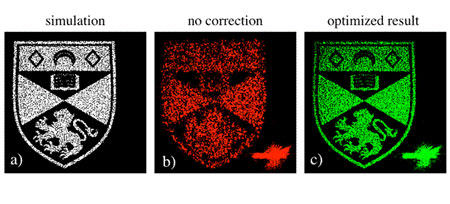
| In section (a) we see a simulation of the image of the University crest that should be obtained by looking through a medium with no aberrations. In section (b) we see the experimental reality of the image being degraded by optical aberrations. However, after the light has been conditioned by the new scheme, the image of the University crest reappears in the experiment as shown in section (c). (Image: Optical Trapping Group, University of St Andrews) | |
| "Any given optical field propagating through an optical system can be expressed as a composition of modes in an arbitrary orthogonal representation," Cizmar explains the principle of the technique. "Regardless of the optical system and the selected representation of the modes, optimal focusing is achieved if all the modes meet at a selected point in space with the same phase. The constructive interference between all of these modes would guarantee the highest achievable intensity at that point. However, in a real experimental set-up, the phase of a given mode at the selected point is randomized by sources of optical aberrations." | |
| Cizmar describes the procedure: "First, we select one mode as a phase reference. This mode is kept on, and its phase remains unchanged during the entire procedure. We then progress to searching for the optimal phase shifts for each of the remaining modes, one by one. For each case we isolate the reference and the tested mode by turning the rest of the modes off, and we measure the intensity signal at the focal point while adjusting the phase of the tested mode. The optimal phase is set correctly when the intensity signal is maximal, showing that both modes arrive at the focal point with the same phase. Once this is achieved for all modes, we can produce the optimal focus by turning all the modes on at the same time with the optimal phase shift applied to each of them." | |
| Having already shown the applicability of their method to optical micromanipulation, the team is confident that it also should find widespread application in imaging, microrheology of colloidal and biological systems, fibre-optics, nanofabrication and other biophotonics methods. | |
| According to Cizmar, one caveat is that presently the method is relatively slow – certainly too slow to be used for in vivo applications – and so it is applicable for time-invariant distortions only. | |
| "We are currently working on several routes to minimize the time necessary for the optimization into sub-second intervals that could introduce massive exploitations of these methods in life science applications" he says. "Our future applications might involve true in vivo trapping, studies and probing of colloidal objects that are embedded deep within an artificial structure, or studies of microrheology in difficult biomedical scenarios." | |
 By
Michael
Berger
– Michael is author of three books by the Royal Society of Chemistry:
Nano-Society: Pushing the Boundaries of Technology,
Nanotechnology: The Future is Tiny, and
Nanoengineering: The Skills and Tools Making Technology Invisible
Copyright ©
Nanowerk LLC
By
Michael
Berger
– Michael is author of three books by the Royal Society of Chemistry:
Nano-Society: Pushing the Boundaries of Technology,
Nanotechnology: The Future is Tiny, and
Nanoengineering: The Skills and Tools Making Technology Invisible
Copyright ©
Nanowerk LLC
|
|
|
Become a Spotlight guest author! Join our large and growing group of guest contributors. Have you just published a scientific paper or have other exciting developments to share with the nanotechnology community? Here is how to publish on nanowerk.com. |
|
