| Posted: Nov 06, 2007 | |
Functional protein building blocks could be used to fabricate tunable, dynamic materials |
|
| (Nanowerk Spotlight) Proteins, large organic compounds made of amino acids, provide many of the most basic units of function in living systems. They make up about half of the dry mass of animals and humans. There may be as many as 1 million different types of proteins in the human body (it is estimated that the human proteome is comprised of an average of 5–7 protein isoforms per open reading frame in the human genome and a further 600 000-odd immunoglobulins present in serum at any given moment) - nobody really knows. The word protein comes from the Greek prota, meaning 'of primary importance', and they actually may become of great importance in nanoscale fabrication as well. Proteins have an amazing number of functions inside our bodies: Enzymes serve as catalysts to break down food into various components; transport proteins such as hemoglobin transport molecules (e.g. oxygen); storage proteins store molecules (e.g. iron is stored in the liver as a complex with the protein ferritin); structural proteins such as keratin or collagen are needed for mechanical support in tissues like cartilage and skin but also hair and nails; proteins are the major component of muscles and for instance actin or myosin are key to contracting muscle fibers; hormones control the growth of cells and their differentiation; antibody proteins are needed for immune protection; and toxins are, well, toxic, but in minute amounts could have beneficial medical properties. Scientists believe that this variety of natural protein functions - actuation, catalysis, structural transport and molecular sequestering - could serve as valuable and versatile building blocks for synthesis of functional materials. Researchers now have found that nanometer-scale changes in protein conformation can be translated into macroscopic changes in material properties. The result is a new class of dynamic, protein-based materials. | |
| "Previous studies have generated protein-based materials, and some of these materials can undergo changes in their properties based on differences in protein-ligand binding, for example" Dr. William L. Murphy tells Nanowerk. "However, previous studies have not specifically used protein conformational changes as a mechanism to build dynamic materials." | |
| This new dynamic mechanism may have broad implications, as over 200 protein conformational changes are well-known. In addition, proteins undergo conformational changes in response to a wide range of stimuli, including pH, temperature, electric field, and the binding of specific biological molecules. | |
| Murphy, an assistant professor in biomedical engineering at the University of Wisconsin-Madison, notes that approaches for direct use of biological motions to build novel materials require a mechanism to scale nanometer-scale conformational changes into macroscopic effects. | |
| Reporting their findings in Advanced Materials ("Dynamic Materials Based on a Protein Conformational Change"), Murphy and his team have used a photochemical approach to generate protein-based materials that retain the function of the protein building blocks. This approach may significantly enhance the range of stimuli that can be used to dynamically influence material properties. | |
 |
|
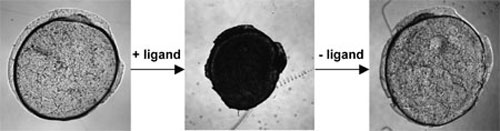
| Calmodulin(CaM)-based hydrogels undergo substantial volume changes as a result of TFP ligand binding. Photomicrographs showing CaM-based hydrogels (50 nmoles CaM included) with CaM in extended conformation (left) and collapsed conformation (middle). The volume decrease was recovered when gels were returned to an environment favoring the extended CaM conformation (right) (1 mm scale bars). (Image: Dr. Murphy/University of Wisconsin-Madison) | |
| "Specifically, we exploit the ability of the protein calmodulin to undergo reversible 'hinge' motion upon binding of a small molecule drug" Murphy explains. "This approach can produce materials with a range of dynamic properties, and the dynamic response of these materials can be confined to specified locations in a material." | |
| The approach described by the University of Wisconsin scientists may have broad potential in basic materials science and in engineering disciplines. | |
| Murphy points out that much of this potential stems from the adaptable nature of the dynamic building blocks. "There are hundreds of well-characterized protein motions, and dynamic proteins can be readily engineered using standard recombinant techniques" he says. "One could therefore envision creating modular proteins with custom engineered ligand binding sites and hinge regions to tailor the response of dynamic hydrogels." | |
| In particular biosensors, actuators, microfluidics components (e.g. pumps, valves), and drug delivery systems are potential applications that could benefit from functional protein building blocks. | |
| This research is still in its early stages (how often have I written this sentence...), with scientists trying to understand the detailed mechanism by which nanometer scale motions of proteins are translated into macroscopic motion. Once the general mechanism is well-characterized, this general approach can be used to create materials with broadly tunable properties. | |
 By
Michael
Berger
– Michael is author of three books by the Royal Society of Chemistry:
Nano-Society: Pushing the Boundaries of Technology,
Nanotechnology: The Future is Tiny, and
Nanoengineering: The Skills and Tools Making Technology Invisible
Copyright ©
Nanowerk LLC
By
Michael
Berger
– Michael is author of three books by the Royal Society of Chemistry:
Nano-Society: Pushing the Boundaries of Technology,
Nanotechnology: The Future is Tiny, and
Nanoengineering: The Skills and Tools Making Technology Invisible
Copyright ©
Nanowerk LLC
|
|
|
Become a Spotlight guest author! Join our large and growing group of guest contributors. Have you just published a scientific paper or have other exciting developments to share with the nanotechnology community? Here is how to publish on nanowerk.com. |
|
