
| Posted: Mar 29, 2006 | |
A simple design for a DNA nanoswitch |
|
| (Nanowerk News) French and U.S. researchers designed a nanomechanical DNA switch controlled by the rate of temperature variation, thereby providing a flexible, scalable alternative to simultaneous chemical control of different DNA switches at equilibrium. | |
| Beyond its central role in biology, DNA has long been recognized as a versatile molecule that can self-assemble into nanoscale objects or form well-controlled supramolecular scaffolds. More recently, DNA was also shown to provide switchable nanomechanical devices whose equilibrium states can be controlled by changing, for example, the medium ionic strength or by using additional "fuel" and "waste" DNA molecules. | |
| A group of French and U.S. researchers came up with a simple alternative design of a generic DNA switch controlled by the rate of temperature variation, under fixed chemical conditions. | |
| "We have designed and experimentally studied an alternative concept, based on folding kinetics control, to drive and maintain a DNA nanomechanical device out-of-equilibrium under fixed chemical conditions" Hervé Isambert from the Institut Curie in Paris told Nanowerk. | |
| Their DNA nanomechanical switch can be driven back and forth between "out of equilibrium" and "equilibrium" states under fixed chemical conditions, by submitting them to fast and slow cooling rates, respectively. | |
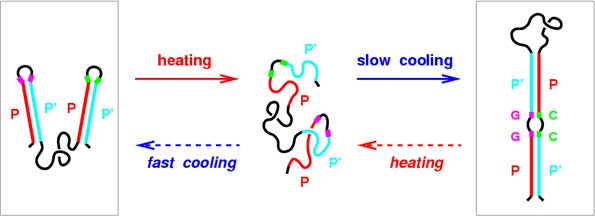 | |
| Driven and spontaneous transitions of the DNA switch. Heating and slow cooling (solid arrows) versus heating and fast cooling (dashed arrows) cycles drive the DNA switch back and forth between equilibrium, elongated conformation and out-of-equilibrium, contracted conformation through a denatured intermediate state in high ionic strength solution. Spontaneous relaxation operates on much longer time scales (beyond weeks at room temperature). (Source: Hervé Isambert) | |
| "As a proof-of-concept, we designed a uni-molecular DNA switch that folds, following heat denaturation, into its lowest energy conformation under moderate cooling rate while an alternative, fast folding conformation is kinetically formed upon rapid cooling," Isambert says. | |
| Isambert sees various applications for their DNA switch: "For instance, our switch could provide rejuvenatable "DNA-fuel" for DNA-driven nanodevices. Thus, regularly rejuvenated "DNA fuel" under folding kinetics control should enable a continuous driving of DNA-fueled nanodevices without the need for a chemical turnover of "fuel" and "waste" DNA strands in solution." | |
| The group reported its findings in a recent paper titled "DNA Nanomechanical Switches under Folding Kinetics Control", published online on Dec. 1, 2006 in Nano Letters. Isambert's co-authors were Virgile Viasnoff from Institut Curie and Amit Meller from the Single Molecule Biophysics group at The Rowland Institute at Harvard. | |
 By
Michael
Berger
– Michael is author of three books by the Royal Society of Chemistry:
Nano-Society: Pushing the Boundaries of Technology,
Nanotechnology: The Future is Tiny, and
Nanoengineering: The Skills and Tools Making Technology Invisible
Copyright ©
Nanowerk LLC
By
Michael
Berger
– Michael is author of three books by the Royal Society of Chemistry:
Nano-Society: Pushing the Boundaries of Technology,
Nanotechnology: The Future is Tiny, and
Nanoengineering: The Skills and Tools Making Technology Invisible
Copyright ©
Nanowerk LLC
|
|
Become a Spotlight guest author! Join our large and growing group of guest contributors. Have you just published a scientific paper or have other exciting developments to share with the nanotechnology community? Here is how to publish on nanowerk.com.