
| Posted: Mar 30, 2006 | |
The patent land grab in nanotechnology continues unabated, creating problems down the road |
|
| (Nanowerk News) The race to patent anything related to nanotechnology continues to produce a flood of patents in the U.S., with the number of patents on average growing by over 30% every year since 2000. Well over 5,000 nanotechnology-related patents have been issued in the U.S. as of late March 2006. | |
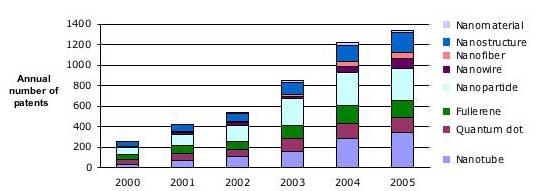 | |
| Number of patents issued by the United States Patent and Trademark Office (USPTO) every year since 2000 that contain one of the charted terms (as of March 24, 2006). This data may contain double counting. (Source: Base data from the USPTO database; compilation and graphic: Nanowerk) | |
| The strongest growth can be observed in patents referring to "Nanoparticle" (147% CAGR since 2000), "Nanotube" (141%) and "Fullerene" (139%). | |
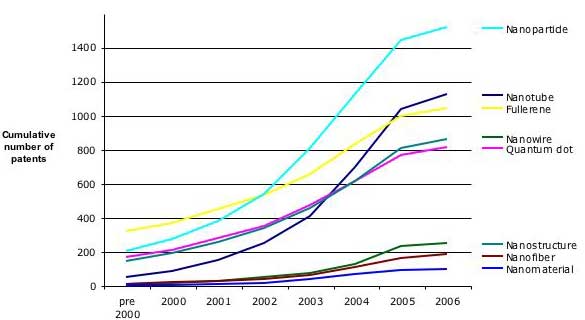 | |
| Cumulative number of patents issued by the USPTO, by year, that contain one of the charted terms (as of March 24, 2006). This data may contain double counting. (Source: Base data from the USPTO database; compilation and graphic: Nanowerk) | |
| This trend clearly shows that nanotechnology firms and researchers are racing to secure patent protection for early-stage commercial applications but also might be trying to create license fee generating positions. | |
| As patent offices are struggling with the soaring number of patent applications filed, nanotechnology- related patents create new challenges and problems. | |
| One case in point is nanomedicine. According to Dr. Raj Bawa, author of a recent paper titled "Will the nanomedicine "patent land grab" thwart commercialization?" published online on Dec. 19, 2005 in Nanomedicine: Nanotechnology, Biology and Medicine, the critical role of patents to the nanomedicine "revolution" cannot be underestimated. | |
| "When investors in nanomedicine or pharmaceutical companies consider the merits of a particular investment, patent issues are one of the most important items that they review" says Bawa. "There is also ample evidence that companies, start-ups, and universities are ascribing ever greater value and importance to patents." | |
| "For a start-up company, patents are a means of validating the company’s foundational technology to attract investment" Bawa says. Universities are also becoming increasingly aggressive in patenting their nanotech-related research, with the hope of generating licensing revenue in the future. | |
| In some areas, this situation has led to what is known as "patent thicket" – an overlapping set of patent rights requiring those seeking to commercialize new technology obtain licensees from multiple patentees. According to Bawa, such a classic patent thicket seems to be developing in the area of carbon nanotubes. The race for nanotech patents has not only produced overlapping patents, but has produced a flood of "unduly broad" nanopatents. | |
| "Patent thickets are considered to discourage and stifle innovation" says Bawa. "Claims in such patent thickets have been characterized as often broad, overlapping and conflicting – a scenario ripe for massive patent litigation battles in the future." | |
| According to Bawa, nanomedicine start-ups may soon find themselves in patent disputes with large, established companies, as well as between themselves. In most of the patent battles the larger entity with the deeper pockets will rule the day even if the innovators are on the other side. | |
| "In the future the nanomedicine start-ups will become attractive acquisitions for larger companies, since takeover is generally a more cost effective alternative to litigation" says Bawa. | |
 By
Michael
Berger
– Michael is author of three books by the Royal Society of Chemistry:
Nano-Society: Pushing the Boundaries of Technology,
Nanotechnology: The Future is Tiny, and
Nanoengineering: The Skills and Tools Making Technology Invisible
Copyright ©
Nanowerk LLC
By
Michael
Berger
– Michael is author of three books by the Royal Society of Chemistry:
Nano-Society: Pushing the Boundaries of Technology,
Nanotechnology: The Future is Tiny, and
Nanoengineering: The Skills and Tools Making Technology Invisible
Copyright ©
Nanowerk LLC
|
|
Become a Spotlight guest author! Join our large and growing group of guest contributors. Have you just published a scientific paper or have other exciting developments to share with the nanotechnology community? Here is how to publish on nanowerk.com.