
| Posted: May 01, 2006 | |
Fungus as bionanofactory for synthesis of silver nanoparticles |
|
| (Nanowerk News) Researchers in India have demonstrated a reliable and eco-friendly biological process for synthesis of silver nanoparticles. | |
| Microorganisms that are exposed to pollutants in the environment, such as metal ions, have a remarkable ability to fight that metal stress. These metal-microbe interactions have already found an important role in biotechnological applications. It is only recently that microorganisms have been explored as potential biofactories for synthesis of metallic nanoparticles. | |
| Dr. D'Souza, head of the Nuclear Agriculture and Biotechnology Division at the Bhabha Atomic Research Center in Mumbai, India together with first author Kuber C. Bhainsa published their findings, titled "Extracellular biosynthesis of silver nanoparticles using the fungus Aspergillus fumigatus" in the Feb. 1, 2006 edition of Colloids and Surfaces B: Biointerfaces. | |
| Research in D'Souza's group is directed towards understanding the mechanism for synthesis of nanoparticles in biological systems for achieving better control over shape, size and kinetics together with characterization and application. | |
| Silver nanoparticles have many important applications that include: spectrally selective coating for solar energy absorption and intercalation material for electrical batteries as optical receptors, polarizing filters and catalysts in chemical reaction. Besides, these particles also find use as staining pigments for glasses and ceramics, transparent conducting coating, electronics, in surface-enhanced Raman spectroscopy, biolabelling and antimicrobial agents. | |
| Application of silver nanoparticles in these fields depend on the ability to synthesize particles with different chemical composition, shape, size, and monodispersity. Furthermore, the particles should be chemically stable without undergoing degradation such as partial oxidation or undesired sintering. | |
| There are several physical and chemical methods for synthesis of silver nanoparticles, including chemical reduction of silver ions in aqueous solutions with or without stabilizing agents, thermal decomposition in organic solvents, chemical and photo reduction in inverse micelles and radiation chemical reaction that are followed by the material scientists currently. However, in view of the rapid progress of application of nanomaterials in different fields, development of simple and ecofriendly synthesis methods are gaining importance. Using the natural processes of biological systems is an obvious route to take. | |
| "Filamentous fungi, such as Aspergillus fumigatus are very good candidates for the development of extracellular processes as they secret a variety of enzymes and are easy to grow and simple to handle" D'Souza explains to Nanowerk. "The synthesis process in our experiments was quite fast and silver nanoparticles were formed within minutes of silver ion coming in contact with the cell filtrate." | |
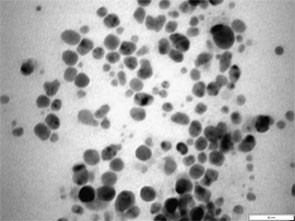  | |
| (Left) TEM micrograph of silver nanoparticles synthesized by Aspergillus fumigatus; (Right) Kinetics of silver nanoparticles synthesis in the aqueous medium containing cell filtrate of A. fumigatus. (Reprinted with permission from Elsevier) | |
| "The organism has shown potential for extracellular synthesis of fairly monodispersed, spherical silver nanoparticles in the range of 5-25 nm" says D'Souza (left image). "The result showed synthesis of silver nanoparticles within 10 minutes of silver ions coming in contact with the filtrate" (right image). D'Souza points out that the nanoparticles present in the aqueous medium were quite stable, even up to four months of incubation at 25°C." | |
| To the best of our knowledge" he says, "this is the first report showing such rapid synthesis of stable, silver nanoparticles within minutes of contact time using a microbial system." | |
 By
Michael
Berger
– Michael is author of three books by the Royal Society of Chemistry:
Nano-Society: Pushing the Boundaries of Technology,
Nanotechnology: The Future is Tiny, and
Nanoengineering: The Skills and Tools Making Technology Invisible
Copyright ©
Nanowerk LLC
By
Michael
Berger
– Michael is author of three books by the Royal Society of Chemistry:
Nano-Society: Pushing the Boundaries of Technology,
Nanotechnology: The Future is Tiny, and
Nanoengineering: The Skills and Tools Making Technology Invisible
Copyright ©
Nanowerk LLC
|
|
Become a Spotlight guest author! Join our large and growing group of guest contributors. Have you just published a scientific paper or have other exciting developments to share with the nanotechnology community? Here is how to publish on nanowerk.com.