

Biotechnology News – Latest Headlines
 Subscribe to our Biotechnology News feed
New tool for mining bacterial genome for novel drugs
Vanderbilt biochemists have discovered that the process bacteria undergo when they become drug resistant can act as a powerful tool for drug discovery.
January 25, 2013 Read more
Computer scientists develop new way to study molecular networks
In biology, molecules can have multi-way interactions within cells, and until recently, computational analysis of these links has been "incomplete," according to T. M. Murali, associate professor of computer science in the College of Engineering at Virginia Tech. His group authored an article on their new approach to address these shortcomings.
January 25, 2013 Read more
Researchers solve complex problem in membrane biochemistry through study of amino acids
After years of experimentation, researchers at the University of Arkansas have solved a complex, decades-old problem in membrane biochemistry. The consequence of their work will give scientists more information about the function and structure of proteins, the workhorses within the cells of the human body.
January 24, 2013 Read more
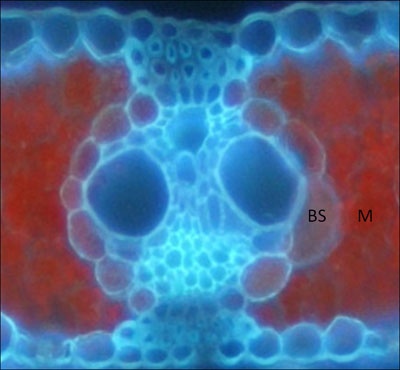
Scientists discover genetic key to efficient crops
With projections of 9.5 billion people by 2050, humankind faces the challenge of feeding modern diets to additional mouths while using the same amounts of water, fertilizer and arable land as today. Cornell researchers have taken a leap toward meeting those needs by discovering a gene that could lead to new varieties of staple crops with 50 percent higher yields.
January 23, 2013 Read more
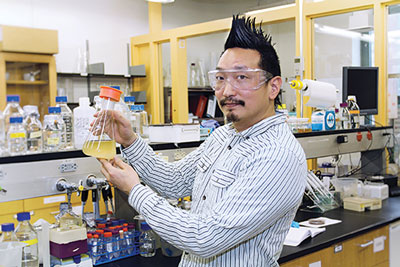
Researchers are developing a biochemical process to disrupt the process by which bacteria become virulent
Scientists at the SUNY College of Environmental Science and Forestry (ESF) are developing a biochemical process that uses a protein molecule to disrupt the process by which bacteria become virulent, a finding that could have widespread implications for human health.
January 23, 2013 Read more
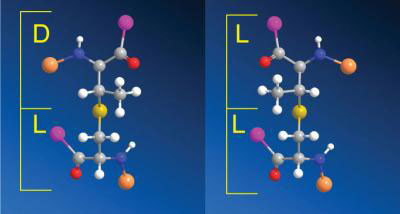
Odd biochemistry yields lethal bacterial protein
While working out the structure of a cell-killing protein produced by some strains of the bacterium Enterococcus faecalis, researchers stumbled on a bit of unusual biochemistry. They found that a single enzyme helps form distinctly different, three-dimensional ring structures in the protein, one of which had never been observed before.
January 22, 2013 Read more
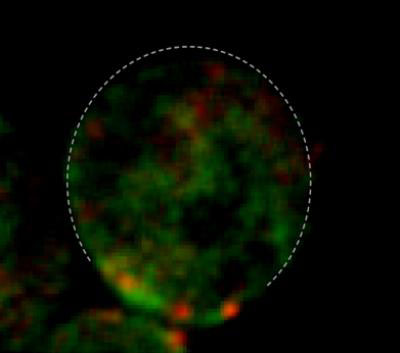
A diffusion trap
Sticky spots on cell membranes hold onto the master regulator of cell polarity, helping to ensure that the regulatory protein accumulates in high enough concentrations to trigger cell polarity.
January 22, 2013 Read more
Developing microbial cell factories by employing synthetic small regulatory RNAs
A new metabolic engineering tool that allows fine control of gene expression level by employing synthetic small regulatory RNAs was developed to efficiently construct microbial cell factories producing desired chemicals and materials.
January 20, 2013 Read more
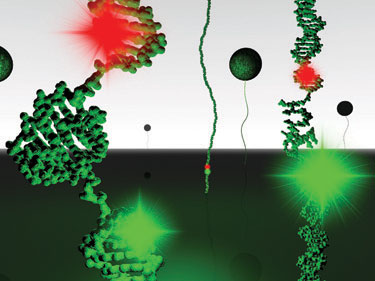
Novel technique reveals dynamics of telomere DNA structure
Chromosome-capping telomeres are a potential target for anti-cancer drugs.
January 19, 2013 Read more
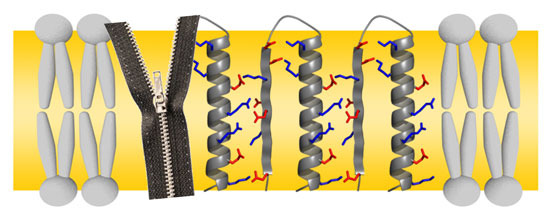
Protein folding via charge zippers
Researchers report a novel charge zipper principle used by proteins to form functional units.
January 18, 2013 Read more
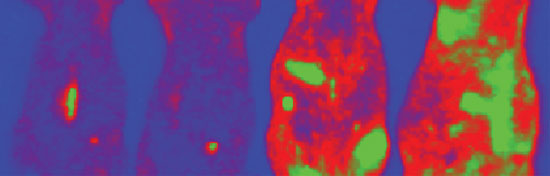
Researchers use luminescent mice to track cancer and aging in real-time
Scientists have developed a new method to visualize aging and tumor growth in mice using a gene closely linked to these processes.
January 18, 2013 Read more
A molecular assembly line brings muscles into shape
Scientists at the Research Institute of Molecular Pathology (IMP) in Vienna, Austria and at the University of Cologne, Germany have discovered the molecular basis underlying the patterned folding and assembly of muscle proteins.
January 18, 2013 Read more
The cell that isn't (w/video)
New technique captures division of membrane-less cells.
January 18, 2013 Read more
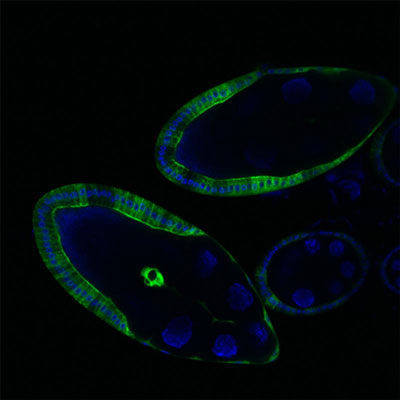
Scientists shed light on the "dark matter" of DNA
Genes make up only a minority of the entire genome sequence - roughly two percent in humans. The remainder was once dismissed as "junk", mostly because its function remained elusive. "Dark matter" might be more appropriate, but gradually light is being shed on this part of the genome, too.
January 17, 2013 Read more

Fraunhofer shows bio-tiles and heat-resistant biopolymers
Fraunhofer researchers are exhibiting how renewable, biodegradable and biostable raw materials can be used in architecture, interior design and the packaging industry at this year's International Green Week in Berlin.
January 17, 2013 Read more
Honey, I'm just trying to loss weight - Viagra converts fat cells
Researchers from the University of Bonn treated mice with Viagra and made an amazing discovery: The drug converts undesirable white fat cells and could thus potentially melt the unwelcome 'spare tire' around the midriff.
January 17, 2013 Read more
Electrogenic bioreactor harnesses BactoBots that clean wastewater, generate electricity, and produce hydrogen
United States patent for wastewater-to-value technology awarded to Bacterial Robotics.
January 17, 2013 Read more
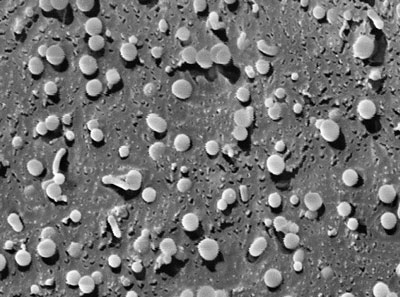
Lipid vesicles to replace mouse experiments
Researchers from ETH Zurich have filed a patent application for a method to test the biological activity of one of the strongest toxins known, the botulinum neurotoxin. If the procedure is adopted by the pharmaceutical industry, it could save the lives of more than half a million mice per year.
January 17, 2013 Read more