

Nanotechnology News – Latest Headlines
LOPE-C 2010: Powering the next wave organic and printed electronics
In its second year on the international stage, LOPE-C 2010 (Large-area, Organic and Printed Electronics Convention) has successfully positioned itself as the central market place of a newly emerging basic industry, serving as the meeting platform of its industrial, scientific, engineering, investor and end-user communities.
July 8, 2010 Read more
Neuer Quantenzustand der Materie in Heusler-Verbindungen entdeckt
Forscher aus Mainz und Stanford zeigen Wege fuer Spin-Elektronik, Quantencomputing und fuer voellig neue physikalische Effekte.
July 8, 2010 Read more
Revolutionary medical dressing uses nanotechnology to fight infection
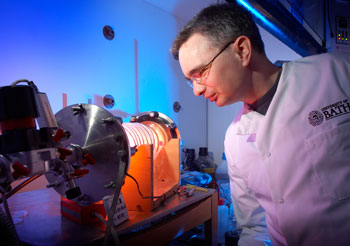
The dressing will work by releasing antibiotics from nanocapsules triggered by the presence of disease-causing pathogenic bacteria, which will target treatment before the infection takes hold.
July 8, 2010 Read more
Synthetic nanopolymer makes it easier to study cancer ptoteins
A Purdue University researcher can better retrieve specific proteins needed to study how cancer cells form by using a newly developed technique and synthetic nanopolymer.
July 7, 2010 Read more
Energy Secetary Chu advances nanotechnology in spare time
Chu has a dense research paper being published online Wednesday in the prestigious scientific journal Nature. The title: 'Subnanometre single-molecule localization registration and distance measurements'.
July 7, 2010 Read more

Center for NanoScience professor wins ERC starting grant
The European Research Council (ERC) has again granted one of the prestigious Starting Independent Researcher Grants to a researcher of the Center for NanoScience (CeNS) at LMU Munich.
July 7, 2010 Read more
Researchers aim at hard disk with a storage density capacity of one terabit per square inch
Scientists from the EU-funded TERAMAGSTOR ('Terabit magnetic storage technologies') project are aiming to push the boundaries of disk storgae further with a hard disk that has the storage density capacity of one terabit per square inch.
July 7, 2010 Read more
Team finds new parallel between cold gases and 'hot' superconductors
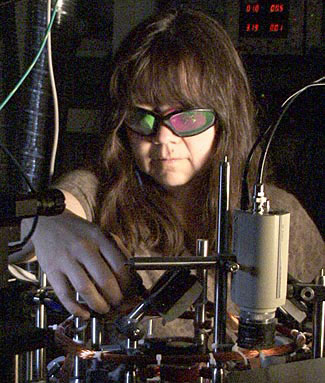
Scientists at JILA, working with Italian theorists, have discovered another notable similarity between ultracold atomic gases and high-temperature superconductors, suggesting there may be a relatively simple shared explanation for equivalent behaviors of the two very different systems.
July 7, 2010 Read more
Novel ion trap with optical fiber could link atoms and light in quantum networks
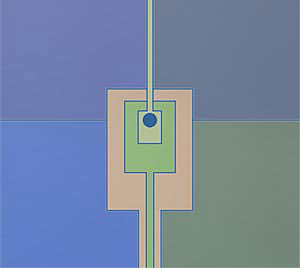
Physicists at the National Institute of Standards and Technology (NIST) have demonstrated an ion trap with a built-in optical fiber that collects light emitted by single ions (electrically charged atoms), allowing quantum information stored in the ions to be measured. The advance could simplify quantum computer design and serve as a step toward swapping information between matter and light in future quantum networks.
July 7, 2010 Read more
New strategy boosts speed, accuracy in simulation of protein folding
Rice University researchers have come up with a computer program to accurately simulate protein folding dramatically faster than previous methods. It will allow scientists to peer deeper into the roots of diseases caused by proteins that fold incorrectly.
July 7, 2010 Read more
Pinpoint nanotechnology precision: Delivering a biochemical payload to a single cell
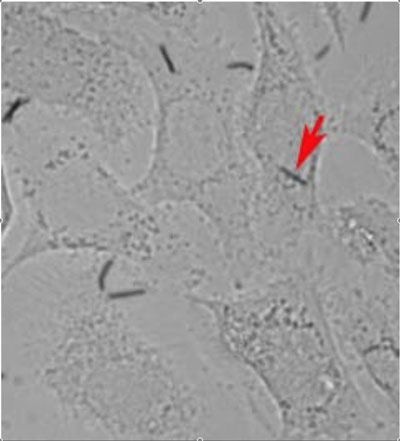
Imagine being able to drop a toothpick on the head of one particular person standing among 100,000 people in a stadium. It sounds impossible, yet this degree of precision at the cellular level has been demonstrated by researchers affiliated with the Johns Hopkins University Institute for NanoBioTechnology.
July 7, 2010 Read more
Nanomaterials are widely used in commerce, but EPA faces challenges in regulating risk
The U.S. Government Accountability Office (GAO) has released a report "Nanotechnology: Nanomaterials Are Widely Used in Commerce, but EPA Faces Challenges in Regulating Risk" (pdf) in which it recommends that EPA complete its plans to modify its regulatory framework for nanomaterials as needed.
July 7, 2010 Read more
International micro-, nanotechnology leaders headline the 2010 COMS Conference in Santa Ana Pueblo, New Mexico, August 29 - September 2, 2010
The Micro and Nanotechnology Commercialization Education Foundation, MANCEF, is celebrating the 10th anniversary of its Commercialization of Micro-Nano Systems Conference (COMS) in New Mexico.
July 7, 2010 Read more
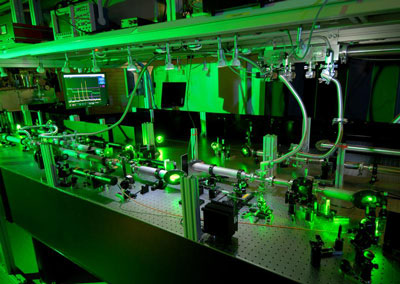
Ultrakurze Strahlungsblitze in der Biomedizin
Auf dem Forschungscampus Garching wird in den kommenden Jahren das Centre for Advanced Laser Applications (CALA) errichtet. Hauptanliegen der universitaeren Forschung ist die Entwicklung von Verfahren zur grundlegenden Verbesserung der Heilungschancen von Krebspatienten.
July 7, 2010 Read more
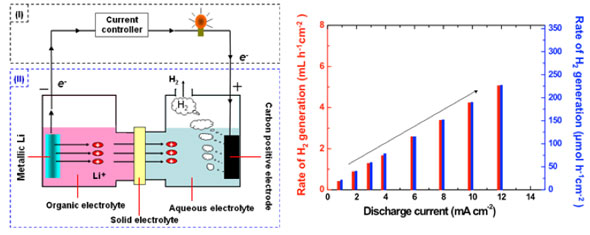
Producing clean hydrogen by controlling lithium-water reaction
Researchers in Japan have developed the concept of a clean hydrogen production system based on controlled lithium-water electrochemical reactions and have successfully investigated the system.
July 7, 2010 Read more
Premier opens Melbourne Centre for Nanofabrication
Self cleaning paint, miniature sensors that detect disease in its early stages and next generation batteries are all revolutionary products that could result from research undertaken at the new $57 million Melbourne Centre for Nanofabrication.
July 7, 2010 Read more
 Subscribe to our Nanotechnology News feed