

Nanotechnology News – Latest Headlines
New model paves the way for the prediction of the properties of nanoparticle ensembles
A team of scientists led by Eugenia Kumacheva of the Department of Chemistry at the University of Toronto has discovered a way to predict the organization of nanoparticles in larger forms by treating them much the same as ensembles of molecules formed from standard chemical reactions.
July 12, 2010 Read more
VDI-Nachwuchspreis Nanotechnik im Rahmen der Nanofair verliehen
Noel Wilck erhielt die Auszeichnung fuer seinen wissenschaftlichen Beitrag zur Steigerung des Wirkungsgrades von Solarzellen.
July 12, 2010 Read more
Organic nanowires open up possibilities for nanoelectronics
Swiss and German materials scientists have created simple networks of organic nanowires for future electronic and optoelectronic components. The successful approach synthesises the complex and incredibly thin nanowire structures, and joins them to electrically conducting links (essentially creating an electronic circuit).
July 12, 2010 Read more
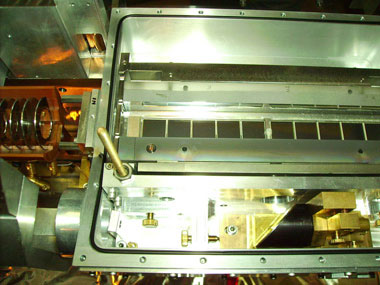
The proton - smaller than thought
An international team measures the charge radius of the hydrogen nucleus and stumbles across some mysteries of physics.
July 12, 2010 Read more
Graphen auf Ladungsentzug
Immer kleiner, schneller und belastbarer - so soll die Zukunft der Elektronik aussehen. Forscher des Max-Planck-Instituts fuer Festkoerperforschung in Stuttgart tragen mit aktuellen Arbeiten dazu bei, dass sich diese Hoffnung erfuellt. Sie haben Wege gefunden, Graphen von elektrischen Ladungen zu befreien.
July 12, 2010 Read more
Launch of FP7 MiSpiA photonics project
MiSPiA (Microelectronic Single-Photon 3D Imaging Arrays for low-light high-speed Safety and Security Applications) is a new Collaborative research project funded by the European Commission in its Seventh Framework Programme for research, technological development and demonstration activities (2007-2013), and was launched in June 2010 under the coordination of the Politecnico di Milano.
July 12, 2010 Read more
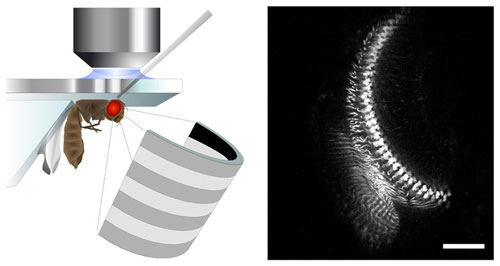
The brain of the fly - a high-speed computer
Neurobiologists use state-of-the-art methods to decode the basics of motion detection.
July 12, 2010 Read more
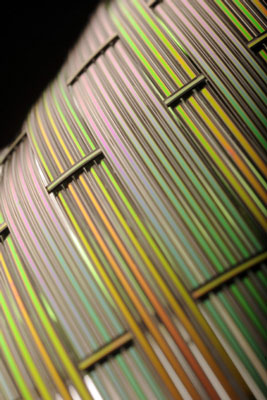
Fibers that can hear and sing
MIT researchers pass a milestone on the path to sophisticated fibers that interact with their surroundings in new ways.
July 12, 2010 Read more
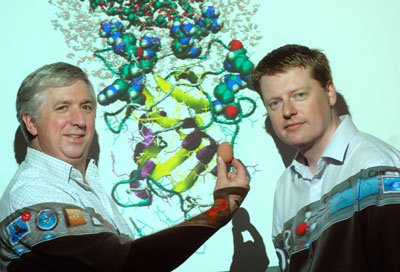
Researchers apply computing power to crack egg shell problem
Researchers at the University of Warwick and the University of Sheffield have applied computing power to crack a problem in egg shell formation. The work may also give a partial answer to the age old question 'what came first the chicken or the egg'?
July 12, 2010 Read more
Prediction markets to facilitate real-time science?
Kaggle, a web platform for data prediction competitions, has just issued a press release that touts the usefulness of open prediction technology for data-heavy scientific problems. The platform allows researchers and organizations to post their problem and have it scrutinized by the world's best statisticians to predict the future (produce the best forecasts) or predict the past (find the best insights hiding in data).
July 12, 2010 Read more
Thai labs build capabilities in agricultural nanotechnology
Thailand's National Science and Technology Development Agency (NSTDA), and Department of Agriculture, Ministry of Agriculture and Cooperatives have signed a research collaborative MoU to identify and initiate agricultural research activities. The initial phase of the collaboration will focus on nanotechnology particularly in the area of food packaging and encapsulation technology for control release of fertilizers.
July 12, 2010 Read more
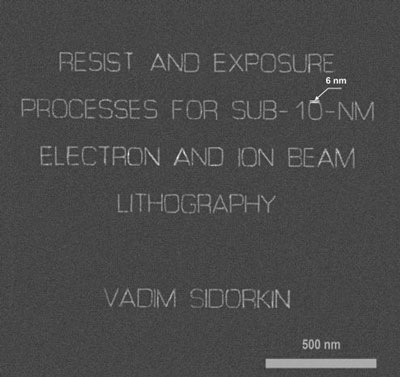
Reducing lithography nanopatterns to 6 nanometers in size
NanoNed researcher Vadim Sidorkin is the first in the world to succeed in patterning a substrate with markings only 6 nanometres in size and only 14 nanometres apart. A spacing of 14 nanometres, would increase in the capacity of the memory chips of, for example, new generation mobile phones tenfold.
July 10, 2010 Read more
DNA through graphene nanopores
A team of researchers from Delft University of Technology announces a new type of nanopore devices that may significantly impact the way we screen DNA molecules, for example to read off their sequence.
July 10, 2010 Read more
Die Anziehungskraft des Goldes
Elektrische Spannung reguliert Bindung von DNA.
July 10, 2010 Read more
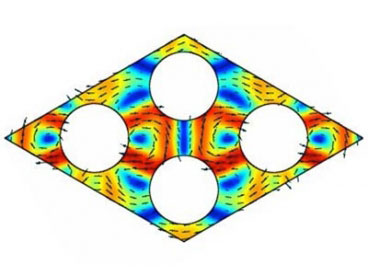
Explained: Phonons
When trying to control the way heat moves through solids, it is often useful to think of it as a flow of particles.
July 10, 2010 Read more
Nanogenerator for mechanical energy harvesting
The journal, Nano Letters, recently published an article highlighting the fascinating nanogenerators developed by Dr. Yong Shi, a professor in the Mechanical Engineering Department at Stevens Institute of Technology.
July 9, 2010 Read more
 Subscribe to our Nanotechnology News feed