

Nanotechnology News – Latest Headlines
Elektronen im Verzug
Anders als bislang angenommen werden Elektronen bei der Fotoemission verzoegert aus einem Atom katapultiert.
June 25, 2010 Read more
How not to blow up a molecule
Researchers study what effects femtosecond x ray pulses had on a simple molecular system, nitrogen.
June 24, 2010 Read more
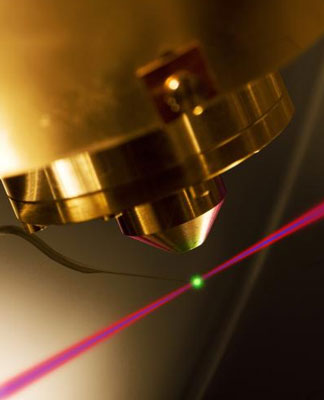
Delayed time zero in photoemission
Until now, it has been assumed that during photoemission the electron start moving out of the atom immediately after the impact of the photon. This point in time can be detected and has so far been considered as coincident with the arrival time of the light pulse, i.e. with 'time zero' in the interaction of light with matter. Using their ultra-short time measurement technology, physicists have now tested this assumption.
June 24, 2010 Read more
Researchers develop living, breathing human lung-on-a-chip
Researchers from the Wyss Institute for Biologically Inspired Engineering at Harvard University, Harvard Medical School and Children's Hospital Boston have created a device that mimics a living, breathing human lung on a microchip. The device, about the size of a rubber eraser, acts much like a lung in a human body and is made using human lung and blood vessel cells.
June 24, 2010 Read more
Gene therapy a step closer to mass production
EUREKA project E! 3371 Gene Transfer Agents has made great advances in the development of novel non-viral carriers able to introduce genetic material into the target cells. These new agents, derivatives of cationic amphiphilic 1,4-dihydropyridine (1,4-DHP), avoid the problems of the recipient's immune system reacting against a viral carrier.
June 24, 2010 Read more
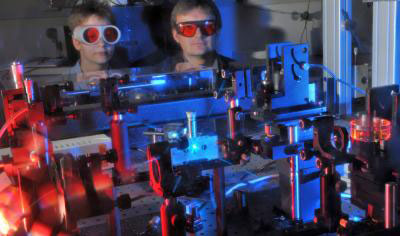
Scientists show that the first step already affects the efficiency of hydrogen generation
In trying to copy the photosynthesis in the laboratory a team of scientists of the Universities of Jena and Erlangen-Nuernberg and of the Institute of Photonic Technology (IPHT) in Jena (Germany) made a huge step forward. The physicists and chemists were able to prove in their tests, that the first step already affects the efficiency of hydrogen generation.
June 24, 2010 Read more
Nanotech Insight conference to provide a look at the latest trends and discoveries in nanoscience
Nanotech Insight (NTI), scheduled for February 27 - March 2, 2011 in Cairo, Egypt, will provide a look at the latest trends and discoveries in nanoscience. The conference will feature keynote lectures from some of the world's leading speakers in the field.
June 24, 2010 Read more

Nordrhein-Westfalen erweist sich abermals als Global Player der Nanobiotechnologie
Zum mittlerweile dritten Mal traf sich anlaesslich der 6. NanoBio-Europe die internationale Nanobiotechnologie-Szene in Muenster. Rund 280 Wissenschaftler aus mehr als 20 Laendern hatten zu dem internationalen Leitkongress im Messe und Congress Centrum Halle Muensterland zusammengefunden.
June 24, 2010 Read more
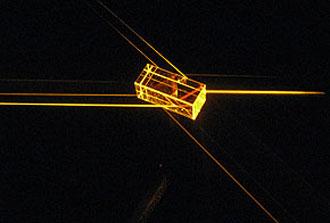
World first for quantum memory storage
An Australian National University-led team has developed the most efficient quantum memory for light in the world, taking us closer to a future of super-fast computers and communication secured by the laws of physics.
June 24, 2010 Read more
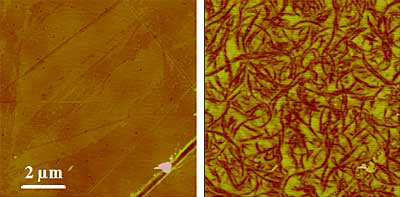
Depth charge: Using atomic force microscopy to study subsurface structures
Over the past couple of decades, atomic force microscopy (AFM) has emerged as a powerful tool for imaging surfaces at astonishing resolutions - fractions of a nanometer in some cases. But suppose you're more concerned with what lies below the surface? Researchers have shown that under the right circumstances, surface science instruments such as the AFM can deliver valuable data about sub-surface conditions.
June 24, 2010 Read more
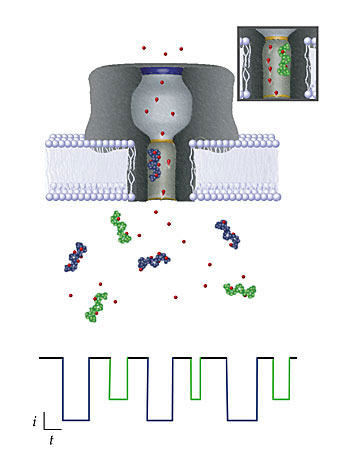
Advances in analysis using nanopore-based single-molecule mass spectrometry
National Institute of Standards and Technology (NIST) scientists have moved a step closer to developing the means for a rapid diagnostic blood test that can scan for thousands of disease markers and other chemical indicators of health. The team reports it has learned how to decode the electrical signals generated by a nanopore - a 'gate' less than 2 nanometers wide in an artificial cell membrane.
June 24, 2010 Read more
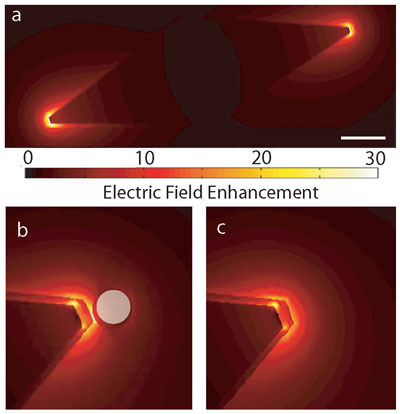
New technique can sense movement of single molecules over hours
Scientists can detect the movements of single molecules by using fluorescent tags or by pulling them in delicate force measurements, but only for a few minutes. A new technique by Rice University researchers will allow them to track single molecules without modifying them - and it works over longer timescales.
June 23, 2010 Read more
Quantum simulations uncover hydrogen's phase transitions
Not much is known about what happens to this abundant element under high-pressure conditions when it transforms from one state to another. Using quantum simulations, scientists were able to uncover these phase transitions in the laboratory.
June 23, 2010 Read more
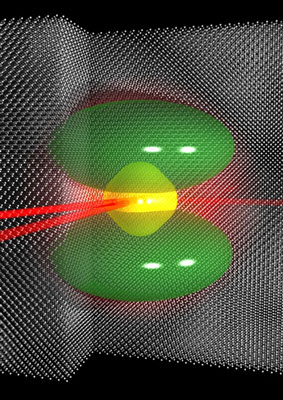
Silicon breakthrough brings quantum computer one step closer
The remarkable ability of an electron to exist in two places at once has been controlled in the most common electronic material - silicon - for the first time.
June 23, 2010 Read more
Nanomaterials researchers' guide for solving optimization problems now available from NAG
Worldwide nanomaterials researchers seeking the most appropriate way to solve difficult optimization problems typical of nanomaterials research can get easy to follow step-by-step instructions on how to select the best-suited local or global optimization routines, from the Numerical Algorithms Group (NAG) Library, by making use of the Decision Trees for optimization.
June 23, 2010 Read more
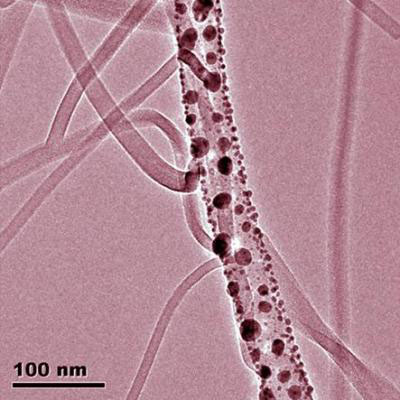
Nanowires for the electronics and optoelectronics of the future
Empa scientists have developed a new method which allows them to create simple networks of organic nanowires.
June 23, 2010 Read more
 Subscribe to our Nanotechnology News feed