

Nanotechnology News – Latest Headlines

Ultra-secure quantum communications
The risk of sensitive information falling into the wrong hands could be eliminated by a new quantum communication process that delivers unprecedented security.
May 24, 2010 Read more
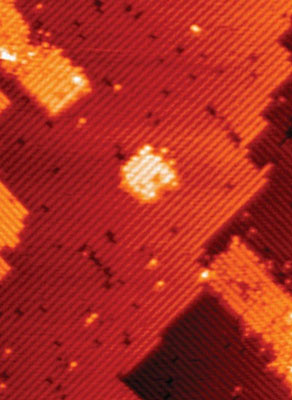
Nanotechnology researchers build transistor with just seven atoms
Scientists have literally taken a leap into a new era of computing power by making the world's smallest precision-built transistor - a quantum dot of just seven atoms in a single silicon crystal.
May 24, 2010 Read more
Nano-bio-chip checks for oral cancer
The gentle touch of a brush on the tongue or cheek can help detect oral cancer with success rates comparable to more invasive techniques like biopsies, according to preliminary studies.
May 21, 2010 Read more
Novel nanoparticles prevent radiation damage during cancer therapy
Nanoparticles covered with the natural pigment melanin may protect bone marrow from the harmful effects of anticancer radiation therapy.
May 21, 2010 Read more
Nanoporous particles deliver novel molecular therapies to tumors
Using nanoporous silicon particles, two teams of investigators have created drug delivery vehicles capable of ferrying labile molecular therapies deep into the body. Both groups believe their new drug delivery vehicles create new opportunities for developing innovative anticancer therapies.
May 21, 2010 Read more
Self-assembling gold nanoparticles use light to kill tumor cells
A new method for creating supramolecular assemblies of gold nanoparticles functions as highly efficient photothermal agents of a size designed to optimize their delivery to tumors.
May 21, 2010 Read more
Potential for new nanoparticle-based cancer detection
Researchers have created a targeted gold nanoparticle that appears to offer a more sensitive and accurate method for detecting early stage prostate cancer. These nanoparticles may also be useful for detecting lung and breast cancers, too.
May 21, 2010 Read more
Mapping tumor heterogeneity with quantum dots
Using a mixture of four quantum dots linked to antibodies that can detect cancer-associated proteins, a research team from Emory University has developed a method for mapping the molecular heterogeneity of human prostate tumor biopsies obtained from cancer patients. This method should be applicable to other types of tumors.
May 21, 2010 Read more
New invention regulates nerve cells electronically
A major step toward being able to regulate nerve cells externally with the help of electronics has been taken by researchers in Sweden. The breakthrough is based on an ion transistor of plastic that can transport ions and charged biomolecules and thereby address and regulate cells.
May 21, 2010 Read more
With speedy couriers in the cell, nature shows nanotechnologists how it's done
Biophysicists at the Technische Universitaet Muenchen (TUM) and Ludwig Maximilians Universitaet Muenchen (LMU) have now succeeded in explaining fundamental functions of a particularly interesting motor protein
May 21, 2010 Read more
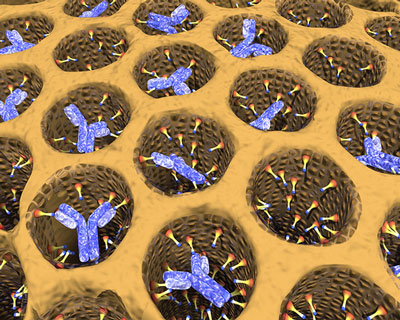
Silica nanocages help anti-cancer antibodies kill tumors in mice
Honeycombed particles filled with cancer drug act like time-release capsules at tumor site.
May 21, 2010 Read more
Nanomaterials2010: A leading platform focused on commercialisation of nanomaterials
This year's NanoMaterials conference offers unrivalled networking opportunities with the exhibition being almost sold out, delegates from more than 100 organisations already registered and 1-2-1 Networking Event taking place during 2 full days.
May 21, 2010 Read more
Prospects in the use of nanotechnologies in plant growing
Nanotechnologies in agriculture are mostly associated with the reproduction of agricultural species and the processing and improvement of the quality of production. Nanotechnologies are already being used for disinfection of the air and of various materials, including food for animals, for purification of water in agro-ecological systems, for the treatment of seeds and cultures, for stimulation of the growth and the development of plants, as well as for the development of new types of packing materials allowing the continuous preservation of the ready products.
May 21, 2010 Read more
Nanotechnologies in contemporary plant-growing
In plant-growing, nanobiotechnologies, being methods for changing the structure of substances, are realized at nano- and sub-nano levels. Growth regulators of a new generation and sophisticated biotechnologies at the nano-level are already successfully applied in plant-growing on more than 50 cultures.
May 21, 2010 Read more

Theorists find surprising behaviours in quantum random networks
Scientists have proven that these quantum complex networks have surprising properties: even in a very weakly connected quantum network, performing some measurements and other simple quantum operations allows to generate arbitrary graphs of connections that are otherwise impossible in their classical counterparts.
May 21, 2010 Read more
International workshop 'Normative pluralism and Nanotechnologies. Internormativity and nanotechnology regulation'
The workshop will discuss the relevance of the different types of regulation, their interaction, and their capacity to define a coherent framework for nano-products. These themes will be discussed by a multidisciplinary group of scholars (legal experts, sociologists, economists, biologists, physicists, toxicologists, etc.).
May 21, 2010 Read more
 Subscribe to our Nanotechnology News feed