

Nanotechnology News – Latest Headlines
TAPPI and VTT Nanotechnology Conference features Dr. Kovalenko as a keynoter
Dr. Andriy Kovalenko will make a keynote presentation at the 2010 International Conference on Nanotechnology for the Forest Products Industry, presented by TAPPI and VTT. He is Senior Research Officer, Group Leader - Theory and Modeling, NRC-NINT and Adjunct Professor, Department of Mechanical Engineering, University of Alberta.
May 27, 2010 Read more
Secrets of a chiral gold nanocluster unveiled
The theoretical structure was confirmed via comparison to experimental results obtained by X-ray diffraction from powder samples of the pure cluster material.
May 27, 2010 Read more
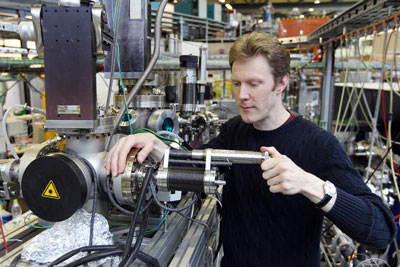
Novel storage materials of the future will be made out of magnetic films
Christian Stamm and his colleagues at the Helmholtz-Zentrum Berlin fuer Materialien und Energie (HZB) can look back on six years of pioneering work at the synchrotron BESSY II. They have set up a unique experiment on so-called femtoslicing, and are now publishing a result obtained in collaboration with an external user group.
May 26, 2010 Read more
Winners of Energy Challenge to help U.S. Navy reduce its carbon footprint
Aiming to motivate researchers to help the U.S. Navy decrease its reliance on fossil fuels, the Office of Naval Research announced nine winners of an 'Energy Challenge' that was issued at its recent Naval Energy Forum.
May 26, 2010 Read more
Si2 to host free 'Design for Manufacturability Coalition Workshop' at DAC 2010
The DFM Workshop explores how both physics and economics conspire against performance, power and cost at the deep sub micron nodes.
May 26, 2010 Read more
Powe Award supports development of nanocomposites to monitor wind turbine blade structure
Gary D. Seidel, assistant professor of aerospace engineering in the College of Engineering at Virginia Tech, has received a Ralph E. Powe Junior Faculty Enhancement Award to support development of a carbon nanotube-enhanced composite for structural health monitoring sensors to improve the resiliency of huge wind turbine blades.
May 26, 2010 Read more
Optische Methoden machen Zellalterung sichtbar
Mit der Alterung biologischer Zellen beschaeftigen sich deutsche Wissenschaftler und Unternehmen in einem neuen Verbundprojekt. Modernste optische Methoden sollen die Prozesse in lebenden Zellen beruehrungslos charakterisieren und abbilden.
May 26, 2010 Read more
EPA awards small businesses to develop new environmental technologies
The U.S. Environmental Protection Agency (EPA) has awarded nearly $2.5 million to 11 companies to support their work in eight key environmental areas: monitoring and control of air emissions, biofuels, green buildings, drinking water monitoring, hazardous waste monitoring, water infrastructure, homeland security, nanotechnology and innovation in manufacturing.
May 26, 2010 Read more
Could humans be infected by computer viruses?
Dr Mark Gasson, from the School of Systems Engineering, contaminated a computer chip which had been inserted into his hand as part of research into human enhancement and the potential risks of implantable devices.
May 26, 2010 Read more
Sandia nanotechnology researchers Phillips, Moody named MRS Fellows
Julia Phillips, director of Nuclear Weapons Science and Technology Programs at Sandia National Laboratories, and Sandia researcher Neville Moody have been named Fellows in the Materials Research Society (MRS).
May 26, 2010 Read more
Electron spin in silicon will lead to revolutionary quantum chips
A silicon-based nanoscale system which aims to harness the spin of electrons to boost the processing power of future computer systems is being developed by researchers at the University of Southampton, jointly with the University of Cambridge, the NTT Basic Research Laboratories and the Hitachi Cambridge Laboratory.
May 26, 2010 Read more
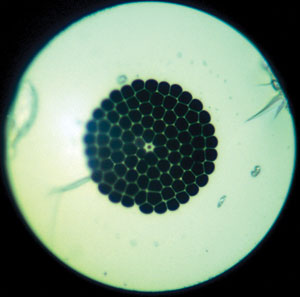
Photonic crystal fibers with unique internal cross-sections take chemical detectors to new levels of sensitivity
A new type of optical fiber, called photonic crystal fiber (PCF), is set to revolutionize the performance of fiber-optic devices. PCF contains a periodic arrangement of small air holes that can manipulate the behavior of photons, enabling control over the transmission of light in ways never seen before.
May 26, 2010 Read more
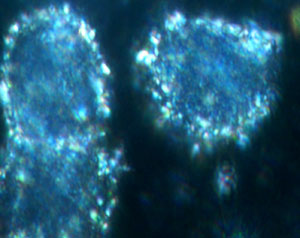
Cell imaging: Reporting live on location
Rapid synthesis of nanoscale reporter tags offers a promising alternative to fluorescent labeling.
May 26, 2010 Read more
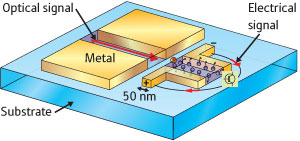
Novel design promises a sensitive detector of hybrid particles that unite light and charge
Scientists at A*STAR Institute of High Performance Computing in Singapore have proposed and analyzed theoretically an electronic device that detects 'surface plasmon polaritons.
May 26, 2010 Read more
Microrobots showcase their skills at competition
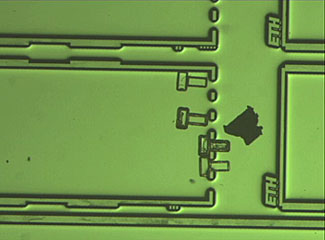
Make room, Bender, Rosie and R2D2! Your newest mechanical colleagues are a few steps closer to reality, thanks to lessons learned during robotics events at the recent IEEE International Conference on Robotics and Automation (ICRA) in Anchorage, Alaska.
May 26, 2010 Read more
Scientists gain new 'core' understanding of nanoparticles
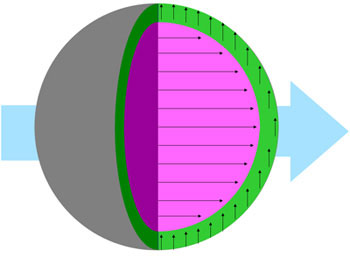
While attempting to solve one mystery about iron oxide-based nanoparticles, a research team working at the National Institute of Standards and Technology (NIST) stumbled upon another one. But once its implications are understood, their discovery may give nanotechnologists a new and useful tool.
May 26, 2010 Read more
 Subscribe to our Nanotechnology News feed