

Nanotechnology News – Latest Headlines
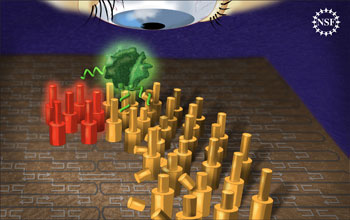
Molecular robots on the rise
Researchers from Columbia University, Arizona State University, the University of Michigan and the California Institute of Technology (Caltech) have created and programmed robots the size of single molecule that can move independently across a nano-scale track.
May 13, 2010 Read more
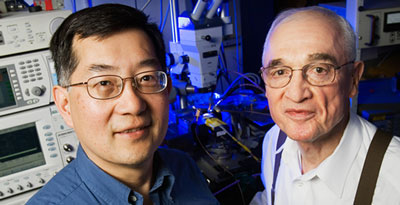
Redefining electrical current law with the transistor laser
While the laws of physics weren't made to be broken, sometimes they need revision. A major current law has been rewritten thanks to the three-port transistor laser, developed by Milton Feng and Nick Holonyak Jr. at the University of Illinois.
May 12, 2010 Read more
Investigating how spiders spin their silk, researchers unravel a key step
Discovery opens the way toward biomimetic production of ultra-strong, elastic fibers.
May 12, 2010 Read more
Computer scientist shows how evolution meets computation in new book
Nature and technology may seem worlds apart, but New York University Computer Scientist Dennis Shasha maintains that the natural world can bolster the capacity of today's most sophisticated machines. In Natural Computing: DNA, Quantum Bits, and the Future of Smart Machines, Shasha and co-author Cathy Lazere describe the work of 15 pioneers who have successfully harnessed nature's power in advancing technology.
May 12, 2010 Read more
Chemists create novel DNA assembly line
Chemists at New York University and China's Nanjing University have created a DNA assembly line that has the potential to create novel materials efficiently on the nanoscale.
May 12, 2010 Read more
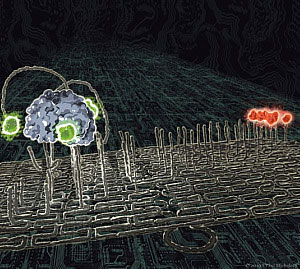
Spiders at the nanoscale: Molecules that behave like robots
A team of scientists from Columbia University, Arizona State University, the University of Michigan, and the California Institute of Technology (Caltech) have programmed an autonomous molecular 'robot' made out of DNA to start, move, turn, and stop while following a DNA track.
May 12, 2010 Read more
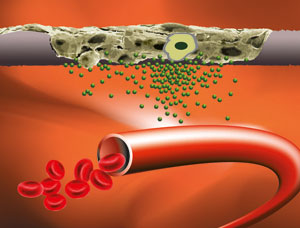
Researchers make progress on biotolerance of textile implants
Stem cells stimulate regeneration of vascular tissue to allow for optimised integration of textile implants.
May 12, 2010 Read more
From beams to buckyballs - setting the stage for the nanotechnology revolution
Twenty-five years after the laser beam came to be, a historic meeting took place at Rice University that led to the discovery of the buckminsterfullerene, the carbon 60 molecule for which two Rice scientists won the Nobel Prize.
May 12, 2010 Read more
European Alliance targets separation technologies for sustainable energy systems
The 'European Inorganic Membrane Research Alliance' (EIMRA) aims to facilitate the transition from basic research to applications. In this way, EIMRA will contribute to the worldwide effort to enhance industrial efficiency and reduce carbon dioxide emissions.
May 12, 2010 Read more
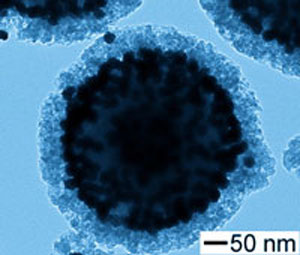
Superparamagnetic gold nanoshells with tunable optical properties
A solution-phase process has been developed by CNM users from the University of California at Riverside, working collaboratively with the Nanophotonics Group, for synthesizing stable multifunctional colloidal particles composed of a superparamagnetic Fe3O4 core, a gold nanoshell, and a mesoporous silica outer layer.
May 12, 2010 Read more
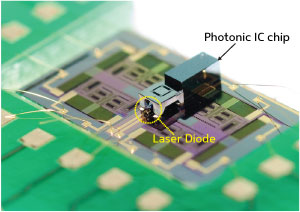
Micro-electromechanical systems accurately align optical components on a silicon microchip
All optics research requires precise alignment of optical components to ensure that light passes efficiently from one element to the next. At the micro-scale, however, the process is much more delicate and complicated. Now, an alignment mechanism integrated onto a silicon chip to allow quick and cheap optical optimization has been demonstrated.
May 12, 2010 Read more
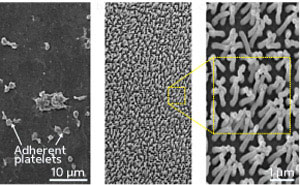
Nanoscale features patterned on surfaces of polymer biomaterials can prevent blood clots
Researchers have discovered that adding miniature topographical features to polymer surfaces can reduce blood coagulation and improve the hemocompatibility, or blood compatibility, of biomaterials.
May 12, 2010 Read more
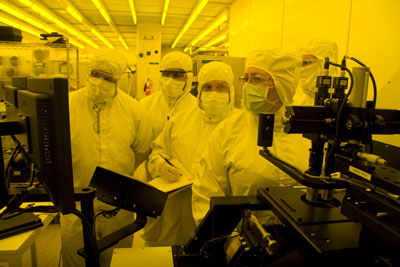
Where nanotechnology's future is incubating
Arizona State University's NanoFab facility is teaching industry ways to manufacture better products and helping engineers and scientists develop new technologies.
May 12, 2010 Read more
World record for shortest controllable time
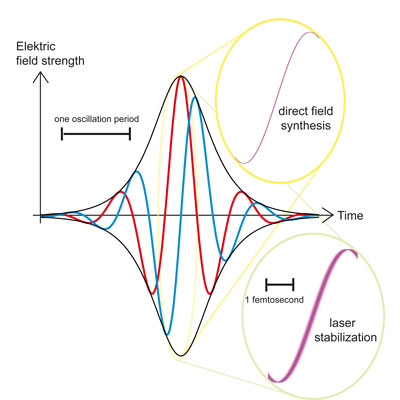
Scientist at the Max Born Institute for Nonlinear Optics and Short Time Spectroscopy (MBI) in Berlin, Germany have demonstrated timing control with a residual uncertainty of 12 attoseconds.
May 11, 2010 Read more
DNA could be backbone of next generation logic chips
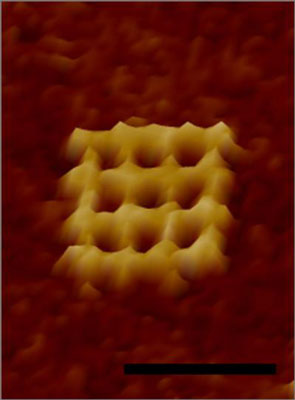
In a single day, a solitary grad student at a lab bench can produce more simple logic circuits than the world's entire output of silicon chips in a month. So says a Duke University engineer, who believes that the next generation of these logic circuits at the heart of computers will be produced inexpensively in almost limitless quantities.
May 11, 2010 Read more
Quantum move toward next generation computing
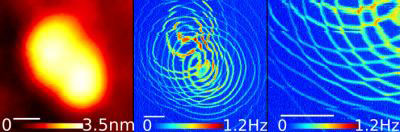
Physicists at McGill University have developed a system for measuring the energy involved in adding electrons to semi-conductor nanocrystals, also known as quantum dots - a technology that may revolutionize computing and other areas of science.
May 11, 2010 Read more
 Subscribe to our Nanotechnology News feed