

Nanotechnology News – Latest Headlines
Nanotechnology patch delivers vaccine 100 times better than needle and syringe
New research, led by Professor Mark Kendall, from the Australian Institute for Bioengineering and Nanotechnology, demonstrates that a vaccine delivered by a Nanopatch induces a similarly protective immune response as a vaccine delivered by needle and syringe, but uses 100 times less vaccine.
April 22, 2010 Read more
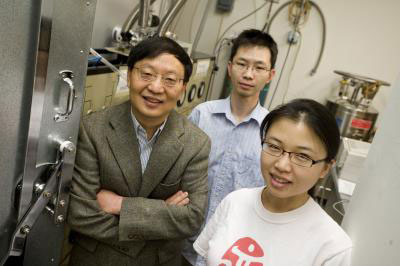
Bizarre matter could find use in quantum computers
Rice physicists: Odd electron mix has fault-tolerant quantum registry.
April 21, 2010 Read more
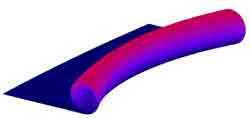
Controlling the formation of graphene nano-scrolls
Can graphene - a newly discovered form of pure carbon that may one day replace the silicon in computers, televisions, mobile phones and other common electronic devices - be made to bend, twist and roll? Physicists at UC San Diego and Boston University think so.
April 21, 2010 Read more
Hydrogen and inert species improve solid phase epitaxy of germanium on silicon
It was shown that the presence of hydrogen and/or inert species during Ge deposition significantly improves the quality of the Ge layers grown on Si by solid phase epitaxy.
April 21, 2010 Read more
Novel strategy to tune plasmon resonances has potential applications in biomolecular detection
Researchers at imec have developed an innovative strategy to tune plasmon resonances. They do so by breaking the symmetric geometry of the nanostructures, using a combination of bottom-up and top-down fabrication processes.
April 21, 2010 Read more
Junctionless transistor outperforms nanowire MOSFET
Recent modeling results obtained in imec for a GaAs and Si nanowire indicate that the nanowire pinch-off FET can outperform the nanowire MOSFET. These results combined with scalability and ease of processing make the junctionless transistor a true competitor for the nanowire MOSFET.
April 21, 2010 Read more
Quantum Cryptography breakthrough heralds uncrackable communication networks
The Cambridge Lab of Toshiba Research Europe today announced a major breakthrough that will allow ultra-secure encryption of sensitive data sent by banks, hospitals and government organisations.
April 21, 2010 Read more
MIT's Technology Review identifies ten technologies poised to change the world
The editors of Technology Review, MIT's magazine of innovation, have announced their annual list of the 10 emerging technologies that will soon have a profound impact on how we live and work.
April 20, 2010 Read more
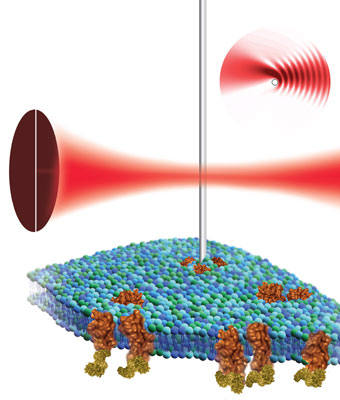
A little less force: Making Atomic Force Microscopy work for cells
Researchers have developed nano-sized cantilevers whose gentle touch could help discern the workings of living cells and other soft materials in their natural, liquid environment. Used in combination with a revolutionary detection mechanism, this new imaging tool is sensitive enough to investigate soft materials without the limitations present in other cantilevers. By placing a nanowire cantilever in the focus of a laser beam and detecting the resulting light pattern, scientists at the Molecular Foundry believe atomic force microscopy can be used to non-destructively image the surface of a biological cell.
April 20, 2010 Read more
Oak Ridge National Laboratory, industry to collaborate in advanced battery research
Through new collaborations totaling $6.2 million, the Department of Energy's Oak Ridge National Laboratory (ORNL) and American industry will tackle some of the most critical challenges facing lithium ion battery production.
April 20, 2010 Read more
Breakthrough in the use of continuous flow microreactors in thin-film solar cell technology
Researchers have made an important breakthrough in the use of continuous flow microreactors to produce thin film absorbers for solar cells - an innovative technology that could significantly reduce the cost of solar energy devices and reduce material waste.
April 20, 2010 Read more
Carbon nanotubes boost cancer-fighting cells
Yale University engineers have found that the defects in carbon nanotubes cause T cell antigens to cluster in the blood and stimulate the body's natural immune response.
April 20, 2010 Read more
Call for research papers: The Nano Archive
The Nano Archive, the online open-access repository for nanoscience and nanotechnology, invites you to submit research papers to be published free online for users across the globe.
April 20, 2010 Read more
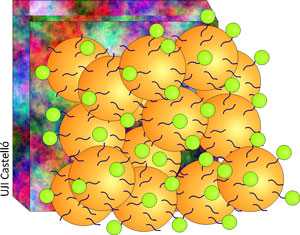
Universitat Jaume starts project on nanotechnology-based solar cells
After responding to a call for proposals, the research group led by Juan Bisquert at Universitat Jaume I of Castello has won the bid for a scientific and technological research project on new types of solar cells based on nanotechnologies. The project is entitled 'Low cost nanodesigned solar cells based on semiconductor nanocrystals'.
April 20, 2010 Read more
Symposium 'Nanowissenschaften und Nanotechnologie'
Das Symposium 'Nanowissenschaften und Nanotechnologie' der Bayerischen Akademie der Wissenschaften am Donnerstag, 29. April 2010, stellt aktuelle Entwicklungen der Forschung und moegliche Anwendungen vor, die sich durch die Nanowissenschaften in der Informations- und Kommunikationstechnologie, der Umwelttechnik und der Medizin ergeben.
April 20, 2010 Read more
Scientists create artificial human skin with biomechanical properties using tissue engineering
Scientists from the University of Granada, Spain, have generated artificial human skin by tissular engineering basing on agarose-fibrin biomaterial.
April 20, 2010 Read more
 Subscribe to our Nanotechnology News feed