

Nanotechnology News – Latest Headlines
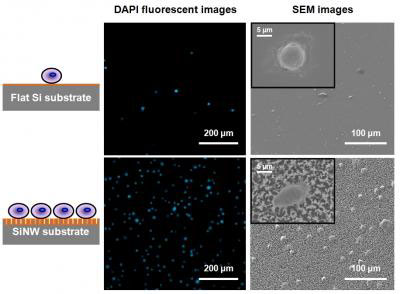
Researchers create 'fly paper' to capture circulating cancer cells
New method may help improve diagnosis, prognosis and treatment monitoring.
November 18, 2009 Read more
FABS21 benchmarking tool will help Ssemiconductor manufacturing facilities improve energy-efficiency
Scientists at the Department of Energy's Lawrence Berkeley National Laboratory, in cooperation with the International SEMATECH Manufacturing Initiative (ISMI), are releasing for beta testing a computer-based tool to help the world's semiconductor manufacturing facilities evaluate and improve their energy efficiency.
November 18, 2009 Read more
Protection facilitates construction of molecules
Sulfate groups are crucial building blocks for many molecules but are difficult to handle. Dutch researcher Martijn Huibers has discovered how sulfate groups can be protected during the construction of a molecule. Thanks to his method new molecules, which could be used for the production of medicines, can now be constructed far more easily.
November 18, 2009 Read more
Better way to harness waste heat with quantum dot devices
In everything from computer processor chips to car engines to electric powerplants, the need to get rid of excess heat creates a major source of inefficiency. But new research points the way to a technology that might make it possible to harvest much of that wasted heat and turn it into usable electricity.
November 18, 2009 Read more
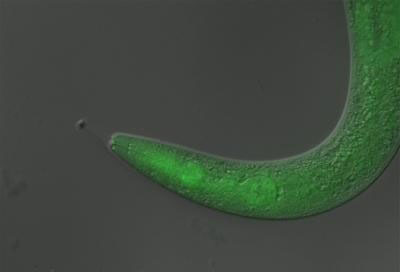
Star Trek phaser on stun? Light beam paralyzes animals
In an advance with overtones of Star Trek phasers and other sci-fi ray guns, scientists in Canada are reporting development of an internal on-off switch that paralyzes animals when exposed to a beam of ultraviolet light.
November 18, 2009 Read more
Succesful nanophotonics and nanomodelling schools organized at nanoGUNE center
The EU funded nanoICT project establishes a broad array of specialised training activities to provide mainly students with interdisciplinary competences in Nanotechnology and more specifically 'nano-scale ICT devices and systems' (Emerging Nanoelectronics).
November 18, 2009 Read more
Freiburg Bioware Team a serial gold medal winner in synthetic biology competition
The Freiburg Bioware Team, an important part of the Excellence Cluster bioss, has done it again: one gold medal and two special prizes at the iGEM (international Genetically Engineered Machine) competition, the largest event in the world for undergraduates in synthetic biology.
November 18, 2009 Read more
Beryllium: A metal of high potential
On KIT Campus North, a beryllium handling laboratory has now been established by the company of Goraieb Versuchstechnik in cooperation with KIT, which is unique in Europe.
November 18, 2009 Read more
Erforschung des Magnetismus im Nanokosmos bekommt 10 Millionen Euro
An der Uni Hamburg, wo die Erforschung des Nanomagnetismus seit vielen Jahren einen herausragenden Forschungsschwerpunkt darstellt, hat die Deutsche Forschungsgemeinschaft bereits 2006 den erfolgreichen Sonderforschungsbereich (SFB) 668 mit dem Thema 'Magnetismus vom Einzelatom zur Nanostruktur' eingerichtet. Jetzt wurde die Fortsetzung des SFB 668 fuer zunaechst vier weitere Jahre mit einem Forschungsetat von ca. 10 Millionen Euro bewilligt.
November 18, 2009 Read more
Illumination activates compounds with therapeutic potential
Researchers describe a new type of molecule that activates so-called voltage-gated potassium channels when exposed to light of a certain color. These molecules could have therapeutic potential in the treatment of some forms of blindness and other diseases.
November 18, 2009 Read more
Passing current through touching molecules
For the first time, a European research cooperation has succeeded in constructing an electrical circuit consiting of two single molecules and probe its electrical properties.
November 18, 2009 Read more

Dauerausstellung Nanotechnologie im neuen 'Zentrum Neue Technologien' im Deutschen Museum
Auf einer Flaeche von 2400 Quadratmetern bietet das ZNT eine flexible, interdisziplinaere und interaktive Plattform fuer aktuelle Themen aus Naturwissenschaft und Technik. Rund um die Dauerausstellung zur Nano- und Biotechnologie gruppieren sich Praesentationen der Partner aus Industrie, Wissenschaft und Forschung, ein Veranstaltungsforum, Sonderausstellungen zu neuen Materialien, Robotik und Wellenkraftwerken.
November 18, 2009 Read more
Magnetic nanotags spot cancer in mice earlier than current methods
Searching for biomarkers that can warn of diseases such as cancer while they are still in their earliest stage is likely to become far easier thanks to an innovative biosensor chip developed by Stanford University researchers.
November 17, 2009 Read more
Detecting the undetectable in prostate cancer testing
A team of Northwestern University researchers, using an extremely sensitive nanotechnology-based tool known as the biobarcode system, has detected previously undetectable levels of prostate-specific antigen (PSA) in patients who have undergone radical prostatectomy.
November 17, 2009 Read more
A tiny cage of gold responds to light, opening to empty its contents
Researchers at Washington University in St. Louis have developed a polymer-coated gold nanocage that not only opens in response to light to release a small amount of a drug payload, but then closes when the light is turned off, leaving this nanodevice ready to deliver another dose of drug on command.
November 17, 2009 Read more
When it comes to drug delivery, size matters
Scientists have developed a mathematical model that predicts the magnitude and specificity of tumor uptake of drug delivery vehicles ranging in size from small peptides to large liposomes.
November 17, 2009 Read more
 Subscribe to our Nanotechnology News feed