

Nanotechnology News – Latest Headlines
An atomic-level look at an HIV accomplice
Scientists at the University of Michigan have determined the atomic-level, three-dimensional structure of a SEVI precursor known as PAP248-286 and discovered how it damages cell membranes to make them more vulnerable to infection with HIV.
November 19, 2009 Read more
Damping of acoustic vibrations in gold nanoparticles
Vibrations in nanostructures offer applications in molecular-scale biological sensing and ultrasensitive mass detection. To approach single-atom sensing, it is necessary to reduce the dimensions of the structures to the nanometer scale while preserving long-lived vibrations.
November 19, 2009 Read more
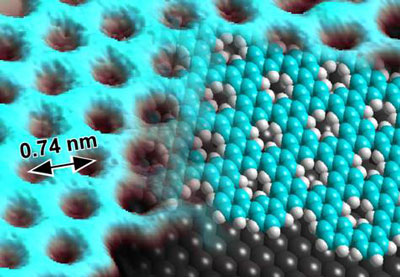
Researchers succeed in synthesizing a graphene-like polymer with well defined pores
Together with colleagues from the Max Planck Institute for Polymer Research in Mainz, scientists from Empa's nanotech@surfaces laboratory have for the first time succeeded in synthesizing a graphene-like polymer with well defined pores
November 19, 2009 Read more
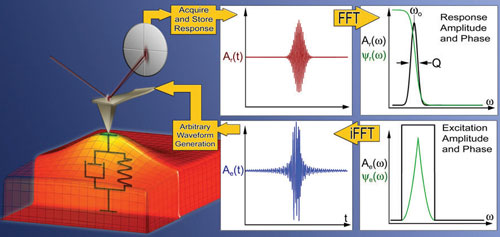
Asylum Research announces grant offering for its band excitation technique
Asylum Research, the technology leader in Scanning Probe and Atomic Force Microscopy (SPM/AFM), has announced a new grant program for early adopters to explore the capabilities and applications of the unique new Band Excitation technique. Existing or new Asylum AFM users are encouraged to apply for grants valued at up to $50,000 USD.
November 19, 2009 Read more
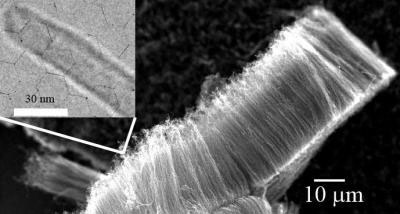
Nanotube defects equal better energy and storage systems
Most people would like to be able to charge their cell phones and other personal electronics quickly and not too often. A recent discovery made by UC San Diego engineers could lead to carbon nanotube-based supercapacitors that could do just this.
November 19, 2009 Read more
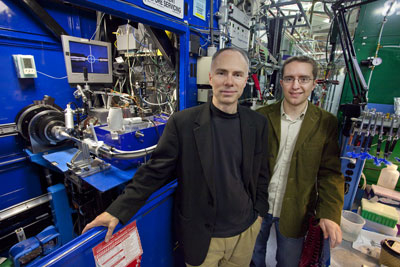
Atomic-level snapshot catches protein motor in action
The atomic-level action of a remarkable class of ring-shaped protein motors has been uncovered by researchers with the Lawrence Berkeley National Laboratory (Berkeley Lab) using a state-of-the-art protein crystallography beamline at the Advanced Light Source
November 19, 2009 Read more
Toshiba develops molecular photoresist technology for EUV lithography
Toshiba Corporation has announced that it has developed a high resolution photoresist (photo-sensitive film) essential for future application of EUV (extreme ultraviolet) lithography in semiconductor fabrication, and proved its viability with the world's first 20nm-scale generation process technology.
November 19, 2009 Read more
Paper examines measurement challenge of atom-thick nanaoelectronics devices
New nanoscale materials and devices are required to replace the silicon transistor that's at the heart of today's semiconductors, but to build these new devices, researchers will have to be able to measure the thickness - if that's the right word - of layers consisting of only a few atoms
November 19, 2009 Read more
NIEHS grants to focus more research on health and safety of nanomaterials
The National Institute of Environmental Health Sciences (NIEHS), part of the National Institutes of Health, is increasing its investment in understanding the potential health, safety and environmental issues related to tiny particles that are used in many everyday products such as sunscreens, cosmetics and electronics.
November 19, 2009 Read more
Start technology education young, EU-funded team recommends
Including technology in the curriculum in early childhood could help to raise the interest of both girls and boys in science and technology, according to recently published, EU-funded research.
November 19, 2009 Read more
Biofuels: a big step towards microchannel hydroprocessing technology
Microchannel processing has the potential to greatly increase the efficiency, effectiveness and commercial value for next generation biofuel production.
November 19, 2009 Read more
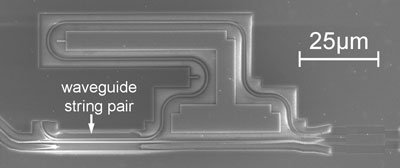
Nanoelectronics researchers demonstrate repulsive and attractive nanophotonic forces
The University of Ghent and the nanoelectronics research center IMEC demonstrated repulsive and attractive nanophotonic forces, depending on the spatial distribution of the light used. These fundamental research results might have major consequences for telecommunication and optical signal processing.
November 19, 2009 Read more
Grant to study the molecular chemistry of depleted Uranium
A scientist at The University of Nottingham has been recognised for his outstanding and creative early career research with a prestigious EUR 1m grant to study speculative and ground-breaking research into molecular depleted uranium chemistry.
November 19, 2009 Read more
OECD nanotechnology awareness-raising workshop for developing and transition countries
OECD and UNITAR will hold Awareness-Raising Workshops for Developing and Transition Countries on Nanotechnology and Manufactured Nanomaterials.
November 19, 2009 Read more
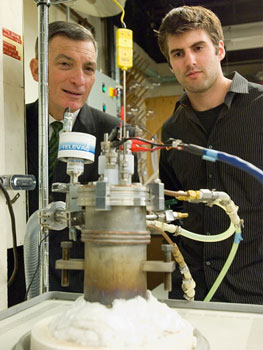
Liquid battery big enough for the electric grid?
The idea is to build an entirely new kind of battery, whose key components would be kept at high temperature so that they would stay entirely in liquid form. The experimental devices currently being tested in an MIT lab work in a way that's never been attempted in batteries before.
November 19, 2009 Read more

Proton's party pals may alter its internal structure
A recent experiment at the Department of Energy's Thomas Jefferson National Accelerator Facility has found that a proton's nearest neighbors in the nucleus of the atom may modify the proton's internal structure.
November 18, 2009 Read more
 Subscribe to our Nanotechnology News feed