

Nanotechnology News – Latest Headlines
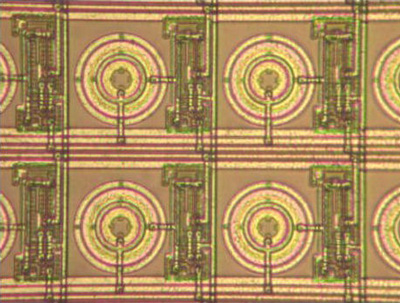
Semiconductor camera capable of filming one million photons per second
European researchers have created a CMOS (semiconductor) camera capable of filming individual photons one million times a second.
October 5, 2009 Read more
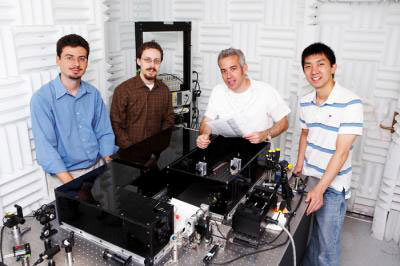
Using optical traps, microfluidic chambers and fluorescence to watch bacteria swim
Researchers have developed a new method for studying bacterial swimming, one that allows them to trap Escherichia coli bacteria and modify the microbes' environment without hindering the way they move.
October 4, 2009 Read more
Understanding a cell's split personality aids synthetic circuits
A new set of experiments by Duke University bioengineers has uncovered the existence of 'bistability', in which an individual cell has the potential to live in either of two states, depending on which state it was in when stimulated.
October 4, 2009 Read more
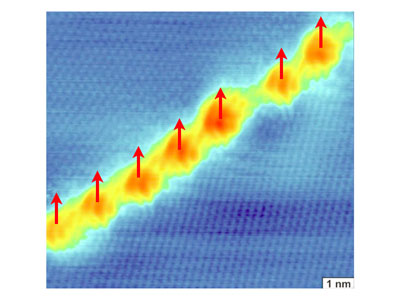
Nanotechnology could benefit from graphite mimicking iron's magnetism
Researchers of Eindhoven University of Technology and the Radboud University Nijmegen in The Netherlands show for the first time why ordinary graphite is a permanent magnet at room temperature.
October 4, 2009 Read more
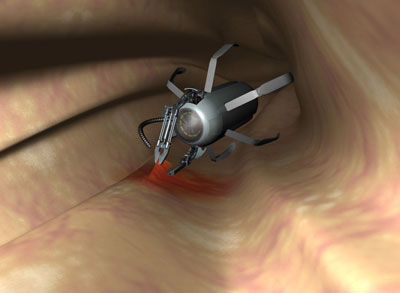
Chipping in together - making microchips cooperatively boosts European innovation
A European-sponsored programme that gives universities inexpensive access to state-of-the-art microchip design tools and fabrication techniques, and helps even small businesses fabricate novel microchips, is helping Europe remain competitive worldwide.
October 4, 2009 Read more
Neue Nanoproduktions Technologien - Systeme, Handling, Analysen
Eine Fachtagung des Cluster Nanotechnologie mit begleitender Ausstellung am 5. und 6. Oktober 2009 an der Universitaet Augsburg / Auszeichnung der Sieger des diesjaehrigen bayerischen Schulwettbewerbs zur Nanotechnologie bei der feierlichen Eroeffnungsveranstaltung.
October 3, 2009 Read more
Director of Nanoengineering and Biotechnology Laboratories Center a winner of Veeco research grant
Prof. Igor Sokolov, director of the Nanoengineering and Biotechnology Laboratories Center (NABLAB) at Clarkson University, was named a winner in the first phase of the Veeco Labs Research Grant Program, 'HarmoniX Innovation'.
October 3, 2009 Read more
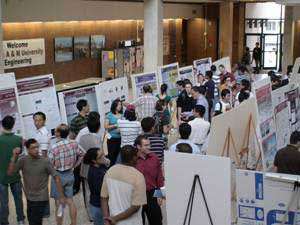
Nanotechnology poster symposium at Texas A+M
The Department of Electrical and Computer Engineering at Texas A+M University sponsored the university's inaugural Nano/Micro Poster Symposium to promote multidisciplinary interaction and scientific communication among students and faculty in the field of nano/micro technology.
October 3, 2009 Read more
Physicists observe magnetism in gas for the first time
An international team of physicists has for the first time observed magnetic behaviour in an atomic gas, addressing a decades-old debate as to whether it is possible for a gas or liquid to become ferromagnetic and exhibit magnetic properties.
October 2, 2009 Read more
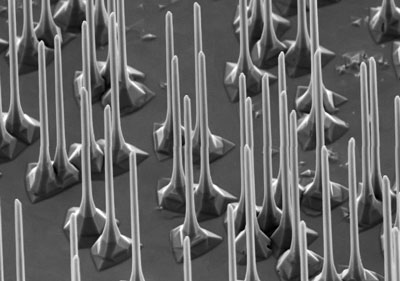
Nanotechnology for super-fast computers gets a new light touch
Building the super-fast computers of the future has just become much easier thanks to an advance by Australian researchers that lets them grab hold of tiny electronics components and probe their inner structure using only a beam of light.
October 2, 2009 Read more
Max-Planck-Gesellschaft folgt auf Harvard
In einem Ranking von ScienceWatch platziert sich die Forschungsorganisation mit Zahl und Zitation ihrer Publikationen direkt hinter Spitzenreiter Harvard University.
October 2, 2009 Read more

Nanoparticle-studded drug shuttle into living cells
Scientists working at Queen Mary, University of London, have developed micrometer-sized capsules to safely deliver drugs inside living cells.
October 2, 2009 Read more
Photosynthetic processes in an artificial system can be described accurately by a quantum physical theory
Researchers have developed a quantum physical model that accurately describes the function of these artificial photosynthetic systems, and provides an understanding of their reaction kinetics that could lead to significant improvements in their conversion efficiencies.
October 2, 2009 Read more
DTSC/California Nano-Industry Network hosts Nanotechnology V Symposium
The Department of Toxic Substances Control (DTSC) and the California Nano-Industry Network is hosting the fifth Nanotechnology Symposium: 'DTSC/California Nano-Industry Network Symposium' on November 16, 2009 in Sacramento, California.
October 2, 2009 Read more
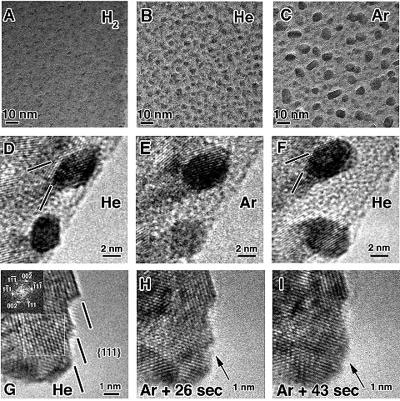
Researchers overcome major obstacle in controlling carbon nanotube growth
Researchers have overcome a major obstacle in efforts to use tiny structures called carbon nanotubes to create a new class of electronics that would be faster and smaller than conventional silicon-based transistors.
October 1, 2009 Read more
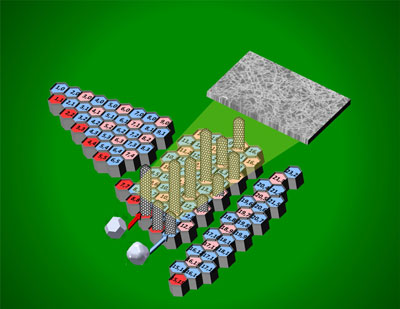
Honda nanotechnology has promise for new class of electronics
Carbon nanotubes may have the potential to transport electricity faster and over greater distances with minimal loss of energy, according to new research.
October 1, 2009 Read more
 Subscribe to our Nanotechnology News feed