

Nanotechnology News – Latest Headlines
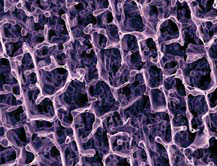
Icy exposure creates nanocomposite-reinforced polymer high-tech foams
Chemists and engineers at the University of Warwick have found that exposing particular mixtures of polymer particles and other materials to sudden freeze-drying can create a high-tech armored foam that could be used for a number of purposes, including a new range of low power room temperature gas sensors.
July 28, 2009 Read more
Crystal structure data help optimize innovative materials
FIZ Karlsruhe offers ICSD, the world's largest database with fully identified inorganic crystal structures / evaluated data of unique quality / customized access options and new web presence with cutting-edge search and analysis functions.
July 28, 2009 Read more

Rethinking Brownian motion
Researchers at the University of Illinois have now revealed the truth about a classic bell-shaped curve used to describe the motion of a liquid as it diffuses through another material.
July 28, 2009 Read more
Argonne's Midwest Center for Structural Genomics determines 1,000th protein structure
Researchers at Argonne National Laboratory's Midwest Center for Structural Genomics recently hit a milestone. They imaged more than 1,000 proteins, the building blocks of life. It is a feat that helps a wide array of scientists better understand dangerous pathogens as well as the basic mechanisms of human and organism survival.
July 27, 2009 Read more
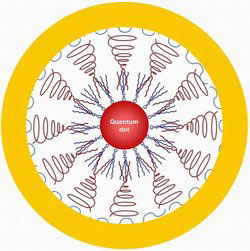
All-in-one nanoparticle: A swiss army knife for nanomedicine
For the first time researchers have combined nanoparticles used for medical imaging and therapy in a single tiny package.
July 27, 2009 Read more

Inventor of IBM Racetrack memory wins IUPAP Magnetism Award and Neel Medal
At the International Conference on Magnetism today in Karlsruhe, Germany, IBM Fellow Stuart Parkin received the International Union of Pure and Applied Physics Magnetism award and the Louis Neel Medal for his pioneering work and fundamental contributions to the development of spintronic nano-materials and nano-devices for magnetic sensing, memory and logic devices.
July 27, 2009 Read more
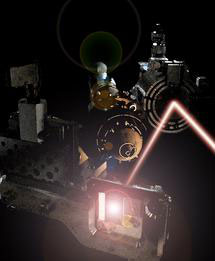
Transparent aluminium is an exotic new state of matter
Oxford scientists have created a transparent form of aluminium by bombarding the metal with the world's most powerful soft X-ray laser. 'Transparent aluminium' previously only existed in science fiction, featuring in the movie Star Trek IV, but the real material is an exotic new state of matter with implications for planetary science and nuclear fusion.
July 27, 2009 Read more
With nanomaterials and innovative techniques, German consortium revolutionizes printing technology
With nanoparticulate functional materials and innovative printing pro-cesses, researchers from BASF SE, Heidelberger Druckmaschinen AG (Heidelberg) and Darmstadt Technical University are revolutionizing printing technology. Organic electronic products of future potential, such as photovoltaic films or bendable light-emitting diodes, head their list of achievements.
July 27, 2009 Read more
UK NanoForum and Emerging Technologies 2009
Registration is now open for the UK NanoForum and Emerging Technologies 2009 will showcase the latest technologies and commercial opportunities. The event will take place on November 3-4, 2009, at the London Hilton on Park Lane Hotel.
July 27, 2009 Read more
Nanodiamonds deliver insulin for wound healing
Using nanodiamonds, researchers have demonstrated an innovative method for delivering and releasing the curative hormone at a specific location over a period of time. The nanodiamond-insulin clusters hold promise for wound-healing applications and could be integrated into gels, ointments, bandages or suture materials.
July 27, 2009 Read more
Navigating in the ocean of molecules - computer program points the way to new candidate agents
Tracking down new active agents for cancer or malaria treatment could soon become easier - thanks to a computer program with which researchers from the Max Planck Institute of Molecular Physiology in Dortmund aim to facilitate the search for suitable pharmaceutical substances.
July 27, 2009 Read more
Exploiting electricity-producing materials for powering nanotechnology devices
Driven by the vision of our society one day being basically self-propelled, a team of University of Houston scientists has set out to both amplify and provoke that potential in materials known as piezoelectrics, which naturally produce electricity when literally subjected to strain. The goal is to use piezoelectrics to create nanodevices that can power electronics, such as cell phones, MP3 players and even biomedical implants.
July 27, 2009 Read more
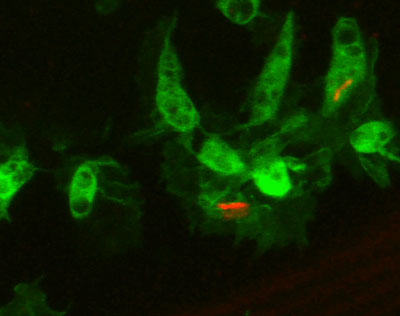
Researchers capture bacterial infection on film
Researchers have developed a new technique that allows them to make a movie of bacteria infecting their living host.
July 27, 2009 Read more
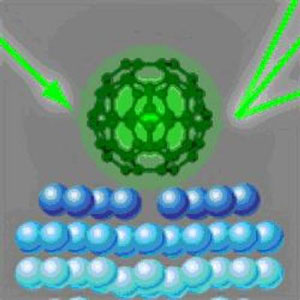
New measurements on buckballs push the limits of surface science
Scientists at Penn State University, in collaboration with institutes in the US, Finland, Germany and the UK, have figured out the long-sought structure of a layer of C60 - carbon buckyballs - on a silver surface.
July 27, 2009 Read more
One nano-step closer to weighing a single atom
By studying gold nanoparticles with highly uniform sizes and shapes, scientists now understand how they lose energy, a key step towards producing nanoscale detectors for weighing any single atom.
July 27, 2009 Read more
New device makes invisibility a reality
Researchers in Spain have developed a device that makes objects invisible under a certain kind of light. Called 'dc metamaterial', the device brings the inside of the magnetic field down to zero but does not change the exterior field.
July 27, 2009 Read more
 Subscribe to our Nanotechnology News feed