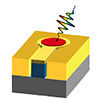
A metasurface-enhanced thermal photodetector achieves 125 picosecond response times, approaching semiconductor speeds without external power or cooling while retaining broad wavelength flexibility.
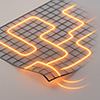
Active boundary heating and cooling can make a small object look much larger to thermal sensors, a step toward compact thermal camouflage and new ways to steer heat in devices.
Layered metasurfaces trained as optical neural networks enable multifunctional holograms and security features, integrating neural computation principles with nanostructured optics to create a versatile new device class.
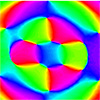
An elastic metamaterial can do math by directing motion through tiny pathways, showing how materials might one day handle simple computing tasks without electronics.
New research combines liquid crystals with metallic metasurfaces in a two-layer design, enabling electrically and thermally switchable displays and security features with superior color control.
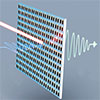
A new terahertz device achieves multi-state switching at unprecedented picosecond speeds, paving the way for advances in optical computing and next-generation communication systems.