

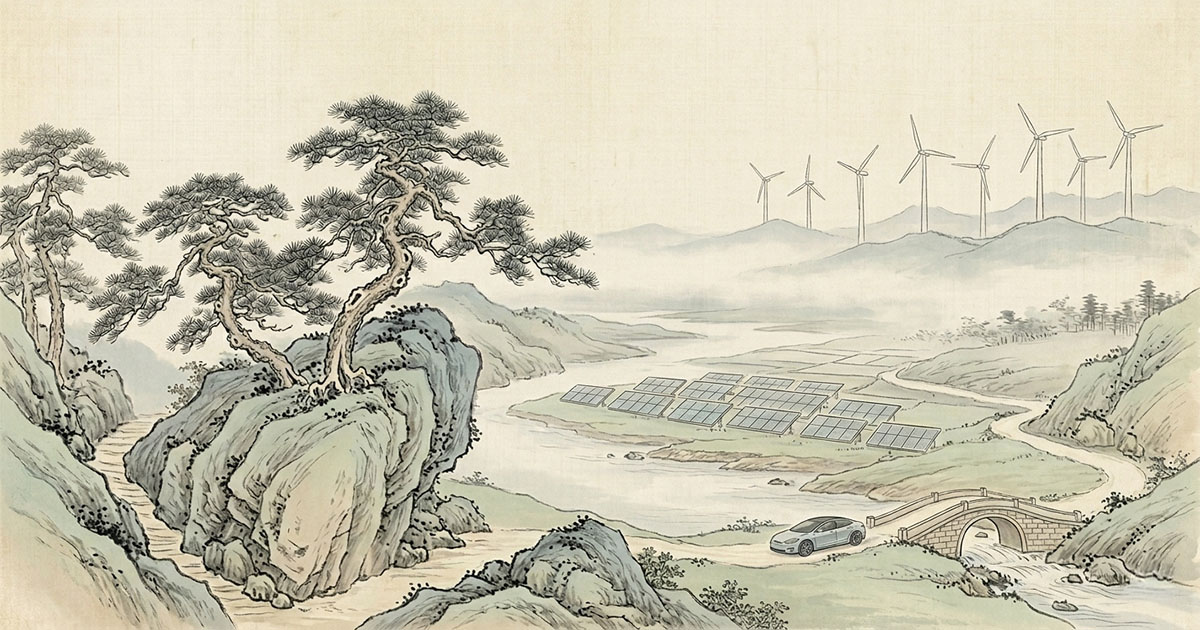
How nanotechnology underpins China's green energy dominance
A stage-by-stage guide to the nanoscale materials science behind the world’s most consequential supply chain
Contents
Introduction
In April 2025, China imposed export controls on lithium iron phosphate battery technology. In the months before that, it restricted exports of rare earth elements critical to wind turbines and electric vehicle motors. This was a demonstration of leverage that took decades to build and that traces, more than most commentators realize, to what happens at the nanoscale.
China’s hold on the green energy value chain is widely reported but poorly understood. The standard narrative focuses on subsidies, scale, and cheap labor. All of those matter. But they do not explain why, for example, China produces nearly all of the world’s lithium iron phosphate battery cathodes, or why it controls over 80% of solar panel manufacturing at every production stage, or why its companies are now the leading suppliers of grid-scale energy storage to countries on every continent. The deeper story is a materials science story, and much of it plays out at the nanoscale.
This guide follows the energy value chain from raw materials to end-of-life recycling. At each stage, we explain what nanotechnology does, where China leads, and, honestly, where the rest of the world has a realistic chance of competing and where it probably does not. We are not making a political argument. We are describing a supply chain reality that anyone interested in green energy, materials science, or geopolitics needs to understand at the level where it actually operates.
A necessary caveat: nanotechnology is one layer of China’s advantage, not the whole story. Industrial policy, state-directed capital, a vast domestic market, vertical integration across supply chains, and decades of workforce development all contributed. What this article adds to the standard analysis is the materials science dimension, which is underreported and, we believe, underestimated as a source of durable competitive advantage.
| Value chain stage | China’s approximate global share | Key nano-enabler |
|---|---|---|
| Raw material processing | ~90% rare earth separation and refining (IEA); ~70% lithium refining; ~65% anode graphite | Nanoscale separation, purification, and carbon coating of electrode materials |
| Solar PV manufacturing | ~97% wafers; ~85% cells; ~80% modules (IEA) | Nano-textured surfaces, anti-reflective coatings, ultra-thin passivation layers |
| Battery manufacturing | >80% of all lithium-ion cells; >90% of LFP grid storage | Carbon nanocoated LFP cathodes, nano-structured anodes and separators |
| Wind turbine magnets | >90% of NdFeB permanent magnets (higher for sintered high-performance grades) | Nanoscale grain engineering in sintered magnets |
| Grid hardware | Growing export share; dominant in transformers, cables | Nano-crystalline transformer cores, nanocomposite cable insulation |
| EVs | ~70% of global EV production; CATL and BYD alone hold >55% of battery installations | All of the above, integrated into a single vehicle platform |
| Recycling | Largest volume; regulatory leadership in EU | Nano-enabled hydrometallurgy, direct cathode recovery (emerging) |
Sources: IEA Solar PV Supply Chains; IEA Battery Markets 2026; SNE Research via CnEVPost; Mining Technology. Figures are approximate and reflect 2024 to 2025 data. “Share” refers to manufacturing or processing capacity, not consumption.
Raw materials and the battery supply chain: the foundation China built first
Rare earths, lithium, and the processing advantage
Every solar panel, wind turbine, battery, and electric motor in the green energy stack begins with raw materials. The list is short and strategically critical: lithium, cobalt, nickel, graphite, silicon, and rare earth elements such as neodymium, dysprosium, and terbium. China does not mine all of these, producing about 69% of the world’s rare earths (Mining Technology, 2025) and only about 13% of its lithium. But it dominates the processing stage, which is where the materials science happens and where nanoscale engineering becomes central.
China processes roughly 90% of the world’s rare earth elements, according to the International Energy Agency. It refines about 70% of global lithium into battery-grade material. It produces 85% of the world’s battery-grade phosphate and 65% of anode-grade graphite (industry estimates). These are not raw commodities. They are precision-engineered materials whose properties depend on particle size, surface chemistry, crystallographic structure, and purity, all of which are controlled at the molecular level.
Where nanotechnology meets mineral processing
Consider graphite, the anode material in virtually every lithium-ion battery. Natural graphite flakes must be purified to 99.95% carbon, spheroidized (shaped into uniform microspheres), and surface-coated with nanoscale carbon layers to improve electrochemical performance. The coating step is critical: it creates a stable solid-electrolyte interphase (SEI) layer that determines how efficiently lithium ions move in and out of the anode during charge and discharge cycles. Chinese processors have spent years optimizing these nanocoating techniques at industrial scale.
Rare earth processing tells a similar story. Separating individual rare earth elements from ore is a hydrometallurgical challenge that relies on solvent extraction at molecular scale. The separation factors between adjacent elements in the lanthanide series are extremely small, typically requiring hundreds of counter-current extraction stages to achieve commercial-grade purity (Chemistry World, 2026). Chinese facilities have refined these processes over three decades, building institutional knowledge that cannot be replicated quickly. The result: China produces over 300,000 tonnes of neodymium iron boron (NdFeB) permanent magnets annually, compared to roughly 1,000 tonnes in the United States (Resources for the Future, 2025).
Lithium refining follows the same pattern. Converting spodumene or lithium brine into battery-grade lithium hydroxide or lithium carbonate requires precise control of crystal nucleation and growth, particle size distribution, and impurity removal at parts-per-million levels. Chinese refiners have scaled these processes to a point where alternative suppliers in Australia, Chile, and the United States struggle to compete on cost or consistency.
The processing gap is the real bottleneck
Multiple countries have the geology to mine critical minerals. Australia has lithium. The United States and Brazil have rare earths. Canada has nickel and cobalt. The bottleneck is not in the ground. It is in the factory. Processing these minerals into battery-grade and magnet-grade materials at the required purity, particle size, and crystal structure is where China’s advantage sits, and it is a nanoscale materials engineering advantage, not a geological one.
Multiple countries have the geology to mine critical minerals. Australia has lithium. The United States and Brazil have rare earths. Canada has nickel and cobalt. The bottleneck is not in the ground. It is in the factory. Processing these minerals into battery-grade and magnet-grade materials at the required purity, particle size, and crystal structure is where China’s advantage sits, and it is a nanoscale materials engineering advantage, not a geological one.
With these processed materials in hand, the question becomes what gets manufactured from them, and who builds it.
Solar manufacturing, wind energy, and hydrogen: where the energy comes from
Solar photovoltaics: where nano built an empire
Solar panel manufacturing is China’s most complete industrial victory in the green energy space. According to the IEA, China’s share in all manufacturing stages of solar panels (polysilicon, ingots, wafers, cells, and modules) exceeds 80%. For wafers specifically, the figure is around 98%. This dominance is more than double China’s share of global photovoltaic demand, revealing structural overcapacity built for export.
The nanoscale engineering inside a modern silicon solar cell is extensive. The cell surface is textured with nanoscale pyramids or inverted pyramids that reduce reflectance and trap incoming light, increasing the number of photons that reach the active layer. Anti-reflective coatings, typically silicon nitride films deposited at precisely controlled thicknesses of 70 to 80 nanometers, further minimize losses. Passivation layers, ultra-thin dielectric films that reduce electron recombination at the silicon surface, have been a major driver of efficiency gains over the past decade. The most advanced commercial cells now use tunnel oxide passivated contact (TOPCon) architectures, where a silicon oxide layer just 1 to 2 nanometers thick separates the silicon absorber from the contact layer.
Chinese manufacturers have moved to TOPCon faster than competitors in any other country, converting production lines at a pace that reflects both the scale of domestic investment and the intensity of internal competition. The result is a cost per watt that non-Chinese manufacturers find extremely difficult to match.
Perovskite solar cells: the next generation, and China is already there
Perovskite solar cells are the most important development in photovoltaics since silicon. They use a nanocrystalline material with the crystal structure ABX3 that can be deposited as a thin-film at low temperatures, potentially at a fraction of the cost of silicon. The most commercially promising configuration is a tandem cell: a perovskite layer on top of a silicon cell, with each layer capturing a different part of the light spectrum. The current NREL-certified world record for a perovskite-silicon tandem cell is 34.85%, set by LONGi in April 2025, compared to around 23 to 24% for commercial silicon panels.
China holds almost 76% of all perovskite solar cell patents globally, with over 33,300 related patents as of October 2025 (PatSnap data). Japan is a distant second with 5,235 patents, followed by the United States with 2,168, South Korea with 1,182 and Germany with 590 patents. In academic publications, the picture is similar: Chinese institutions lead the research output. Several Chinese companies, including GCL Optoelectronic Materials, Microquanta Semiconductor, and Renshine Solar, are already selling perovskite panels at pilot scale, with gigawatt-scale factory plans announced for 2025 and beyond. Government support allows Chinese labs to bring research results to market in under two years, compared to up to five years elsewhere (Chemical & Engineering News, 2025).
The durability challenge remains: perovskite cells degrade faster than silicon when exposed to moisture and heat, and scaling from small laboratory cells to large commercial modules introduces efficiency losses. But the trajectory is clear. This is not a technology where other countries are likely to leapfrog China. The research pipeline, the patent landscape, the manufacturing infrastructure, and the supply chain for precursor materials all favor Chinese producers.
Wind energy: nanocoatings and rare earth magnets
Wind energy is less often discussed as a nanotechnology story, but two critical components are nano-enabled. The first is turbine blade coatings. Modern blades exceed 80 meters in length and operate in harsh environments. Nano-engineered coatings, specifically hydrophobic, anti-icing, and erosion-resistant surface treatments using nanocomposite materials, are commercially deployed on some turbine models and extend blade life and maintain aerodynamic efficiency. Carbon nanotube-reinforced polymer composites are being explored for lighter, stronger blade structures, though this remains largely at research stage.
The second component is permanent magnets. Direct-drive wind turbines (which eliminate the gearbox, reducing maintenance and improving reliability) rely on powerful NdFeB magnets made from rare earth elements. The magnetic properties of these materials are engineered at the atomic level: grain size, grain boundary composition, and microstructural alignment all determine performance. As noted above, China manufactures over 90% of the world’s NdFeB magnets, with an even higher share of the high-performance sintered grades used in wind turbines and EV motors. Without access to Chinese magnets or a viable domestic alternative, no country can manufacture direct-drive wind turbines at scale.
Hydrogen production: nano-catalysts and an open race
Green hydrogen, produced by splitting water using renewable electricity, is one of the few areas of the energy value chain where the competitive landscape is genuinely open. The key technology is the electrolyzer, and its performance depends heavily on nano-catalysts that accelerate the water-splitting reaction.
Three electrolyzer types compete commercially, and the nano-engineering challenges differ for each. Alkaline electrolyzers, the oldest and cheapest design, use nickel-based electrodes and a potassium hydroxide electrolyte. Their catalysts are relatively inexpensive, but improving their efficiency at high current densities requires nano-structured electrode surfaces with higher active area and better gas-bubble management. China dominates alkaline electrolyzer manufacturing, producing units at costs that European and American competitors find difficult to match. Proton exchange membrane (PEM) electrolyzers offer faster response times and higher current densities, making them better suited for coupling with intermittent renewables, but they depend on iridium and platinum catalysts that are expensive and supply-constrained (South Africa produces about 70% of the world’s platinum). Reducing or eliminating that precious-metal dependence through nano-engineered alternatives is the central research challenge. Solid oxide electrolyzers, which operate at high temperatures and can achieve the highest efficiencies, use ceramic electrolytes with nano-scale grain structures that determine ionic conductivity and long-term durability. They are the least mature commercially but have strong research programs in Europe and Japan.
Across all three types, a major research effort in multiple countries is focused on developing nano-structured non-precious-metal catalysts, based on metal oxides, transition metal compounds, and single-atom catalyst architectures, that can match the performance of platinum-group metals at a fraction of the cost. This work is active in Europe, Japan, South Korea, and the United States, not just China.
Case study: Reducing iridium dependence in PEM electrolyzers
In December 2024, a team at Germany’s Helmholtz-Zentrum Berlin (HZB) published results showing that a newly developed catalyst, called P2X, uses only one quarter of the iridium of the best commercial benchmark while matching its efficiency and long-term stability. The key: an amorphous nanostructure that creates a more active chemical environment for the oxygen evolution reaction during water splitting. Separately, researchers at Forschungszentrum Jülich developed a scalable photodeposition method to create TiO2@IrOx core-shell catalysts with iridium loadings as low as 40% by weight. These are laboratory-stage results, not yet in commercial electrolyzers, but they illustrate that the nano-catalyst frontier in hydrogen is genuinely contested outside China.
In December 2024, a team at Germany’s Helmholtz-Zentrum Berlin (HZB) published results showing that a newly developed catalyst, called P2X, uses only one quarter of the iridium of the best commercial benchmark while matching its efficiency and long-term stability. The key: an amorphous nanostructure that creates a more active chemical environment for the oxygen evolution reaction during water splitting. Separately, researchers at Forschungszentrum Jülich developed a scalable photodeposition method to create TiO2@IrOx core-shell catalysts with iridium loadings as low as 40% by weight. These are laboratory-stage results, not yet in commercial electrolyzers, but they illustrate that the nano-catalyst frontier in hydrogen is genuinely contested outside China.
However, China is also investing heavily. It has the world’s largest installed electrolyzer capacity and is scaling alkaline electrolyzer manufacturing rapidly. The competition in hydrogen is more distributed than in solar or batteries, but the window for other countries to establish a lasting advantage is narrowing. The question is whether Western and Japanese research leads in PEM and solid oxide technology can be translated into manufacturing positions before Chinese companies close the gap, as they have done repeatedly in solar and batteries.
Generating renewable electricity is only half the problem. The other half is storing it until it is needed, and that is where China’s position is strongest of all.
LFP batteries and energy storage: China’s deepest moat
Lithium-ion batteries and the LFP revolution
Energy storage is where China’s lead is most pronounced and most consequential. The country manufactures over 80% of all lithium-ion batteries globally. For grid-scale energy storage, which overwhelmingly uses lithium iron phosphate (LFP) chemistry, the concentration is even more extreme: more than 90% of grid storage batteries are LFP cells supplied almost exclusively from China, according to the IEA.
The LFP story is, at its core, a nanotechnology story. Lithium iron phosphate as a cathode material has an inherent disadvantage: its electrical conductivity is extremely low compared to nickel-based cathode chemistries. In its bulk form, it would make a poor battery electrode. The breakthrough that made LFP viable for commercial batteries was nano-engineering: coating each cathode particle with a nanoscale layer of conductive carbon and reducing the particle size to the nanoscale, which shortens the distance lithium ions must travel within the particle. This combination of nanoparticle sizing and carbon nanocoating transformed an unpromising material into the leading chemistry for grid storage and an increasingly popular choice for electric vehicles.
Chinese companies, led by CATL and BYD, perfected this nano-engineering at manufacturing scale. The raw materials for LFP cathodes (iron, phosphate) are globally abundant commodity chemicals that cost a fraction of the supply-constrained nickel and cobalt used in competing chemistries. The nano-processing is the value-added step, and China holds that capability. In 2025, China imposed export controls on LFP cathode technology, a clear signal of how strategically the government views this capability.
Case study: CATL’s fifth-generation LFP battery
In April 2024, CATL introduced its Shenxing PLUS LFP battery, reporting an energy density of 205 Wh/kg and marking the first time LFP chemistry surpassed the 200 Wh/kg threshold. In November 2025, the company subsequently began mass production of its fifth-generation LFP cells. Together, these developments indicate a narrowing performance gap between LFP and nickel-manganese-cobalt (NMC) battery chemistries, which have traditionally offered higher energy density.The improvement comes from continued refinement of nanoscale carbon coatings, particle morphology, and cell-level structural optimization. CATL operates 13 production facilities worldwide, employs nearly 150,000 people, and its recycling subsidiary Brunp achieved a 96% recovery rate on over 120,000 tonnes of waste batteries processed in 2024. This is what industrial-scale nano-engineering looks like in practice.
In April 2024, CATL introduced its Shenxing PLUS LFP battery, reporting an energy density of 205 Wh/kg and marking the first time LFP chemistry surpassed the 200 Wh/kg threshold. In November 2025, the company subsequently began mass production of its fifth-generation LFP cells. Together, these developments indicate a narrowing performance gap between LFP and nickel-manganese-cobalt (NMC) battery chemistries, which have traditionally offered higher energy density.The improvement comes from continued refinement of nanoscale carbon coatings, particle morphology, and cell-level structural optimization. CATL operates 13 production facilities worldwide, employs nearly 150,000 people, and its recycling subsidiary Brunp achieved a 96% recovery rate on over 120,000 tonnes of waste batteries processed in 2024. This is what industrial-scale nano-engineering looks like in practice.
What nanotechnology does inside a battery
Beyond cathode chemistry, nanotechnology is embedded throughout a modern lithium-ion cell. On the anode side, silicon nanowires and silicon nanoparticles are being explored (at pilot and early commercial stage) to increase energy density: silicon can store roughly ten times more lithium per unit mass than conventional graphite, but it swells dramatically during charging. Nano-structuring the silicon (using nanowires, porous nanoparticles, or silicon-carbon nanocomposites) accommodates this expansion and prevents the electrode from cracking. Several manufacturers now incorporate small percentages of nano-silicon into graphite anodes in commercial cells, though pure silicon anodes remain at the research and pilot stage.
The separator (the membrane between anode and cathode that prevents short circuits) is another nano-engineered component. Ceramic nanoparticle coatings on polymer separators improve thermal stability and mechanical strength, reducing the risk of thermal runaway (the chain reaction that causes battery fires). Nano-engineered electrolyte additives form stable interfacial layers on electrode surfaces, extending cycle life.
Graphene and carbon nanotubes are used as conductive additives in both electrodes, improving electron transport and enabling faster charging. The term “graphene battery” as used in consumer marketing is misleading: no commercial battery uses graphene as its primary electrode material yet. But graphene-enhanced components are a real and growing part of the battery supply chain. For a detailed assessment, see Nanowerk’s graphene batteries explainer.
Solid-state batteries: the next frontier
Solid-state batteries replace the liquid electrolyte in conventional lithium-ion cells with a solid material, typically a ceramic or sulfide, that is both safer (no flammable liquid) and potentially enables higher energy density (by allowing the use of a lithium metal anode). The solid electrolyte layer must be kept as thin as possible (on the order of tens of micrometers) to minimize ionic resistance, and the interface between electrolyte and electrodes must be engineered at the nanoscale to ensure good ionic contact without the dendrite growth that can short-circuit the cell.
This is one area where Japan and South Korea hold significant intellectual property and pilot-stage capability. Toyota has announced plans for commercial solid-state batteries by the late 2020s. Samsung SDI and LG Energy Solution are both investing heavily. The technology is at pilot stage, not yet mass production, which means the manufacturing base has not yet been locked down the way it has for LFP.
Whether that window stays open is the critical question. China is also pouring resources into solid-state research (Shanghai Metals Market), and its track record suggests that once a technology reaches the manufacturing scale-up phase, Chinese companies can move faster than almost anyone.
Beyond lithium: sodium-ion and supercapacitors
Sodium-ion batteries are emerging as a cheaper alternative to lithium-ion for stationary storage. Sodium is abundant and inexpensive, and the cell architecture is similar enough to lithium-ion that existing manufacturing lines can be adapted. The nano-engineering challenge is in the anode: sodium ions are larger than lithium ions and require electrode structures with bigger interstitial spaces. Hard carbon with precisely controlled nanoscale porosity is the leading anode material, and Chinese companies (including CATL, which has announced a sodium-ion product line) are at the forefront of commercializing it.
Supercapacitors occupy a different niche: they charge and discharge in seconds rather than hours, making them useful for grid frequency regulation and regenerative braking. Graphene-based and carbon nanotube electrodes with extremely high surface area are the key nano-enabled component. Commercial supercapacitors exist today, but their energy density remains far lower than batteries, limiting them to applications where speed matters more than storage capacity.
A battery is useless without a grid to connect it to. The infrastructure that moves electricity from source to user is the next link in the chain, and it is more nano-intensive than most people realize.
Grid hardware and power electronics: the infrastructure nobody talks about
Transformers and cables: where nano saves gigawatts
The grid is the least glamorous part of the energy value chain and one of the most consequential. Every kilowatt-hour lost in transmission is a kilowatt-hour that had to be generated, stored, and paid for. The components that determine grid efficiency, including transformers, high-voltage cables, and switchgear, are increasingly supplied by Chinese manufacturers expanding aggressively into overseas markets as countries upgrade their grids for renewable energy and AI-driven demand.
The nano-engineering inside these components is hidden but significant. High-efficiency power transformers use nano-crystalline soft magnetic alloys for their cores: iron-based ribbons with grain sizes of 10 to 20 nanometers, produced by rapid solidification from the melt. These nanocrystalline materials have lower hysteresis and eddy-current losses than conventional grain-oriented silicon steel, reducing the energy wasted as heat during every magnetic cycle. Over the lifetime of a grid transformer (often 30 to 40 years), the cumulative energy savings are substantial. Chinese and Japanese manufacturers (Hitachi Metals, now Proterial, developed the original FINEMET nanocrystalline alloy; Chinese firms such as AT&M (Advanced Technology & Materials), which licensed the Hitachi patents and now produces over 3,000 tonnes of nanocrystalline ribbon annually, have scaled competing products.
High-voltage direct current (HVDC) cables, essential for moving renewable power over long distances, use nanocomposite insulation. Adding nano-silica or nano-alumina particles to the cross-linked polyethylene insulation improves dielectric strength, thermal conductivity, and resistance to electrical treeing, the branching degradation patterns that eventually cause cable failure. This is a materials science problem solved at the materials science level, and it determines whether a cable can operate reliably at 800 kV or above for decades.
Grid-scale sensors using carbon nanotube or graphene-based sensing elements for real-time monitoring of temperature, strain, and partial discharge are a growing market where European, US, and Japanese companies are active alongside Chinese firms. Power inverters, which convert DC from solar panels and batteries into AC for the grid, increasingly use wide-bandgap semiconductors (silicon carbide and gallium nitride) with nanoscale device architectures that achieve higher switching frequencies and lower losses. Chinese companies, notably Sungrow and Huawei, are among the world’s largest inverter manufacturers. The inverter and sensor markets are more competitive than batteries or solar cells, but Chinese firms are increasingly bundling software with competitively priced hardware, making it harder for competitors to monetize software expertise independently.
Energy usage: where the power goes
Electric vehicles: China’s most visible export
The electric vehicle market is the most consumer-visible expression of China’s green energy lead. BYD surpassed Tesla in 2024 to become the world’s largest electric vehicle maker. For the full year 2025, global EV battery installations reached 1,187 GWh, a 31.7% increase over 2024. CATL and BYD alone accounted for more than 55% of that total, with CATL at 39.2% market share and BYD at 16.4% (SNE Research via CnEVPost, 2026). Counting all Chinese battery manufacturers together, the share exceeds two-thirds of global installations.
The EV is a platform for the entire upstream value chain described in this guide. The rare earth magnets in the motor, the LFP or nickel-based cells in the battery pack, the nanocoated graphite anodes, the nano-engineered separators, the carbon nanotube-reinforced structural composites for weight reduction, the nano-thermal interface materials that manage heat transfer between battery and cooling system. All of these converge in a single product, and the supply chain for most of them runs through China.
The demand side extends beyond vehicles. The explosive growth of artificial intelligence is creating data center power requirements on a scale that few predicted, driving new investment in grid infrastructure, backup battery storage, and cooling systems that all draw on Chinese-manufactured components. Nano-enabled building materials (electrochromic smart windows, aerogel insulation, quantum dot-enhanced LED lighting) represent a further frontier where the science is proven and early commercial products exist, but deployment has not yet reached the scale where it significantly shifts global energy consumption.
Every battery, solar panel, and magnet described in this guide eventually reaches end of life. What happens then determines whether the green energy transition creates new dependencies or begins to close the loop.
Recycling and end-of-life: closing the loop
The battery recycling imperative
The green energy transition creates a waste problem that is only beginning to be addressed. The first large wave of EV and grid storage batteries will reach end-of-life in the late 2020s and early 2030s. Without effective recycling, the demand for virgin lithium, cobalt, nickel, and other materials will intensify the very mining and processing dependencies this guide has described.
Nano-enabled recycling technologies are emerging. The conventional approach, pyrometallurgy, smelts spent cells at high temperatures to recover metals, but destroys the cathode structure and loses lithium in slag. The alternative, hydrometallurgy, uses chemical leaching to dissolve and selectively recover metals from the intermediate product known as black mass (the shredded and dried remains of battery cells). Nano-structured sorbents and selective nano-membranes can improve the selectivity and efficiency of these leaching steps, recovering lithium, cobalt, and nickel with lower energy input and less chemical waste. The most promising frontier is direct cathode recycling, which recovers and re-lithiates the cathode material without breaking it down to its elemental components, preserving the engineered nanostructure of the cathode particles and dramatically reducing the energy and cost of reprocessing.
This is an area where Europe has a regulatory advantage. The EU Battery Regulation, which took effect in stages from 2024, sets mandatory recycling efficiency targets and minimum recycled-content requirements for new batteries sold in Europe. These regulations are driving investment in European recycling capacity and creating incentives for the development of advanced recycling technologies. China leads in recycling volume (it has more batteries to recycle), but the regulatory and technological competition is more balanced here than in manufacturing.
Where the competition is still open, and where it probably is not
Where the papers are being written
Any honest assessment of where other countries can compete with China must start with the research base. In 2024, more than 256,000 nanotechnology-related articles were indexed in the Web of Science (WoS) database, with China accounting for 46% of them — more than 100,000 articles for the third consecutive year. The 2025 Quadrennial Review of the National Nanotechnology Initiative by the U.S. National Academies of Sciences, Engineering, and Medicine confirmed that China now far outpaces both the United States and Europe in nanotechnology papers, and the same is true for patents. India, which surpassed the United States in 2022, held second place; the United States, which led the world in nanotechnology publications as recently as 2011, was third. In energy-specific nanotechnology research, the concentration is even starker: the top five affiliations publishing in the journal Energy Storage Materials are all Chinese institutions, led by the Chinese Academy of Sciences, followed by Tsinghua University, the University of Science and Technology of China, the Harbin Institute of Technology, and Tianjin University. The NSF's own Science & Engineering Indicators 2025 report noted that China's overall publication output was more than double that of the United States in 2023, and that Chinese authors accounted for more than half of the growth in annual global publication output from 2014 to 2023.
In perovskite solar cells, China holds 76% of global patents and leads academic output. In lithium-ion battery nanotechnology for electric vehicles, a bibliometric analysis covering 2001 to 2024 found that China contributed 46.5% of all research publications (Discover Sustainability, 2025). In rare earth magnet science, Chinese institutions are the leading publishers. The pattern is consistent: China is not just manufacturing green energy technology at scale, it is increasingly generating the fundamental and applied research that determines what comes next.
This matters because research volume tends to predict commercial advantage with a lag of five to ten years. A caveat is warranted: publication volume is not the same as frontier innovation. The United States still leads in average citations per paper and in publications in the highest-impact journals. Japanese and Korean labs hold leading positions in specific subfields such as solid-state electrolytes and perovskite stability engineering. Cutting-edge materials science research remains globally distributed. But the sheer scale of China’s output means that even at a lower average impact, the absolute number of high-quality papers is large and growing. The papers being published today are the products and manufacturing processes of the early 2030s.
Where it is probably too late
Three areas stand out where China’s position is, for practical purposes, locked in for the next decade or more:
Silicon solar cell manufacturing: over 80% share at every production stage, with a cost, scale, and equipment ecosystem that alternative suppliers cannot replicate within a decade. Tariffs can shift module assembly; the upstream components will remain overwhelmingly Chinese.
LFP batteries: China holds the cathode material supply chain, the nano-processing know-how, and the cell manufacturing. Korean producers are investing, but against established, lower-cost competitors in an oversupplied market.
Rare earth magnets: over 90% of global NdFeB production, and a near-monopoly on the high-performance sintered grades. Alternative sources (Lynas, MP Materials) are a rounding error. Experts estimate a decade to build competitive processing elsewhere.
Perovskite solar cells are a borderline case. The technology is not yet manufactured at volume, so this is not a locked-in advantage in the way silicon PV or LFP batteries are. But the trajectory is strongly in China’s favor: 76% of global patents, a commanding lead in publications, and a demonstrated ability to move from lab to factory faster than competitors. If that trajectory holds, this will follow the same path as silicon PV. The window for other countries to establish a serious manufacturing position in perovskites is narrowing, but it has not yet closed.
Where there is a genuine opening
Solid-state batteries. This is the most credible technology race that is not yet decided — but the window is narrowing. Annual patent applications in the field surged from 302 in 2017 to 1,288 in 2025 (PatSnap, 2026). Japan and South Korea hold the strongest intellectual property positions in terms of high-value patents: LG Energy Solution leads with 77 key patents in core technologies, Toyota has roughly 1,800 patent families overall, and Japanese firms collectively account for 43% of commercial solid-state battery patents (CAS, 2026). Toyota, Panasonic, Samsung SDI, and LG Energy Solution are all running pilot lines targeting mass production by 2027–2028. The manufacturing processes are fundamentally different from liquid-electrolyte lithium-ion cells, so China's existing factory dominance does not automatically transfer. The nano-engineering challenges — particularly stable electrode-electrolyte interfaces at scale — remain unsolved, and the breakthrough could come from any of several research traditions.
But measured by sheer volume of filings, China has already overtaken Japan. As recently as October 2023, Chinese companies held fewer than 100 all-solid-state battery patents collectively. By 2025, cumulative Chinese patents in the field reached 6,312 — 44% of the global total — surpassing Japan's 3,331, according to industry reports. CATL is already at the 20Ah sample trial-production stage. China's strategy is pragmatic: commercialize semi-solid-state batteries first, then advance to all-solid-state leveraging the world's largest EV market. The United States accounts for just 8% of commercial patent activity in this space. The window for competitors may not stay open much longer.
Battery recycling. Regulatory mandates in Europe are creating demand for advanced recycling technology that China has not yet locked in. The science of direct cathode recycling (recovering nano-engineered cathode materials intact rather than smelting them) is still developing, and North American companies such as Redwood Materials and Li-Cycle have early-mover positions. Europe’s path has been rougher: Northvolt, once the continent’s flagship battery maker, filed for bankruptcy in March 2025; its Revolt recycling subsidiary was wound up in May 2025 after no buyer materialized. US lithium-sulfur startup Lyten signed a binding agreement in August 2025 to acquire the remaining Northvolt assets in Sweden and Germany, with the acquisition finally completing in February 2026. The episode underscores both the difficulty of competing with Chinese battery manufacturing and the fragility of Europe’s industrial base in this sector. The economics of recycling will ultimately depend on battery volumes, which are growing everywhere, not just in China.
Grid-scale software and AI. Grid management, demand response, and energy trading platforms are software businesses where China does not have the same structural advantage it enjoys in hardware. Western companies have deep expertise in AI, optimization algorithms, and cybersecurity-compliant enterprise software. The challenge is that Chinese companies increasingly bundle software with competitively priced hardware, making the software advantage harder to monetize independently.
The policy response so far
Governments are not standing still. The US Inflation Reduction Act (IRA), signed in 2022, directs hundreds of billions of dollars toward domestic clean energy manufacturing, including battery production and critical mineral processing, with tax credits tied to domestic content requirements. The EU Critical Raw Materials Act, adopted in 2024, sets targets for domestic extraction, processing, and recycling of strategic materials, including a goal of processing 40% of the EU’s annual consumption within the bloc by 2030. India’s Production Linked Incentive (PLI) scheme is subsidizing domestic solar cell and battery manufacturing, and India has already overtaken Southeast Asia as the second-largest solar module production region.
These are serious efforts, but they face a structural problem: policy can accelerate factory construction, but it cannot fast-track the materials science expertise, the process engineering know-how, or the trained workforce that underpin competitive manufacturing. China spent decades building those foundations. The policy response is necessary but not sufficient, and the gap between ambition and operational reality remains wide.
A note on the publication gap
China’s 46% share of global nanotechnology publications is not just a volume metric. Publication counts correlate, imperfectly but meaningfully, with the depth of the trained workforce, the breadth of institutional knowledge, and the speed at which laboratory results can be translated into manufacturing processes. Countries that produce fewer papers in a field typically produce fewer engineers and scientists with hands-on expertise in that field. This is the less visible dimension of the competitive landscape, and it is arguably the hardest to reverse.
China’s 46% share of global nanotechnology publications is not just a volume metric. Publication counts correlate, imperfectly but meaningfully, with the depth of the trained workforce, the breadth of institutional knowledge, and the speed at which laboratory results can be translated into manufacturing processes. Countries that produce fewer papers in a field typically produce fewer engineers and scientists with hands-on expertise in that field. This is the less visible dimension of the competitive landscape, and it is arguably the hardest to reverse.
Where this is going
Within three to five years, tandem perovskite-silicon solar cells are likely to reach volume commercial production at module efficiencies in the high 20s, with certified cell-level records at 34.85%. The first mass-market solid-state battery EVs may appear, though widespread adoption will take longer. Sodium-ion batteries should become cost-competitive with LFP for stationary storage, broadening the range of countries that can source battery materials domestically. Hydrogen electrolyzer costs will continue to fall as non-precious-metal nano-catalysts improve, and grid-scale deployment of nano-enabled sensors will make renewable-heavy grids more manageable.
The geopolitical question underneath all of this is whether the world’s transition to clean energy will also be a transition to deeper dependence on Chinese manufacturing. Countries are realizing, with increasing discomfort, that the path to energy independence through renewables runs through the very supply chain dependencies they are trying to escape.
The honest conclusion from a materials science perspective is that this dependency was built over decades through sustained investment, fierce domestic competition, strategic industrial policy, and deep nanoscale engineering expertise. It will not be unwound by tariff schedules or policy announcements. The few openings that remain (solid-state batteries, hydrogen catalysts, recycling, software) are real but narrow, and they require the same kind of patient, science-first investment that built China’s position in the first place.
A note on “green” and nanomaterials
It would be incomplete to discuss nanotechnology in green energy without noting that “green” technology is not automatically green at the materials level. Some engineered nanomaterials, including certain metal oxide nanoparticles and carbon nanotubes, have uncertain toxicity profiles and poorly understood environmental persistence. The lifecycle impacts of manufacturing, deploying, and eventually disposing of nano-enabled components (coatings, electrode additives, composite reinforcements) are an active area of research, not a settled question. The energy and chemical inputs required to produce nanomaterials at industrial scale also carry their own environmental footprint. This does not diminish the case for nano-enabled clean energy, but it does mean the full lifecycle picture deserves the same scrutiny we apply to the technologies nanotechnology is replacing.
It would be incomplete to discuss nanotechnology in green energy without noting that “green” technology is not automatically green at the materials level. Some engineered nanomaterials, including certain metal oxide nanoparticles and carbon nanotubes, have uncertain toxicity profiles and poorly understood environmental persistence. The lifecycle impacts of manufacturing, deploying, and eventually disposing of nano-enabled components (coatings, electrode additives, composite reinforcements) are an active area of research, not a settled question. The energy and chemical inputs required to produce nanomaterials at industrial scale also carry their own environmental footprint. This does not diminish the case for nano-enabled clean energy, but it does mean the full lifecycle picture deserves the same scrutiny we apply to the technologies nanotechnology is replacing.
About this guide
This article is part of Nanowerk’s evidence reviews series. Data on market shares, production volumes, and patent counts are sourced from the International Energy Agency, industry databases, and peer-reviewed bibliometric analyses, cited inline. Where specific figures are approximate or contested across sources, we note that. Our editorial standard is accuracy and honesty, not advocacy for any country or technology.
This article is part of Nanowerk’s evidence reviews series. Data on market shares, production volumes, and patent counts are sourced from the International Energy Agency, industry databases, and peer-reviewed bibliometric analyses, cited inline. Where specific figures are approximate or contested across sources, we note that. Our editorial standard is accuracy and honesty, not advocacy for any country or technology.