Plasmonics and Plasmons
Plasmons are collective oscillations of free electrons in a conductor. Plasmonics is the field that uses these oscillations, especially at metal–dielectric interfaces and in metallic nanoparticles, to confine, guide, and enhance light at nanometer length scales below the wavelength of light.
Related concepts: surface plasmons, surface plasmon polaritons, localized surface plasmon resonance, plasmon resonance, plasmonic optics, nanoplasmonics.
In practice, surface plasmon resonance usually refers to propagating surface plasmon polaritons on a thin metal film, while localized surface plasmon resonance refers to resonances confined to nanoparticles or nanoscale structures.
| Key term | A plasmon is a quantum of collective oscillation of conduction electrons in a metal or semiconductor. |
|---|---|
| Plasmonics | The science and technology of controlling light using plasmons in nanostructured conductors. |
| Main types | Bulk (volume) plasmons, surface plasmon polaritons, and localized surface plasmons. |
| Typical materials | Gold, silver, aluminum, copper, doped semiconductors, graphene. |
| Length scale | Field confinement of 10–100 nm, well below visible wavelengths. |
| Main uses | Biosensing, surface-enhanced spectroscopy, photothermal therapy, photocatalysis, metamaterials, solar cells, color generation. |
On this page: Definition Types of plasmons Physics of plasmon resonance Plasmonic materials How plasmons are excited Applications Comparison Challenges FAQ
What Are Plasmons and What Is Plasmonics?
A plasmon is the quantum of a collective oscillation of free electrons in a conductor, in much the same way that a phonon is the quantum of a lattice vibration and a photon is the quantum of the electromagnetic field. When a metal is illuminated, the conduction electrons can oscillate coherently against the fixed positive ion cores, producing a charge-density wave whose energy and momentum are described as a plasmon.
Plasmonics is the branch of nanophotonics concerned with these oscillations and with how they couple to light. By patterning metals at the nanoscale, optical fields can be confined to volumes only tens of nanometers across, well below the 400–700 nm wavelengths of visible light. This near-field confinement bypasses the usual far-field diffraction limit and produces strong local electric fields, often called “hot spots,” that underpin many of the most striking effects in plasmonic systems.
The field sits at the intersection of optics, condensed-matter physics, and chemistry. Although the name plasmonics dates from the early 2000s, plasmonic effects have been exploited unintentionally since at least the 4th century AD. The dichroic Roman Lycurgus Cup, which appears green in reflected light and red in transmitted light, owes its color to gold and silver nanoparticles whose localized surface plasmon resonance selectively absorbs and scatters visible wavelengths.
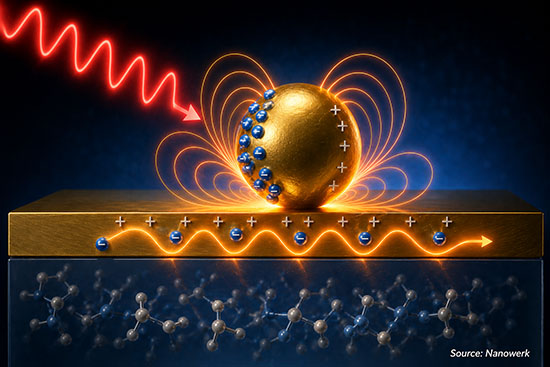
What Are the Different Types of Plasmons?
Three classes of plasmonic excitation are distinguished by their geometry and how they couple to light.
Bulk (volume) plasmons are longitudinal density waves of conduction electrons in the interior of a metal. They cannot couple directly to transverse free-space light and are usually probed by inelastic scattering of fast electrons in electron energy-loss spectroscopy. Their energies typically lie several to fifteen electron-volts in the ultraviolet, and they are responsible for the characteristic energy-loss peaks observed in fast-electron spectra of simple metals.
Surface plasmon polaritons (SPPs) are electromagnetic modes that propagate along a metal–dielectric interface, with field amplitude decaying exponentially into both media. Their dispersion relation lies to the right of the light line, meaning they cannot be excited by direct illumination of a flat surface; momentum-matching techniques such as a prism in the Kretschmann configuration, a periodic grating, or a sharp near-field probe are required.
Localized surface plasmons (LSPs) are non-propagating oscillations confined to metal nanoparticles smaller than the wavelength of light. Unlike SPPs, LSPs couple to free-space light directly and produce strong absorption and scattering at the LSP resonance frequency. The resonance position depends sensitively on the nanoparticle composition, size, shape, and surrounding dielectric environment, which is the basis for tuning plasmonic nanoparticles across the visible and near-infrared.
The Physics Behind Plasmon Resonance
In the simplest description, the Drude model treats the conduction electrons of a metal as a free electron gas. The natural oscillation frequency of this gas, the plasma frequency ωp, is set by the electron density, charge, mass, and vacuum permittivity, and lies in the ultraviolet for most metals. Below this frequency the dielectric function is negative and the metal is highly reflective; above it the metal becomes transparent. A plasmon is the quantum of this collective oscillation, with an energy proportional to the plasma frequency.
For a small spherical metal nanoparticle in a dielectric medium, the quasistatic resonance condition for the localized plasmon is reached when the real part of the metal’s dielectric function equals −2 times that of the surrounding medium. For a 20-nm gold sphere in water, this gives a resonance near 520 nm, producing the characteristic ruby color of colloidal gold that Michael Faraday first studied in 1857. Elongation into a nanorod, dimerization into a coupled pair, or core–shell architectures shifts the resonance from the visible into the near-infrared, allowing access to the biological transparency window for medical applications.
SPPs at a flat metal–dielectric interface obey a more general dispersion relation that depends on the dielectric functions of both media. Near optical frequencies, SPP wavelengths are shorter than the free-space wavelength, which is what makes them attractive for subwavelength optics. Ohmic losses cause SPPs to decay as they propagate, with characteristic propagation lengths ranging from microns at visible frequencies to centimeters in the mid-infrared.
Which Materials Are Used in Plasmonics?
Gold and silver dominate visible-light plasmonics. Silver gives the strongest field enhancement and the narrowest resonances but tarnishes in air; gold is chemically stable and biocompatible but absorbs more strongly in the blue. Copper supports plasmonic resonances in the red and near-infrared and offers a lower-cost alternative, while aluminum extends plasmonic operation into the deep ultraviolet and is compatible with standard semiconductor manufacturing.
Beyond the noble metals, doped semiconductors and conductive oxides such as indium tin oxide and aluminum-doped zinc oxide support plasmonic resonances in the near- to mid-infrared, with carrier densities and resonance frequencies that can be tuned by chemical doping or applied bias. Highly doped graphene hosts plasmons at terahertz to mid-infrared frequencies whose dispersion can be electrostatically gated, a feature unavailable in conventional metals. Refractory plasmonic materials such as titanium nitride combine gold-like optical response with high-temperature stability and CMOS compatibility, while chiral plasmonic structures exhibit a response that depends on the handedness of the incident light. The choice of material always reflects a trade-off between resonance wavelength, optical losses, environmental stability, and integration with the rest of the device.
How Plasmons Are Excited and Detected
Coupling free-space light to SPPs requires bridging the momentum mismatch between photons and surface plasmons. The Kretschmann prism configuration uses total internal reflection to create an evanescent wave whose in-plane wavevector matches the SPP dispersion at a particular angle, while gratings, defects, and sharp near-field optical probes provide alternative routes to supply the missing momentum. Localized plasmons in nanoparticles couple directly to free-space light because their finite size relaxes the strict momentum-conservation requirement that constrains SPPs.
Plasmonic excitations are characterized by an array of optical and electronic methods. UV-visible spectroscopy reveals LSPR peaks in colloidal samples, dark-field microscopy images single nanoparticles by their scattered light, and SERS and surface-enhanced infrared absorption spectroscopy exploit the local-field enhancement to fingerprint adsorbed molecules. Near-field optical microscopy and tip-enhanced techniques map the spatial distribution of plasmonic fields below the diffraction limit, while electron-based methods such as EELS and cathodoluminescence probe both bulk and surface plasmons with nanometer spatial resolution.
What Is Plasmonics Used For?
Sensing and biosensing
Plasmonic resonances are highly sensitive to the local refractive index, which makes them ideal transducers for label-free chemical and biological sensing. Surface plasmon resonance sensors track shifts in the reflectivity dip at a flat metal film as biomolecules bind to a functionalized surface and have become a standard tool in pharmaceutical research and binding-affinity studies. LSPR-based biosensors use noble-metal nanoparticles as miniature transducers, where binding events shift the absorption or scattering peak, often by measurable fractions of a nanometer to several nanometers for surface binding, with bulk refractive-index sensitivities that depend strongly on particle shape and material. Arrays of such particles can be multiplexed to detect many analytes simultaneously, supporting point-of-care diagnostic platforms.
Surface-enhanced spectroscopies
The intense local fields at plasmonic hot spots can boost the cross sections of optical processes that would otherwise be exceedingly weak. In optimized hot spots, surface-enhanced Raman scattering can amplify Raman signals by factors of 108 to 1014, sufficient for single-molecule detection. Surface-enhanced infrared absorption spectroscopy operates on the same principle in the infrared and provides a complementary fingerprint of molecular vibrations, particularly useful for biomolecules whose Raman cross sections are small.
Photothermal therapy and biomedical applications
Plasmonic nanoparticles absorb light efficiently and convert it to heat with high fidelity. Gold nanorods or nanoshells tuned to the near-infrared biological window of roughly 700 to 1100 nm can be delivered or engineered to accumulate in tumor tissue and locally heat the surrounding cells when irradiated, leading to thermal ablation of cancer cells. Related photothermal effects are exploited for plasmon-driven steam generation and water purification, antimicrobial surfaces, and on-demand release of drugs from heat-responsive carriers.
Hot-carrier chemistry and energy conversion
When a plasmon decays non-radiatively, its energy can transfer to high-energy “hot” electrons in the metal that, if extracted before thermalization, drive chemical reactions or photoinduced charge separation in adjacent semiconductors. Plasmonic hot-electron photovoltaics and photocatalysis have been demonstrated for water splitting, nitrogen fixation, carbon dioxide reduction, and ultrafast photodetection at sub-bandgap photon energies. Embedded directly into solar cells, metallic nanoparticles can also scatter incident light into thin absorber layers and increase optical absorption per unit volume of semiconductor.
Metamaterials, super-resolution, and waveguiding
Plasmonic nanostructures serve as building blocks for metamaterials with negative refractive indices, hyperbolic dispersion, or strong chirality, with potential uses in subwavelength imaging, hyperlenses, and electromagnetic cloaking. Plasmonic waveguides can route optical signals through channels narrower than the diffraction limit allows, and plasmonic crystals create photonic band gaps for surface plasmons. Plasmonic nanoantennas integrated with single-molecule emitters can boost spontaneous emission rates and serve as ultracompact components for quantum nanophotonics.
Comparison of Plasmon Types
The three principal plasmon types differ in their dimensionality, dispersion, and the methods used to excite and detect them. The table below summarizes the practical distinctions that determine which type of plasmon is relevant to a given application.
| Plasmon type | Geometry | Coupling to free-space light | Typical excitation method | Common detection |
|---|---|---|---|---|
| Bulk (volume) plasmon | 3D longitudinal mode in metal interior | None directly; longitudinal mode | Fast electron beams, X-rays | EELS, inelastic X-ray scattering |
| Surface plasmon polariton | 2D wave at a metal–dielectric interface | Requires momentum matching | Prism (Kretschmann), grating, near-field tip | SPR sensors, leakage radiation, near-field microscopy |
| Localized surface plasmon | 0D oscillation on a metal nanoparticle | Direct optical coupling | Plane-wave illumination | UV-Vis absorption, dark-field scattering, SERS |
In practice the boundaries between these categories blur. Coupled nanoparticles exchange energy through hybridized plasmon modes that bridge the localized and propagating regimes, while plasmonic nanoantennas combine LSP-like field concentration with SPP-like directional emission. Many of the most powerful applications, including SERS substrates and metasurfaces, deliberately engineer interactions between multiple plasmon modes.
Challenges and Future Perspectives
Despite rapid progress since the early 2000s, plasmonic systems face fundamental and practical limitations. Optical losses in noble metals remain the main obstacle to active plasmonic devices: quality factors of plasmonic resonators are typically much lower than those of dielectric microcavities, capping the achievable enhancement and device efficiency. Reproducibility of nanofabricated structures over wafer-scale areas is also challenging, since sub-nanometer variations in geometry shift LSP resonance positions noticeably. The cost of gold and the lack of CMOS compatibility for noble-metal patterning further slow integration with semiconductor manufacturing.
Active research targets these issues from several directions. Alternative materials such as titanium nitride and 2D conductors offer routes to stable, tunable, and CMOS-compatible plasmonic platforms. Quantum plasmonics, in which plasmons are treated as bosonic excitations capable of single-photon-level operations, opens overlap with quantum photonics. Hybrid plasmonic–dielectric structures preserve field enhancement while reducing losses, and the integration of plasmonic elements with semiconductor photodetectors, microfluidic platforms, and flexible substrates continues to broaden the technology’s footprint in sensing, imaging, and energy conversion.
Frequently Asked Questions about Plasmonics and Plasmons
What is the difference between a plasmon and a photon?
A photon is a quantum of the free-space electromagnetic field, while a plasmon is a quantum of collective electron oscillation in a conductor. The two can hybridize at a metal–dielectric interface to form a surface plasmon polariton, which carries optical energy along the interface and has a wavelength shorter than the free-space photon at the same frequency.
Why do gold nanoparticles look red and silver nanoparticles look yellow?
Both colors arise from the localized surface plasmon resonance, which absorbs and scatters specific wavelengths from white light. For gold spheres around 10 to 20 nm in water, the resonance sits near 520 nm in the green, so green is removed and the transmitted light looks red. For silver particles of similar size, the resonance lies closer to 400 nm in the violet-blue, so the transmitted light takes on a yellow cast.
Are plasmons real particles?
Plasmons are quasiparticles, meaning they are collective excitations of many electrons that can be described mathematically like particles, with a definite energy and momentum. They are real in the same sense that phonons and excitons are real, but they exist only inside the matter that supports them.
Which metals are best for plasmonics?
Gold and silver are the standard plasmonic metals at visible wavelengths because their dielectric functions are well matched to optical frequencies and their losses are relatively low. Aluminum extends plasmonic activity into the ultraviolet, copper offers a lower-cost alternative in the red and near-infrared, and doped semiconductors and graphene support tunable plasmons in the infrared and terahertz ranges.
What is surface plasmon resonance used for?
Surface plasmon resonance is most widely used in label-free biomolecular sensing. The binding of analyte molecules to a functionalized metal film shifts the SPR angle, which can be tracked in real time. SPR instruments are routinely used in pharmaceutical research, drug discovery, food safety testing, and environmental monitoring.
How does plasmonics overcome the diffraction limit?
Conventional lenses cannot focus light to a spot smaller than roughly half its wavelength. Plasmonic structures confine optical fields to volumes only tens of nanometers across because surface plasmon polaritons have wavelengths shorter than free-space light and localized plasmon fields are bound to nanoscale particles. This enables near-field imaging, nanoscale sensing, and subwavelength waveguiding.
Further Reading
Chemical Reviews, Plasmon-Induced Hot Electrons in Nanostructured Materials: Generation, Collection, and Application to Photochemistry
Light: Science & Applications, New insights into plasmonic hot-electron dynamics