| Jun 16, 2025 |
2D manganese-oxide/graphene lattice to extend zinc-ion battery life
Scientists have developed a new way to improve the lifespan of zinc-ion batteries, offering a safer and more sustainable option for energy storage.
(Nanowerk News) Scientists from the National Graphene Institute at The University of Manchester and the University of Technology Sydney have developed a new way to improve the lifespan of zinc-ion batteries, offering a safer and more sustainable option for energy storage.
|
|
The team designed a two-dimensional (2D) manganese-oxide/graphene superlattice that triggers a unique lattice-wide strain mechanism. This approach significantly boosts the structural stability of the battery’s cathode material, enabling it to operate reliably over 5,000 charge-discharge cycles. That’s around 50% longer than current zinc-ion batteries.
|
|
The research, published in Nature Communications ("Cooperative Jahn-Teller effect and engineered long-range strain in manganese oxide/graphene superlattice for aqueous zinc-ion batteries"), offers a practical route to scalable, water-based energy storage technologies.
|
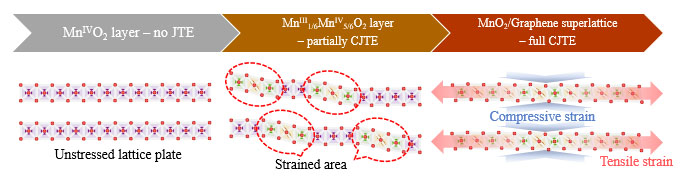 |
| Schematic illustration depicting the distinct structural scenarios in layered MnO2. (Image: University of Manchester)
|
Atomic-level control over battery durability
|
|
The breakthrough centres on a phenomenon called the Cooperative Jahn-Teller Effect (CJTE). A coordinated lattice distortion caused by a specific 1:1 ratio of manganese ions (Mn³⁺ and Mn⁴⁺). When built into a layered 2D structure on graphene, this ratio produces long-range, uniform strain across the material.
|
|
That strain helps the cathode resist breakdown during repeated cycling.
|
|
The result is a low-cost, aqueous zinc-ion battery that performs with greater durability, and without the safety risks linked to lithium-ion cells.
|
|
“This work demonstrates how 2D material heterostructures can be engineered for scalable applications,” said Prof Guoxiu Wang, lead and corresponding author from University of Technology Sydney and a Royal Society Wolfson visiting Fellow at The University of Manchester. “Our approach shows that superlattice design is not just a lab-scale novelty, but a viable route to improving real-world devices such as rechargeable batteries. It highlights how 2D material innovation can be translated into practical technologies.”
|
Towards better grid-scale storage
|
|
Zinc-ion batteries are widely viewed as a promising candidate for stationary storage, storing renewable energy for homes, businesses or the power grid. But until now, their limited lifespan has restricted real-world use.
|
|
This study shows how chemical control at the atomic level can overcome that barrier.
|
|
Co-corresponding author Prof Rahul Nair from The University of Manchester said, “Our research opens a new frontier in strain engineering for 2D materials. By inducing the cooperative Jahn-Teller effect, we’ve shown that it’s possible to fine-tune the magnetic, mechanical, and optical properties of materials in ways that were previously not feasible.”
|
|
The team also demonstrated that their synthesis process works at scale using water-based methods, without toxic solvents or extreme temperatures - a step forward in making zinc-ion batteries more practical for manufacturing.
|