| Jul 21, 2025 |
Defect-rich cobalt nanozymes enable dual-mode sensing of toxic pollutants
Scientists create cobalt-based 2D nanozymes with improved catalytic activity for colorimetric and photothermal detection of dihydroxybenzene pollutants.
(Nanowerk News) Accurately identifying molecules with similar chemical structures remains a challenge in environmental monitoring and biomedical analysis. Conventional approaches often fall short in distinguishing such compounds with high sensitivity and selectivity.
|
|
One promising solution lies in enzyme-based colorimetric assays—tools that mimic biological enzymes to trigger visible color changes in the presence of specific analytes. These systems rely on the catalytic performance of the enzymes or their synthetic mimics to function effectively.
|
|
Among artificial enzyme systems, single-atom catalysts—where individual metal atoms are embedded in a supporting material—have gained attention for their precision and high reactivity. Specifically, cobalt-based single-atom catalysts supported on carbon substrates (Co-CN) have shown excellent oxidase-like activity, making them attractive candidates for analytical sensing. Their catalytic efficiency depends heavily on the local coordination environment of the cobalt atoms.
|
|
Studies have shown that cobalt atoms coordinated by three nitrogen atoms (Co–N₃(C)) exhibit the highest oxidase-like performance. However, most existing catalysts suffer from limited access to these active sites, which are often buried or poorly exposed on the material surface.
|
|
To address this limitation, a team led by Dr. Yizhong Lu at the University of Jinan has developed a two-dimensional (2D) cobalt single-atom catalyst supported on defective carbon nanosheets, referred to as 2D Co-CN(H). Their findings, published in Nano Research ("Single cobalt sites on defective carbon nanosheets as efficient oxidase mimics for visual biosensing"), highlight how atomic-scale defects in the carbon substrate improve the catalyst’s activity and help enable a new sensing strategy for detecting molecular pollutants.
|
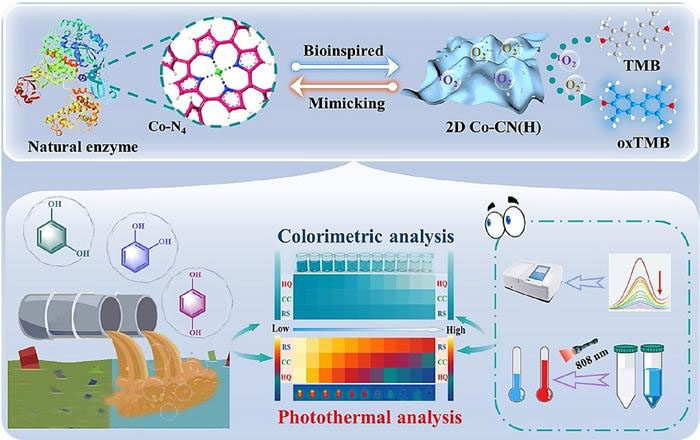 |
| Taking advantage of the excellent oxidase-like activity of 2D Co-CN(H) catalysts and the good photothermal properties of oxTMB, an innovative dual-mode colorimetric-photothermal sensing platform toward effective discrimination and detection of dihydroxybenzene isomers has been successfully constructed. (Image: Nano Research, Tsinghua University Press)
|
|
The team synthesized these catalysts using high-temperature pyrolysis of cobalt-containing metal-organic frameworks (Co-ZIF-8) combined with graphitic carbon nitride (g-C₃N₄). During pyrolysis, the g-C₃N₄ decomposes into reactive gases that etch the carbon structure, creating defects and increasing the number of exposed cobalt sites. As the proportion of g-C₃N₄ increases, the carbon nanosheets transition from minimally etched to highly porous and defect-rich layers. This defect engineering not only enhances the accessibility of catalytic sites but also influences the electronic environment of the cobalt atoms.
|
|
Combined experimental observations and theoretical calculations revealed that these defects disrupt charge symmetry and redistribute spin density around the cobalt centers. This modification enhances the ability of the catalysts to cleave oxygen-oxygen bonds—an essential step in oxidase-like catalysis. As a result, the 2D Co-CN(H) catalysts show significantly improved performance in oxidizing 3,3′,5,5′-tetramethylbenzidine (TMB), a standard colorimetric substrate.
|
|
In a further innovation, the oxidized TMB product (oxTMB) was shown to have strong photothermal properties—it can convert near-infrared (NIR) light into heat. This dual functionality allowed the team to build a hybrid colorimetric-photothermal sensor, capable of detecting and distinguishing between closely related compounds such as dihydroxybenzene isomers. These molecules, often found in industrial wastewater, pose serious health and environmental risks.
|
|
According to Dr. Lu, this study underscores the importance of structural defects in tuning the behavior of single-atom nanozymes and demonstrates their versatility in real-world applications. By integrating defect engineering with two-dimensional design, the team has expanded the scope of artificial enzyme systems, opening new possibilities for pollution sensing and molecular diagnostics.
|