| Aug 28, 2025 |
Discovery overturns century-old model of nanoparticle growth
Researchers tracked nanoparticles in real time and uncovered complex growth phases that defy the classical picture.
(Nanowerk News) A century-old theory says big nanoparticles should get bigger while small ones disappear. New research shows the opposite can happen, forcing scientists to rethink how these particles form and grow.
|
|
Nanoparticles are central to technologies such as quantum-dot displays, catalysts and drug delivery. Their usefulness depends on size and shape, yet the process that drives them toward uniform dimensions has remained poorly explained.
|
|
Classical nucleation theory, the field’s standard model, assumes that larger particles always outcompete smaller ones — a process known as Ostwald ripening. But when a team led by Professor Jaeyoung Sung at Chung-Ang University tracked nanoparticles in real time using liquid-phase transmission electron microscopy, they found a more complicated picture.
|
|
Instead of smooth, predictable growth, the particles moved through several distinct phases. Their growth rates shifted with size, and for brief periods some fused together before separating again. In certain cases, smaller particles expanded while larger ones dissolved, contradicting classical expectations.
|
|
To explain the results, Sung and colleagues built a new framework that incorporates overlooked details: how nanoparticles move, rotate and vibrate, how molecules attach to their surfaces, and how particle shape and energy affect stability.
|
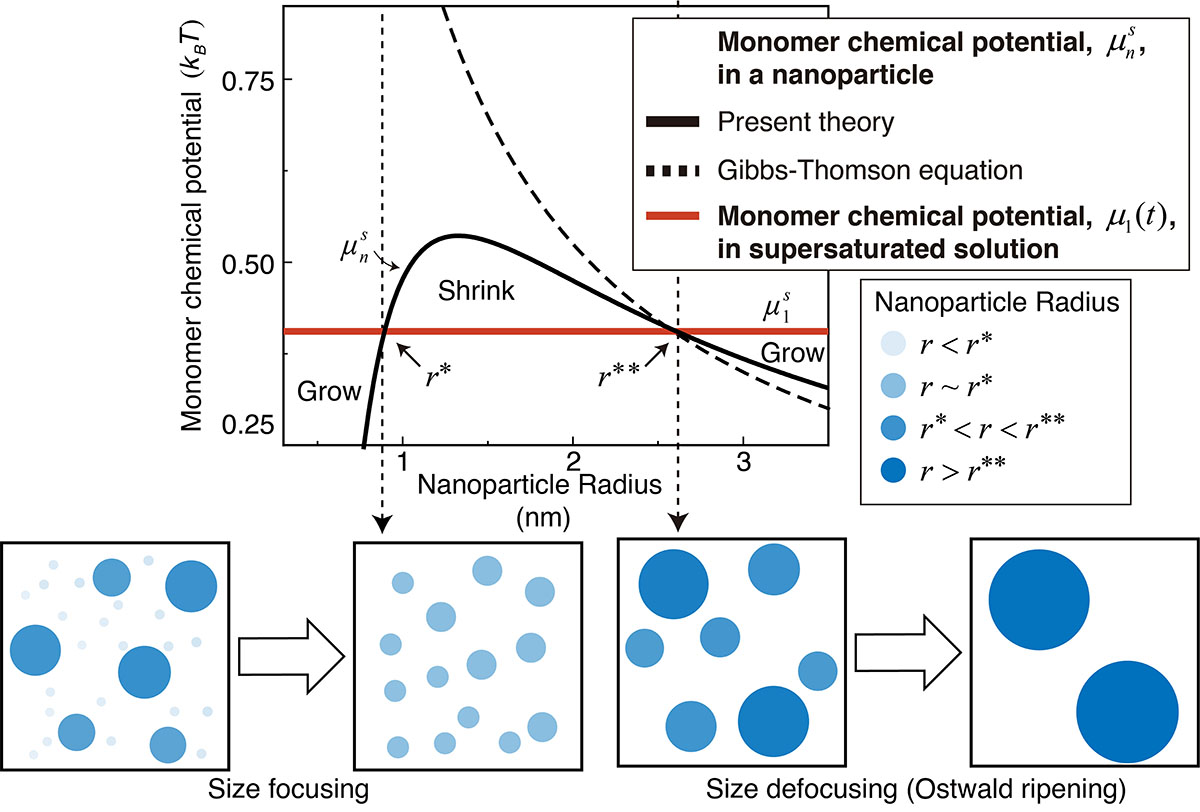 |
| The proposed theory in this study explains the complex size- and time-dependent growth of nanoparticles, representing a fundamental shift in nanoparticle research. (Image: Jingyu Kang, Dr. Ji-Hyun Kim, Professor Jaeyoung Sung from Chung-Ang University) (click on image to enlarge)
|
|
Published in Proceedings of the National Academy of Sciences ("Multiphasic size-dependent growth dynamics of nanoparticle ensembles"), the theory explains why nanoparticle systems often converge toward uniform sizes. It also applies broadly, matching data from platinum, semiconductor and metal oxide nanoparticles formed under different conditions.
|
|
“This work makes it possible to describe how nanoparticles evolve in terms of fundamental physics,” says Sung. The same principles, he adds, may also help explain biological processes such as protein aggregation in Alzheimer’s disease.
|
|
Researchers say the framework could be paired with artificial intelligence to design nanoparticles with precise functions, opening paths to more efficient catalysts, new semiconductor technologies and targeted drug delivery. By overturning the classical model, the study offers a new map for understanding how matter organizes at the smallest scales.
|