| Sep 05, 2025 |
Microwave synthesis transforms biomass into carbon dots for tracking heavy metals
Researchers use microwave-assisted synthesis to create carbon dots from biomass, offering a fast, low-cost, and sustainable way to detect toxic heavy metals in the environment.
(Nanowerk News) A team of researchers has unveiled a promising new way to track toxic heavy metals in the environment by harnessing a simple household principle: microwave heating. Their study introduces an innovative process that uses microwave-assisted synthesis to produce nitrogen-doped carbon dots from renewable biomass (Carbon Research, "Microwave-assisted synthesis of biomass-derived N-doped carbon dots for metal ion sensing"). These glowing nanoparticles can identify hazardous metals like lead, mercury, and cadmium with remarkable precision, offering a greener and more efficient approach to environmental monitoring.
|
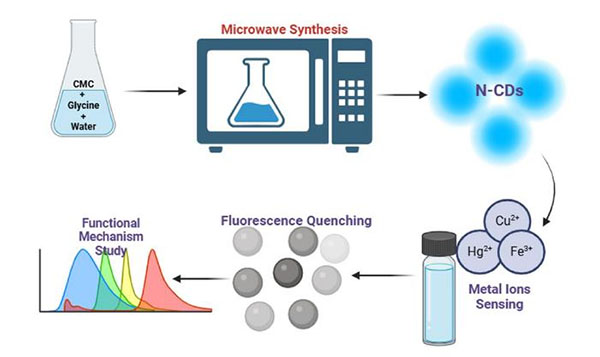 |
| Microwave-assisted synthesis of biomass-derived N-doped carbon dots for metal ion sensing. (Image: reprinted from DOI:10.1007/s44246-025-00215-7, CC BY)
|
|
Heavy metals remain a serious threat to ecosystems and public health. Even at low concentrations, they can contaminate water supplies, accumulate in living organisms, and cause lasting harm. Detecting them quickly and accurately is essential, yet traditional testing methods are often slow, resource-intensive, and difficult to scale. That challenge has pushed scientists to search for solutions that are not only effective but also sustainable.
|
|
The research team turned to carbon dots, nanometer-sized materials known for their optical and electronic properties. By using biomass—a renewable and widely available resource—they created nitrogen-doped carbon dots that light up when exposed to specific metal ions. The choice of microwave technology made the synthesis process especially efficient. Unlike conventional heating methods that can take hours, microwave-assisted synthesis rapidly converts biomass into functional carbon dots in minutes, improving both speed and performance.
|
|
What makes this approach stand out is the combination of sustainability, sensitivity, and practicality. The carbon dots exhibit strong selectivity for heavy metals, which means they can distinguish between different contaminants in complex environments. At the same time, the method reduces costs and avoids the energy-intensive steps common in older production techniques. That opens the door to applications in water quality monitoring, industrial waste detection, and other areas where rapid, reliable sensing is crucial.
|
|
The study also reflects a broader movement in environmental science toward integrating renewable resources with cutting-edge technology. Over the past decade, interest in sustainable materials and innovative sensing strategies has expanded dramatically. This work adds to that momentum by showing how microwave-assisted synthesis and biomass-derived nanomaterials can be combined to address urgent environmental problems.
|
|
Beyond the laboratory, the implications are significant. A cost-effective and scalable sensing technology could help communities protect drinking water, support industries in reducing their environmental footprint, and give regulators better tools to prevent pollution before it spreads. By demonstrating how a simple shift in synthesis technique can enhance both performance and sustainability, the study lays the groundwork for further advances in environmental monitoring.
|
|
The researchers highlight the value of collaboration across disciplines, bringing together expertise in chemistry, materials science, and environmental engineering. Their findings emphasize that innovative thinking and practical application can go hand in hand, particularly when addressing issues as critical as heavy metal pollution.
|
|
This work offers more than just a technical improvement; it points to a pathway toward cleaner, safer ecosystems. As environmental challenges continue to evolve, approaches that merge renewable resources with efficient technology will be essential. Microwave-assisted synthesis of biomass-derived carbon dots may well become a key tool in protecting both human health and the planet.
|