| Sep 22, 2025 |
Deformability emerges as key design rule for next generation microfluidic devices
Researchers showed that particle deformability governs focusing in microfluidics, leading to a new model that could advance diagnostics including early cancer detection.
(Nanowerk News) Scientists in Japan have uncovered a new way to sort particles inside microfluidic channels, a breakthrough that could transform disease diagnostics and liquid biopsies.
|
|
A joint team from Osaka University, Kansai University and Okayama University used the supercomputer Fugaku to explore how deformable particles such as biological cells behave differently from rigid ones. Their findings, published in the Journal of Fluid Mechanics ("Experimental and numerical study on the inertial migration of hydrogel particles suspended in square channel flows"), point to next-generation microfluidic devices that can separate cells with far greater precision, opening the door to advances such as earlier cancer detection.
|
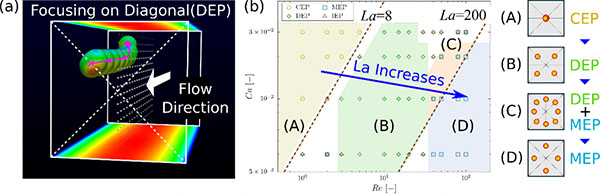 |
| (a) Example of a computational simulation showing particle focusing on the diagonal (DEP). (b) Phase map of particle focusing patterns. (Image: Kazuyasu Sugiyama)
|
|
Microfluidics is the science of manipulating tiny amounts of fluid in microscopic channels. In medical research, controlling how particles move inside these channels is vital for sorting cells and running diagnostic tests. Until now, most studies concentrated on rigid particles, which usually settle near the channel walls. But little was known about how soft, flexible particles behave.
|
|
To answer that, researchers designed hydrogel particles that mimic the size and softness of real cells. By combining lab experiments with powerful simulations and theoretical modeling, they found that deformable particles follow very different paths. Instead of clustering near the walls, soft particles concentrate at the channel center or along diagonal lines, depending on the flow conditions.
|
|
Fugaku’s computing power allowed the team to simulate particle behavior under many flow regimes, defined by two key numbers: the Reynolds number, which reflects inertia, and the Capillary number, which reflects deformability. They discovered a “phase transition” in the focusing patterns controlled by the balance of these two forces. This relationship is captured in a new theoretical model that introduces the Laplace number as a guiding parameter.
|
|
The model breaks down a previously complex nonlinear problem into simpler linear components, making microfluidic channel design more predictable and less reliant on trial and error. By treating particle deformability as a design parameter, researchers are shifting the field toward a more precise, physics-based approach.
|
|
This level of control could greatly improve biomedical applications. Cancer cells, for instance, are often softer than healthy cells, so the ability to quickly sort them based on deformability could lead to faster, more accurate liquid biopsies and better monitoring of treatment response.
|
|
“We are committed to further developing this technology to realize its full potential in healthcare and biotechnology,” said Yuma Hirohata, lead author of the study.
|