| Sep 27, 2025 |
Ultrasound makes carbon dots glow for seconds with promise for imaging and radar
Researchers stabilized carbon dots in a cyclodextrin framework, creating long-lasting phosphorescence and multi-color afterglow for advanced sensing and bioimaging.
(Nanowerk News) Triplet excitons, excited states that can last a long time, are able to emit photons for extended periods. This ability boosts the signal-to-noise ratio and improves tissue penetration, which is crucial for deep and non-invasive imaging.
|
|
Traditional fluorescent materials that respond to environmental or chemical changes are already widely used in optical sensing. They help detect changes in real time, enable non-invasive diagnostics, track processes inside living systems, and even encrypt data through their shifting emission.
|
|
Room temperature phosphorescent (RTP) materials have become a focus in these fields because of their unique excited-state properties. Their long-lasting glow reduces background fluorescence interference, which usually occurs on the nanosecond timescale, making RTP materials valuable for practical applications in detection and bioimaging. But their development faces obstacles.
|
|
Triplet excitons tend to lose energy through non-radiative relaxation pathways and can be quenched by oxygen. At the same time, it is extremely difficult to regulate both the triplet excitons and the responsive sites together. Creating tunable RTP materials that react to external stimuli remains a major challenge.
|
|
A research team has reported a new way to regulate phosphorescent carbon nanodots (CNDs) by constructing micro-scale rigid frameworks (Light: Science & Applications, "Ultrasound-responsive phosphorescence in aqueous solution enabled by microscale rigid framework engineering of carbon nanodots").
|
|
Their method relies on controlling the self-assembly of cyclodextrin in water with ultrasound. Cyclodextrin molecules naturally form assemblies, and under ultrasonic stimulation, they create a rigid environment that stabilizes carbon dots and activates triplet excitons. This approach produced ultrasound-responsive phosphorescent CNDs with a 1.25-second lifespan in aqueous solution.
|
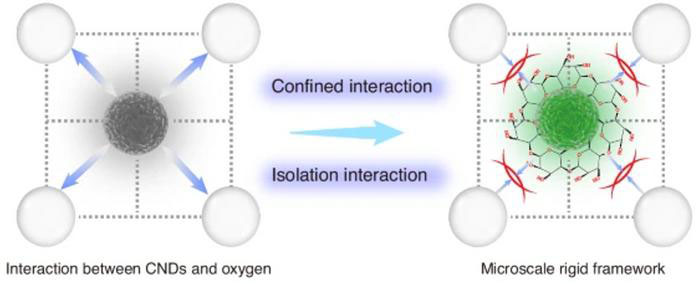 |
| Schematic of micro-scale rigid frame engineering. Due to the weak spin-orbit coupling (SOC) and the molecular motion in the surrounding environment, as well as inhibitors like oxygen and water, triplet excitons are easily dissipated (Figure left). Previously, researchers have employed various methods to protect triplet excitons, including multiple interactions such as hydrogen bonds and covalent bonds to limit molecular motion and reduce non-radiative transitions. Based on this, the authors' team proposed a rigid framework strategy to suppress the non-radiative transition from the excited triplet state to the ground state of CNDs through restricted interactions, thereby achieving efficient phosphorescent emission (Figure right). (Image: Reprinted from DOI:10.1038/s41377-025-01965-0, CC BY)
|
|
Without ultrasound, no phosphorescence could be detected because triplet excitons quickly dissipated in water. After ultrasonic treatment, however, cyclodextrin assemblies confined the carbon dots through hydrogen bonding interactions. This enhanced their RTP performance and extended the afterglow lifetime.
|
|
The study showed that the ultrasound responsiveness of CNDs increases with the crystallinity of the cyclodextrin framework. Using Förster resonance energy transfer theory, the team also achieved multi-color afterglow that responded to ultrasound in water. These properties point to promising uses of ultrasound-responsive phosphorescent CNDs in ultrasound radar detection and in vivo afterglow imaging.
|