| Oct 31, 2025 |
Blueprint for stretchable brain-like transistors in wearable electronics
A new roadmap links materials, design, and process to build stretchable synaptic transistors for soft, low-power AI and wearable electronic systems.
(Nanowerk News) Researchers have drawn up a practical guide for building soft, stretchable electronic transistors that can think and learn like the human brain. The study (Wearable Electronics, "Manufacturing strategies for stretchable synaptic transistors") outlines how materials and design choices interact to make neuromorphic circuits—devices that mimic synapses—work reliably even when bent, stretched, or worn on skin.
|
|
“What’s new here is the process-centric, comprehensive approach,” said first author Tingyu Long. “By comparing photopatterning, printing, and lamination-and-transfer processes across substrates, electrodes, semiconductors, and ion-conducting dielectrics, we show how to maintain stable electrical behavior of devices at low voltage even under ≥50–100% tensile strain.”
|
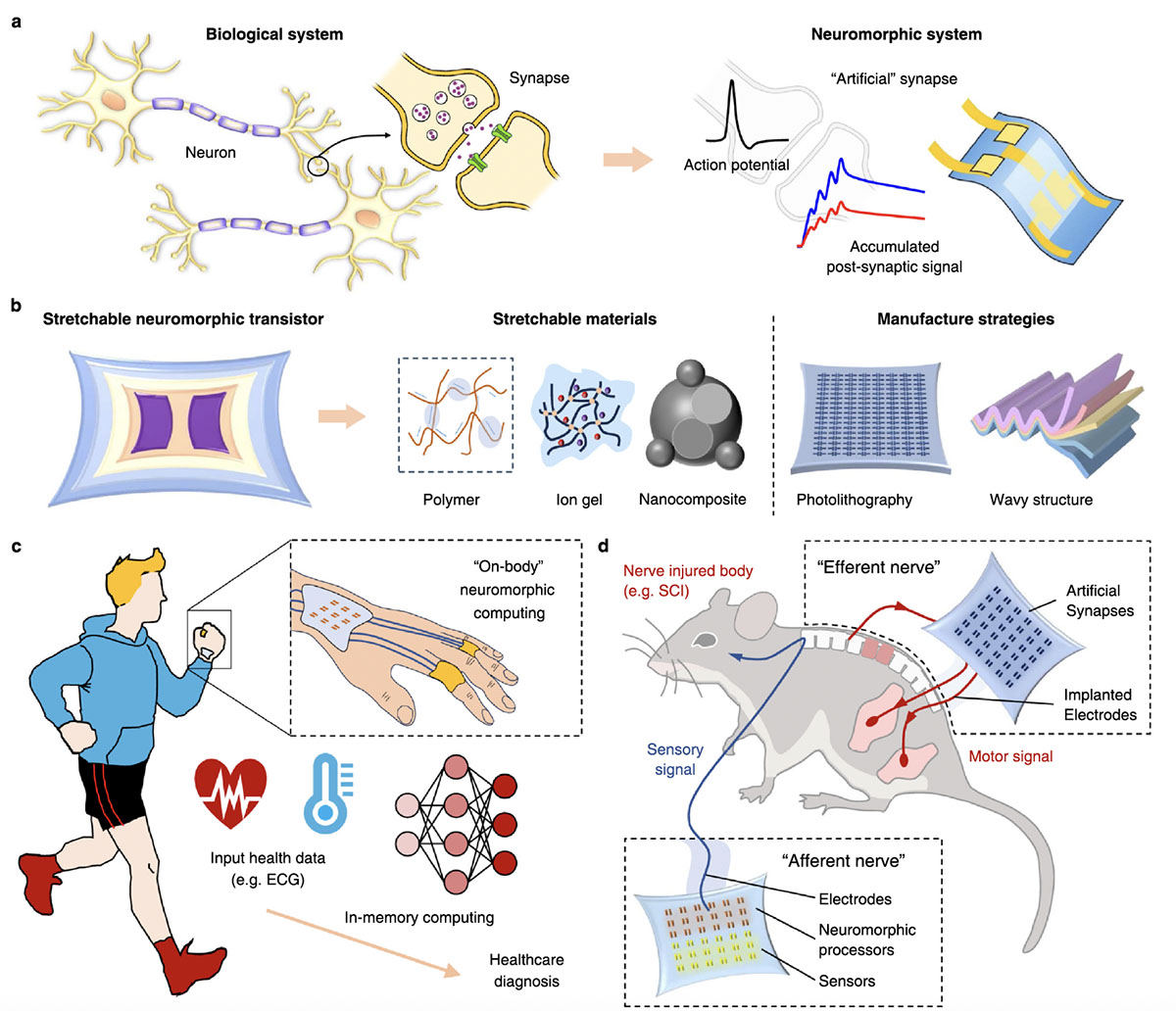 |
| Schematic illustration of the development of stretchable synaptic transistors: a) emulation of biological neural system principles in artificial neuromorphic systems, enabled by b) advanced manufacturing approaches to achieve stretchability and functionality in bio-inspired electronic devices. stretchable synaptic transistors for c) wearable devices and d) artificial nerve applications. (Image: Reprinted from DOI:10.1016/j.wees.2025.07.001, CC BY) (click on image to enlarge)
|
|
The review points out that the architecture of these miniature circuits matters as much as the materials. Vertical organic transistors, which move electrical signals through stacked layers rather than across flat surfaces, keep their function even when deformed. They shorten signal paths and reduce cracking, giving them a clear edge over standard planar designs. Other approaches, such as wavy or textile-based structures, spread mechanical stress across fibers or corrugated networks, helping devices retain their “learning” ability while being stretched.
|
|
“These insights move soft neuromorphic hardware toward scalable, CMOS-compatible integration,” said co-first author Chunghee Kim. “Bridging microfabrication with intrinsically stretchable materials is needed for reliable, large-area arrays for on-skin wearable electronics and bio-interactive prosthetics.”
|
|
The review also highlights immediate uses for these stretchable circuits: on-body artificial intelligence that filters heart-like biosignals, electronic skin that senses pressure or pain, and synthetic nerves that convert sensory input into motion with minimal energy use. Because they flex with the body, such systems could one day provide safer human–robot interaction and more natural prosthetic feedback.
|
|
Still, the field faces major technical hurdles. Future research must produce semiconductors that carry both positive and negative charges while stretching, printable and photo-crosslinkable materials that go beyond polymers, and interfacial layers that prevent short circuits in stacked devices. Developing self-healing, self-powered, and biocompatible platforms will also be crucial for long-term medical use.
|
|
By tracing how every fabrication step—from inkjet printing to nanotransfer—affects electrical and mechanical stability, the authors provide a roadmap for soft computing materials that can one day match the resilience and efficiency of biological tissue.
|