| Dec 03, 2025 |
Water-resistant and recyclable redox-active metal-organic frameworksA new water-resistant redox-active metal-organic framework stores electrons in acidic aqueous batteries with high durability, then can be broken down and resynthesized for reuse.(Nanowerk News) Redox-active metal-organic frameworks (RAMOFs) are highly porous materials made of metals and organic molecules linked together by coordination bonds, and they contain redox-active sites that can store electrons (protons). RAMOFs are promising candidates as electrode-active materials of rechargeable batteries. |
| However, since the coordination bonds in RAMOFs are often prone to decomposition in water, especially in acidic aqueous solutions, their applications as materials for aqueous devices using acidic aqueous solutions have been regarded as a challenge. |
| To remedy this, a research team from Tohoku University working in collaboration with Keio University, demonstrated a water-resistant and recyclable RAMOF for the first time (Nature Communications, "Water-resistant redox-active metal–organic framework"). |
| The team prepared a RAMOF, UiO-66-(OH)2, which contained p-hydroquinone capable of redox reaction to store electrons (protons), while maintaining structural stability in acidic aqueous solutions. They successfully demonstrated, for the first time, that the UiO-66-(OH)2 worked with high durability in an aqueous RAMOF-based rechargeable battery using an acidic aqueous electrolyte, by storing electrons (protons) throughout the material. |
| After using it as an electrode-active material, UiO-66-(OH)2 decomposed under mild conditions and was reused (recycled). |
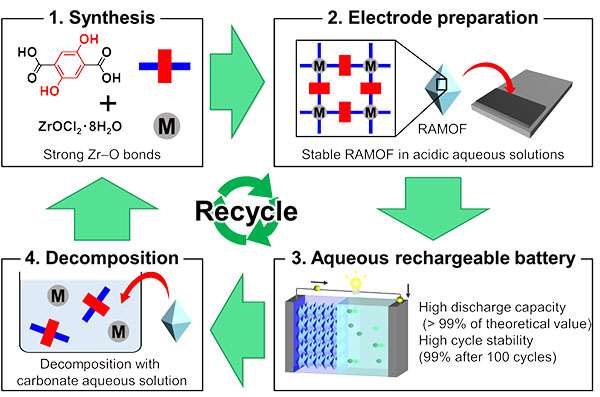 |
| Schematic of this work. (Image: Tohoku University) |
| "RAMOFs have so many potential uses, and an electrode-active material of an aqueous rechargeable battery is just one of them," explains Kouki Oka, associate professor at Institute of Multidisciplinary Research for Advanced Materials, Tohoku University. |
| The findings highlight two key achievements. First, this is the first demonstration showing that an electrode-active material made of a water-resistant RAMOF can stably store electrons even in acidic aqueous solutions. Second, they were able to recycle the RAMOF after using it as an electrode-active material by decomposing the RAMOF back into its raw components in a carbonate aqueous solution and resynthesizing it again for reuse. |
| "Going forward, we aim to develop new designs that make RAMOFs even more recyclable and adaptable for real-world use," added Oka. |
| Source: Tohoku University (Note: Content may be edited for style and length) |