| Dec 15, 2025 |
Optimized MOF membranes boost carbon dioxide separationResearchers developed a highly selective membrane that efficiently separates carbon dioxide from other gases, supporting cleaner energy and industrial processes.(Nanowerk News) Reducing carbon dioxide emissions remains a key challenge in addressing climate change, particularly for energy-intensive industries. Sectors such as power generation and natural gas processing require efficient technologies to separate carbon dioxide from gas streams that typically contain nitrogen or methane. |
| Membrane‑based gas separation is highly attractive because it consumes less energy than traditional methods, yet its performance strongly depends on optimizing the membrane structure and material quality. |
| A research team has developed a membrane based on a porous crystalline material known as metal–organic frameworks (MOFs). The material, called CAU-23, contains one-dimensional channels that selectively allow small gas molecules to pass through while restricting larger ones. |
| By carefully controlling how the membrane crystals grow, the researchers were able to create a dense and uniform membrane with very few microscopic defects. The study is published in Small, ("Critical Role in Structural Optimization and Activation of CAU-23 Membranes for CO2 Separation"). |
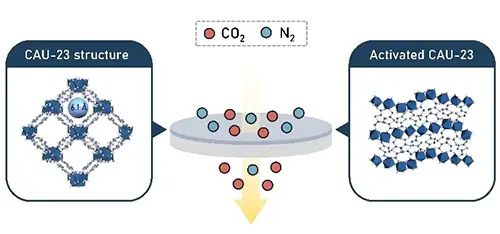 |
| Schematic illustration of membrane optimization enabling efficient carbon dioxide separation. (Image: NTU) |
| In addition to membrane structure, the researchers found that the activation process plays a critical role. Newly synthesized membranes often contain residual molecules trapped inside the pores, which block gas transport and limit efficiency. The team compared heat treatment with a solvent‑based activation method using methanol. |
| They discovered that methanol activation was far more effective at removing these pore‑blocking species, thereby restoring the membrane’s internal pathways and dramatically improving gas flow. |
| Under tested conditions, the optimized CAU-23 membrane showed high selectivity in separating carbon dioxide from nitrogen and methane, including in mixed-gas systems. This performance highlights its potential relevance for carbon capture and gas separation applications. |
| “This study highlights how membrane design and treatment can strongly influence gas separation performance,” says Dun-Yen Kang, professor of chemical engineering at National Taiwan University and co-corresponding author of the study. |
| Source: National Taiwan University (Note: Content may be edited for style and length) |