

| Posted: Oct 17, 2006 |
Fabricating highly mono-disperse nanospheres with biomulecules |
| (Nanowerk Spotlight) Controlling the shape of nanostructures is one of the challenging issues presently faced by synthetic chemists and materials engineers. Various shapes of nanomaterials, such as sphere-, rod-, wire-, triangle-, cube-, and tube-outlines have been synthesized by various approaches. However, to produce nanostructures with high monodispersity is still one of the major issues to be solved. |
| Most work in this area focused on inorganic or synthetically organic materials. Using pure biomolecules to produce nano- or micro-structures, without the assistance of inorganic materials, is rare. Biocompatible nanospheres have been and remain of intense interest for biosensor, drug delivery, and biomedical contrast imaging. |
| A new research report coming out of China now shows that highly monodispersed nanospheres of cystine (a sulfur-containing amino acid) aggregate were successfully produced by a quite simple method without the assistance of any other inorganic materials. This work could be of great significance in the production of nanomaterials, biosensors, and drug delivery. |
| Professor Zhanfang Ma from the Chemistry Department at Northeast Normal University in Chanchun, PR China, explains his group's recent findings to Nanowerk; "Amino acid molecules are one of the most important candidates to fabricate nanomaterials due to their stability, cost-saving, nontoxicity, and biocompatibility. Herein, we prepared multiple shapes of nano- and micro-structured cystine aggregates only by adjusting the concentration and pH value of the L-Cysteine solution under ultrasonic irradiation." |
| Importantly, as Ma points out, a large amount of highly monodispersed nanospheres of cystine aggregates 225 nm in diameter without any other shapes were easily obtained. |
| "To the best of our knowledge, this is the first time highly monodispersed nanospheres have been prepared using a common amino acid with small molecular weight" he says. "The reported method will promote new possibilities for future applications in biosensor, drug delivery, and medicine." |
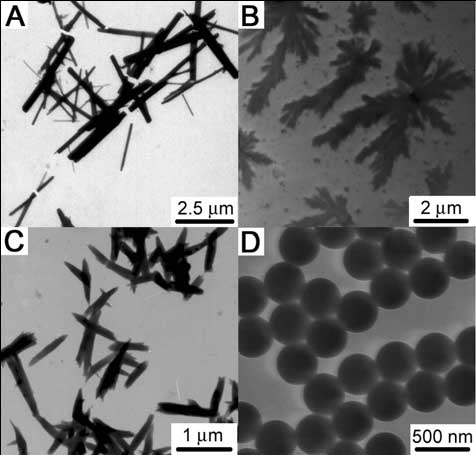 |
| TEM images of cystine aggregates synthesized under different concentrations of L-Cysteine solution with pH = 8.0. The concentrations of L-Cysteine: (A) 0.1 mM, (B) 1 mM, (C) 10 mM, (D) 100 mM. (Reprinted with permission from IOP Publishing Ltd.) |
| The new findings were reported in a paper, titled "A facile method to produce highly monodispersed nanospheres of cystine aggregates", published in the September 28, 2006 online edition of Nanotechnology. |
| The nanospheres of cystine aggregate are biocompatible and degradable, making them a very interesting material for drug or gene carriers in medicine as well as a good template to produce new nanomaterials. |
| Ma explains that the intermolecular interactions that might be responsible for the formation of nano- or micro-structured cystine aggregates mainly include hydrogen bonding and electrostatic interactions, which can be affected by changes in pH. |
| "Based on our experimental results we can assume that the direction of the forming network of hydrogen bonds played an important role in the formation of different shapes of nano- or micro-structured cystine aggregates " says Ma. "By varying the concentrations and pH values of the L-cysteine solution, the direction of intermolecular hydrogen bonding can be affected so that the aggregated predominance appeared in a certain direction and resulted in the formation of different cystine aggregate shapes including nanospheres, rods, spindles, dendrites, and multipods." |
| It can be safely said that this work will be of significance in the applications of nano- and micromaterials in biosensor, drug delivery, medicine, and the production of nanomaterials. |
 By
Michael
Berger
– Michael is author of four books by the Royal Society of Chemistry:
Nano-Society: Pushing the Boundaries of Technology (2009),
Nanotechnology: The Future is Tiny (2016),
Nanoengineering: The Skills and Tools Making Technology Invisible (2019), and
Waste not! How Nanotechnologies Can Increase Efficiencies Throughout Society (2025)
Copyright ©
Nanowerk LLC
By
Michael
Berger
– Michael is author of four books by the Royal Society of Chemistry:
Nano-Society: Pushing the Boundaries of Technology (2009),
Nanotechnology: The Future is Tiny (2016),
Nanoengineering: The Skills and Tools Making Technology Invisible (2019), and
Waste not! How Nanotechnologies Can Increase Efficiencies Throughout Society (2025)
Copyright ©
Nanowerk LLC
|

Become a Spotlight guest author! Join our large and growing group of guest contributors. Have you just published a scientific paper or have other exciting developments to share with the nanotechnology community? Here is how to publish on nanowerk.com.
