| Posted: Apr 14, 2009 | |
Nanotechnology syringes for injections into single cells |
|
| (Nanowerk Spotlight) Stem cell research is being pursued in laboratories all over the world in the hope of achieving major medical breakthroughs. Scientists are striving to create therapies that rebuild or replace damaged cells with tissues grown from stem cells and offer hope to people suffering from cancer, diabetes, cardiovascular disease, spinal-cord injuries, and many other disorders. Nanotechnology is increasingly playing a role in how researchers think about delivering stem cell therapies into cells (see our Spotlight: "Improving stem cell therapies with micro- and nanocapsules"). | |
| "Cell plasma membranes are a formidable barrier to the delivery of exogenous macromolecules in cellular engineering and labeling and cell therapy," Sangyong Jon explains to Nanowerk. "Attempts have been made to breach this barrier, particularly using mechanical means such as microinjectors that deliver genetic material into the cell. However, there is concern about damage to the cell membrane caused by intrinsic invasiveness of the micro- or submicrosized needle used in these procedures." | |
| Jon, an associate professor in the Department of Life Sciences at the Gwangju Institute of Science and Technology in South Korea, together with collaborators from the university's Cell Dynamics Research Center and Research Center for Biomolecular Nanotechnology, has developed a novel platform for intracellular delivery of genetic material and nanoparticles, based on vertically aligned carbon nanosyringe arrays of controllable height. | |
| The team reports their findings in a recent edition of Nano Letters, first authored by Sangjin Park ("Carbon Nanosyringe Array as a Platform for Intracellular Delivery"). | |
| "What we have developed is a universal platform that can deliver a variety of cargos inside cells, resulting in labeled or genetically modified cells," says Jon. "Our carbon nanosyringe array( CNSA) platform is also applicable to a variety of cells. In contrast, previous related work for intracellular delivery had limitations either in choice of cargo or in cells." | |
 |
|
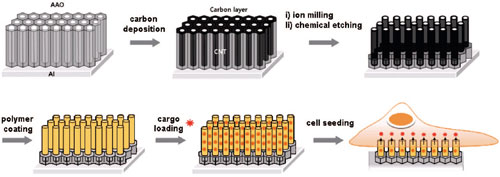
| A schematic illustration of the construction of carbon nanosyringe arrays and their use in cellular delivery of cargo: (i) the thermal CVD method of carbon layer deposition within the well-ordered pore structure of a porous AAO template; (ii) removal of the uppermost carbon surface from the AAO template by ion milling, and subsequent chemical etching to expose the carbon nanosyringes; (iii) surface coating of the carbon nanosyringes with an amphiphilic polymer and loading cargo of interest; and (iv) intracellular delivery based on the carbon nanosyringe platform. (Reprinted with permission from American Chemical Society) | |
| Using this array, the scientists successfully demonstrated intracellular delivery of plasmid and quantum dots into cancer cells and human mesenchymal stem cells. According to Jon, this is the first study of a cellular delivery process using a nanosyringe array platform with hollow nanotubes providing empty compartment for cargo loading and distinguishing it from carbon nanofiber and silicon nanowire arrays. | |
| The carbon nanosyringe array (CNSA) was initially devised by Jon's co-author Won Bae Kim for a different nanotechnology application. After initial discussions, the two decided to collaborate on a project to explore the use of these carbon syringes for the delivery of biomolecules or nanoparticles into cells. | |
| The team prepared their CNSA platforms by a series of chemical and physical steps that included the preparation of nanoporous anodized aluminum oxide (AAO) and subsequent carbon deposition within the empty pores of the AAO. Then, a process of ion milling and chemical etching leads to partial exposure of the carbon nanotube array. The so fabricated nanosyringe have an outer diameter of about 50 nm and an open portal in its tubular structure. | |
| "In order to enable loading of cargo (by capillary action) into the hollow cores of the tubular CNSA syringes we had to convert the hydrophobic surface of the nanosyringe into a hydrophilic one, which we achieved by treating the CNSA with an amphiphilic polymer," Jon explains. "This surface engineering step is necessary because the cargos targeted for intracellular delivery are generally dissolved or dispersed in an aqueous solution." | |
| In the final step, cells seeded onto the CNSA get pierced in a spontaneous manner by cell?s own gravity, and intracellular delivery of cargo ensues. | |
| An issue currently is that the CNSA are opaque, which hampers direct or real time monitoring of cellular delivery events, but the team is already developing a transparent version of their nanosyringe arrays. They are also in the process of devising a high throughput version of the CNSA platform toward commercial lab uses. | |
 By
Michael
Berger
– Michael is author of three books by the Royal Society of Chemistry:
Nano-Society: Pushing the Boundaries of Technology,
Nanotechnology: The Future is Tiny, and
Nanoengineering: The Skills and Tools Making Technology Invisible
Copyright ©
Nanowerk LLC
By
Michael
Berger
– Michael is author of three books by the Royal Society of Chemistry:
Nano-Society: Pushing the Boundaries of Technology,
Nanotechnology: The Future is Tiny, and
Nanoengineering: The Skills and Tools Making Technology Invisible
Copyright ©
Nanowerk LLC
|
|
|
Become a Spotlight guest author! Join our large and growing group of guest contributors. Have you just published a scientific paper or have other exciting developments to share with the nanotechnology community? Here is how to publish on nanowerk.com. |
|
