
| Posted: Dec 13, 2006 | |
Portable, cheap and fast explosives detector built with nanotechnology |
|
| (Nanowerk Spotlight) Due to the the increased use of modern bombs in terrorist attacks worldwide, where the amount of metal used is becoming very small, the development of a new approach capable of rapidly and cost-efficiently detecting volatile chemical emission from explosives is highly desirable and urgently necessary nowadays. The trained dogs and physical methods such as gas chromatography coupled to a mass spectrometer, nuclear quadrupole resonance, electron capture detection as well as electrochemical approaches are highly sensitive and selective, but some of these techniques are expensive and others are not easily fielded in a small, low-power package. | |
| As a complementary method, however, chemical sensors provide new approaches to the rapid detection of ultra-trace analytes from explosives, and can be easily incorporated into inexpensive and portable microelectronic devices. Researchers in PR China have developed a nanocomposite film that shows very fast fluorescence response to trace vapors of explosives such as TNT, DNT or NB. | |
| Professor Guangtao Li from the Key Laboratory of Organic Optoelectronics & Molecular Engineering of the Ministry of Education at Tsinghua University, Beijing, and colleagues have made silica films doped with nitrogen-containing macrocyclic molecules, porphyrins. Even trace levels of explosives such as TNT can cause a fluorescent response in the films. | |
| Current fluorescent sensors for TNT are based upon conducting polymers, which can be hard to make and unstable. According to Li, the films he has developed can overcome these problems. | |
| "Recently, we have prepared two kinds of porphyrin-doped mesoporous silica films" Li explains. "Interestingly, we found that such mesostructured hybrid films showed a high fluorescence quenching sensitivity towards vapor of TNT. In comparison to conjugated-polymer based sensors, the fabrication of these hybrid films is very simple, the used materials are inexpensive, and the trapped organic sensing elements also become very stable in the inert silica matrix." | |
| Two key features of these mesostructured films, namely the porous structure and the large surface area, are believed to be principally responsible for the observed remarkable sensing performance. The unique mesoporous structure provides a necessary condition for the facile diffusion of analytes to sensing elements, while the large surface area considerably enhances the interaction sites between analyte molecules and sensing elements, and thereby further improves the detection sensitivity. | |
 |
|
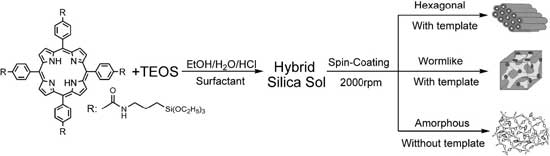
| Schematic illustration of the preparation of porphyrin-doped mesoporous silica films under three different conditions. (reprinted with permission from the Royal Society of Chemistry) | |
| The nanocomposite films developed by Li can exhibit different mesostructures (hexagonal and worm-like). When optimized conditions were used for the fabrication of hybrid film (for example, CdTPP-doped bicontinuous worm-like film), remarkable fluorescence sensitivity was achieved. | |
| Li and his co-workers believe that three reasons are responsible for the observed superior quenching sensitivity in these prepared nanocomposite films. First, the unique mesoporous structure provides a necessary condition for the facile diffusion of TNT molecules to the anchored porphyrin entities. Second, due to the well-known strong tendency to form coordinate bonding between the metalloporphyrin molecule and nitro groups of nitroaromatics as well as p-stacking between porphyrins and aromatic rings, these interactions provide a strong driving force for fast fluorescence quenching. Finally, the adequate energy-level matching between TNT and porphyrin molecules makes the fluorescence quenching very effective. | |
| "Since the preparation is very easy, the used materials are inexpensive, organic sensing elements become stable enough in the inorganic matrix, and the synthesized sensing films are easily incorporated into inexpensive and portable electronic devices, this explored method should be a promising alternative to other developed explosive detection methods" says Li. | |
| Li and his team aim to achieve even lower detection limits. "Our goal is the fabrication of chemosensory materials that could have detection performance comparable to that of the historical gold standard – dogs. By using porous materials we hope that high-performance commercial chemosensory devices for explosives detection will be developed," he said. | |
| This recent work, titled "Metalloporphyrins as sensing elements for the rapid detection of trace TNT vapor", was published in the October 4, 2006 online edition of Journal of Materials Chemistry. | |
 By
Michael
Berger
– Michael is author of three books by the Royal Society of Chemistry:
Nano-Society: Pushing the Boundaries of Technology,
Nanotechnology: The Future is Tiny, and
Nanoengineering: The Skills and Tools Making Technology Invisible
Copyright ©
Nanowerk LLC
By
Michael
Berger
– Michael is author of three books by the Royal Society of Chemistry:
Nano-Society: Pushing the Boundaries of Technology,
Nanotechnology: The Future is Tiny, and
Nanoengineering: The Skills and Tools Making Technology Invisible
Copyright ©
Nanowerk LLC
|
Become a Spotlight guest author! Join our large and growing group of guest contributors. Have you just published a scientific paper or have other exciting developments to share with the nanotechnology community? Here is how to publish on nanowerk.com.