| Posted: Mar 12, 2010 | |
Platinum nanoparticles shown to strongly enhance the efficacy of radiation therapy |
|
| (Nanowerk Spotlight) Cancer treatment typically involves chemotherapy, radiotherapy, or surgery, and – depending on the stage of the disease – often is unsuccessful. The most common drawback of all conventional treatments is that they are very imprecise due to a lack of selectivity between malignant and healthy cells. In contrast, nanotechnology offers a vision for a new approach to fighting tumors: the ability of nanoparticle-based techniques to locate cancer cells and destroy them with single-cell precision. | |
| Although gold nanoparticles have been very popular with nanomedicine researchers, in a novel approach that combines the sensitizing properties of platinum nanoparticles with hadron therapy (irradiation of tissue by fast carbon ions), a French-Japanese research group has demonstrated that platinum nanoparticles strongly enhance the biological efficiency of radiations. | |
| Hadron (or proton) therapy is considered one of the most promising techniques in cancer therapy. The treatment by fast ions opens new perspectives for an efficient and less traumatic eradication of cancers. | |
| "In our work we have combined two sophisticated techniques and expertise concerning 1) the irradiation using fast ions of the most advanced hadron therapy center in the world (HIMAC, Chiba, Japan) and 2) the use and handling of nanoparticles synthesized by a unique method of radiolysis" Sandrine Lacombe, an associate professor in the Department of Chemistry at the Université Paris-Sud, explains to Nanowerk. | |
 |
|
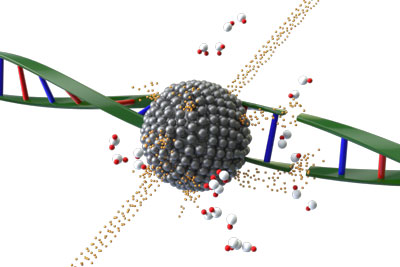
| Fast processes involved in platinum nanoparticles excited by ionizing radiations. (Graphic: Sébastien Tribot) | |
| Reporting their findings in a recent issue of Nanotechnology ("Platinum nanoparticles: a promising material for future cancer therapy?"), Lacombe and her collaborators discovered a strong enhancing effect of lethal damage in DNA induced by platinum nanoparticles when combined to fast carbon ion irradiation. | |
| "This combination – platinum nanoparticles and hadron therapy – improves the efficacy of the radiation but also tumor targeting, thanks to the surface coating" says Lacombe. "It is thus a very promising method for cancer therapy." | |
| In their work, the team highlights for the first time new electronic effects that are specific to the architecture of the platinum nanoparticles. Lacombe and her colleagues ascribe the sensitizing properties of nanoparticles to specific auto-amplified electronic cascades together with charge transfer processes. | |
| "The fast propagation of these effects in a nanometer scale volume explains the amplification of lethal damage in DNA" says Lacombe. "This understanding at a molecular level opens new perspectives of development and investigations." | |
| She points out that a full understanding of the processes induced by nanoparticles in the genetic material is fundamental to further improve the sensitizing properties of these compounds. "Hence, DNA is used as a model system to quantify the effects of ionizing radiations combined with nanoparticles in biological conditions." | |
| According to Lacombe, most of the studies have been focused on the effect of gold nanoparticles combined with x-rays. | |
| "However" she says, "it is worthwhile mentioning that these studies have been performed with laboratory x-rays of 200 keV and below, sources that are poorly relevant for medical applications. In the perspective of future applications in cancer treatment, advanced medical sources must be considered." | |
| The results of this work are relevant for future possible applications because they underline new properties of nanoparticles that are relevant for radiation biology. | |
| "Furthermore" says Lacombe, "the method of investigation, which is focused on the comparison of the effects induced by metal atoms and by metal nanoparticles, is crucial for better characterizing the effects and advantages specific to nanoparticles." | |
| This new area of research, which associates radiation biology and nanotechnologies, is only at the very beginning of its development. Scientists expect that they will be faced with new challenges resulting from the exploration of two main domains: 1) the improvement of the nanoparticle composition and surface coating in order to enhance their specificity, stability, and decrease of their toxicity; 2) the full characterization and quantification of the mechanisms involved in the effects of the nanoparticles being submitted to radiation; from molecular scale to integrated systems; from the attosecond range to a human life time. By nature, this research will involve interdisciplinary collaborations and expertise, using the most advanced experimental instruments and methods. | |
| Information for students: Lacombe is leading an international master course in Surface, Electro, Radiation, Photo-Chemistry (SERP-Chem). | |
 By
Michael
Berger
– Michael is author of three books by the Royal Society of Chemistry:
Nano-Society: Pushing the Boundaries of Technology,
Nanotechnology: The Future is Tiny, and
Nanoengineering: The Skills and Tools Making Technology Invisible
Copyright ©
Nanowerk LLC
By
Michael
Berger
– Michael is author of three books by the Royal Society of Chemistry:
Nano-Society: Pushing the Boundaries of Technology,
Nanotechnology: The Future is Tiny, and
Nanoengineering: The Skills and Tools Making Technology Invisible
Copyright ©
Nanowerk LLC
|
|
|
Become a Spotlight guest author! Join our large and growing group of guest contributors. Have you just published a scientific paper or have other exciting developments to share with the nanotechnology community? Here is how to publish on nanowerk.com. |
|
