| Posted: Aug 13, 2010 | |
Multi-source, multi-component spray coating technique for solar cells |
|
| (Nanowerk Spotlight) The high cost of silicon solar cells and their complex production process has generated interest in developing alternative photovoltaic technologies. Compared to silicon-based devices, polymer solar cells are lightweight, – which is important for small autonomous sensors – disposable, inexpensive to fabricate, flexible, designable on the molecular level, and have little potential for negative environmental impact. These solar cells are so small and pliable that they can be painted onto physical structures so that the windows and walls of a building may one day soon be able to generate electricity. | |
| Spin coating has been the dominant fabrication method for polymer electronics. However, it is not a high-throughput process and numerous research groups are trying to find a scalable fabrication method for polymer solar cells (we just published a Nanowerk Spotlight on one innovative approach – roller painting plastic solar cells). | |
| One such method, spray coating, is capable of delivering large-area, uniform polymer thin films through a relatively simple process, while offering ample processing possibilities of engineering the film structure. Spray-coating is a high-rate, large-area deposition technique that ensures an ideal coating on a variety of surfaces with different morphologies and topographies. It is frequently used for industrial coating and in-line deposition processes. In spray-coating systems, the ink is atomized at the nozzle by pressure or ultrasound and then directed toward the substrate by a gas. An added advantage of spray-coating is that it is efficient: compared to other techniques only a small amount of the solutions are wasted. | |
| A drawback of conventional techniques to fabricate polymer solar cells is that they rely heavily on the phase separation process and post-treatments, which allow only limited control over the polymer film morphology. | |
| Researchers at UCLA have now explored the potential of the spray deposition to provide better control over the film morphology, as well as construct a novel device structure previously not possible. | |
| "The fabrication of the active layers in polymer solar cells typically depends on the phase separation process to form the bulk heterojunction from polymer blend solutions," Yang Yang, a professor in the Department of Materials Science and Engineering at UCLA, explains to Nanowerk. "We have now demonstrated a new approach to actively control the polymer film morphology. The key concept relies on the partial coverage of alternating donor/acceptor layers to construct an interpenetrating network of nanodomains that mimics the nature of the layer-by-layer deposition." | |
 |
|
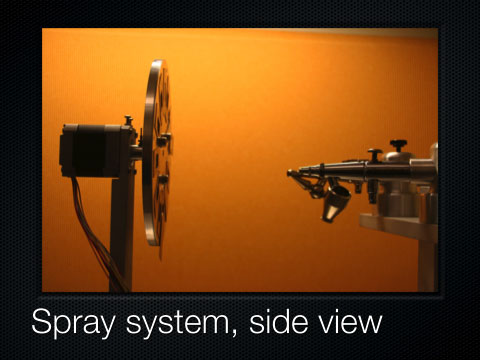
| This is a UCLA home-made multi-gun spray coating system. A computer control interface allows the spray coating system to coat the film from various polymer solutions. (Image: Yang Lab, UCLA) | |
| According to Yang's team, the capability to deposit the donor/acceptor materials from solvents with selective solubilities allows the formation of well-ordered domains without any post-treatments. The alternating spray deposition enables the formation of multi-component films from independent sources regardless of their distinct material properties, which allows the application of a wide spectrum of material systems. | |
| "Furthermore, the concentration required for spray coating can be much lower than other solution processes, thus the ability to deposit materials of insufficient solubility from independent sources shall significantly broaden the selection of materials system," says Li-Min Chen, first author of a paper in the August 6, 2010 online issue of ACS Nano ("Multi-Source/Component Spray Coating for Polymer Solar Cells"). "The alternating spray deposition also enables the formation of multi-component films from independent sources, which allows the application of a wide spectrum of material." | |
| Polymer morphology is crucial in determining the optical and electrical properties for organic electronics, and thus, the overall conversion efficiency for polymer solar cells. Dissolution has been a limiting factor for multi-layer deposition in polymer electronics. In their recent work they have specifically demonstrated a bilayer tandem structure, and an active layer comprising multiple components, with the possibility of photon recycling. | |
| The UCLA researchers say that their alternating spray deposition technique can retain the structural integrity of the underlying film, enabling the deposition of multi-layer films, such as a bilayer tandem cell without an interconnecting layer. | |
| "Polymer solar cells have been shown by us and other groups to exhibit a non-optimal compositional gradient in the vertical direction" says Yang. "With our alternating deposition approach, we can tailor the vertical composition to facilitate charge transport and collection. In addition, by selecting the optimal solvents for the donor and acceptor, we expect polymer systems with insufficient crystallinity to still deliver well-ordered domains." | |
| Chen points out that this approach also features a series of advantages over conventional solution processes such as enabling deposition of materials from lower concentrations and distinct solutions, which significantly broaden the selection of material systems. "Therefore, this versatile deposition technique provides a powerful tool to realize various design and functionality of organic electronic devices and forecasts competitive polymer photovoltaics for renewable energy applications." | |
| Yang notes that his team plans to further explore novel device structures utilizing spray deposition technology. "Since spray coating from multiple sources is possible, this versatile approach can also be integrated with other material systems and processes to directly and precisely introduce functional building blocks resembling the ion implantation process" he says. "Further applications include, but are not limited to, incorporation of dopants and functional layers in light-emitting devices and light-scattering materials for solar cells." | |
 By
Michael
Berger
– Michael is author of three books by the Royal Society of Chemistry:
Nano-Society: Pushing the Boundaries of Technology,
Nanotechnology: The Future is Tiny, and
Nanoengineering: The Skills and Tools Making Technology Invisible
Copyright ©
Nanowerk LLC
By
Michael
Berger
– Michael is author of three books by the Royal Society of Chemistry:
Nano-Society: Pushing the Boundaries of Technology,
Nanotechnology: The Future is Tiny, and
Nanoengineering: The Skills and Tools Making Technology Invisible
Copyright ©
Nanowerk LLC
|
|
|
Become a Spotlight guest author! Join our large and growing group of guest contributors. Have you just published a scientific paper or have other exciting developments to share with the nanotechnology community? Here is how to publish on nanowerk.com. |
|
