

Nanotechnology News – Latest Headlines
Looking to leap forward on laser and photodetector technologies
A team of Arizona State University researchers will get support from the U.S. Department of Defense to aid development of the next generations of lasers and infrared photodetectors.
August 5, 2010 Read more
Safe Work Australia publishes reports on methods to reduce the risk of exposure to nanomaterials
Safe Work Australia commissioned RMIT to undertake a survey of the current substitution/modification practices used in Australian nanotechnology-related activities and a literature review in order to determine the potential substitution/modification options that may reduce the toxicity of engineered nanomaterials used in Australia.
August 5, 2010 Read more
New Safe Work Australia report investigates feasibility of exposure standards for nanomaterials
The focus of the new report "Engineered Nanomaterials: Feasibility of establishing exposure standards and using control banding in Australia" (pdf; 273 KB) is to investigate the feasibility of 1) establishing group-based Australian National Exposure Standards for engineered nanomaterials and 2) using control banding for engineered nanomaterials in Australia.
August 5, 2010 Read more
Schriftenreihe Hessen-Nanotech
Mit einer europaweit einmaligen Schriftenreihe bietet Hessen-Nanotech in leicht verstaendlicher und attraktiv aufbereiteter Form kompakte Informationen ueber die Anwendungsmoeglichkeiten von Nanotechnologie in den verschiedenen Branchen und Technikfeldern.
August 5, 2010 Read more
Newly released 'Nanomaterials in IUCLID 5.2' industry user manual
The Nanomaterials in IUCLID 5.2 Industry User User Manual gives practical instruction to REACH registrants on how to include information on different forms of a substance in a IUCLID 5.2 dossier.
August 5, 2010 Read more
Two innovative LMU projects in physics receive EU funding
Two junior researchers at Ludwig-Maximilians-University (LMU) Munich have been awarded prestigious Starting Grants by the European Research Council (ERC). Professor Dieter Braun and Professor Philip Tinnefeld, both members of the Faculty of Physics, will each receive research funding in the amount of some 1.5 million Euros over the next five years.
August 5, 2010 Read more
Compact microscope a marvel
A compact microscope invented at Rice University is proving its potential to impact global health. This portable, battery-operated fluorescence microscope, which costs $240, stacks up nicely against devices that retail for as much as $40,000 in diagnosing signs of tuberculosis.
August 5, 2010 Read more
Gaming for a cure: Computer gamers tackle protein folding
Biochemists and computer scientists at the University of Washington two years ago launched an ambitious project harnessing the brainpower of computer gamers to solve medical problems. The game, Foldit, turns one of the hardest problems in molecular biology into a game a bit reminiscent of Tetris.
August 5, 2010 Read more
Thai foundation honors outstanding scientists
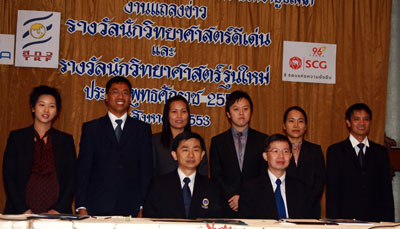
The Foundation for the Promotion of Science and Technology today recognizes and honors eight Thai scientists with outstanding achievements in scientific research for 2010.
August 5, 2010 Read more
Nano-Energy Workshop on September 13-14
Sessions and discussions will explore how a wide range of nanotechnology disciplines across chemistry, materials, electrical engineering, physics and photonics are being explored to address the need to improve today's energy efficiencies and even tap into new sources of energy production.
August 5, 2010 Read more
NSF funds innovative approach to biomimetic nanofiber bone regeneration
Funded by the National Science Foundation, Dr. Hongjun Wang, a professor in the Department of Chemistry, Chemical Biology and Biomedical Engineering at Stevens Institute of Technology and his collaborators have developed a revolutionary bottom-up approach for reconstructing intricate bone tissue with the potential to form hierarchical cortical bone.
August 4, 2010 Read more
UAlbany NanoCollege and New Energy New York present the Fifth Annual New Energy Symposium
Hundreds expected to attend event on August 9-10 showcasing clean energy technologies.
August 4, 2010 Read more

For the first time ever, scientists watch an atom's electrons moving in real time
An international team of scientists has used ultrashort flashes of laser light to directly observe the movement of an atom's outer electrons for the first time. Through a process called attosecond absorption spectroscopy, researchers were able to time the oscillations between simultaneously produced quantum states of valence electrons with great precision. These oscillations drive electron motion.
August 4, 2010 Read more
AACR hosts its fourth Molecular Diagnostics Conference in Denver
This year, the American Association for Cancer Research will host its fourth Molecular Diagnostics in Cancer Therapeutic Development: Challenges and Horizons conference at the Sheraton Denver Downtown Hotel in Denver, Colo.
August 4, 2010 Read more
Spin ice used to examine exotic properties of magnetic systems
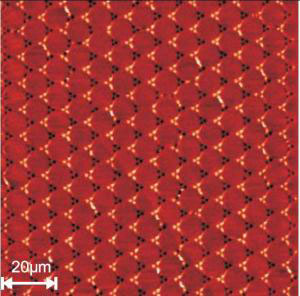
Spin ice can be used to examine exotic properties of magnetic systems. Surprising observations have been made by physicists using magnetic islands only micrometres in size that are placed on a periodic lattice with honeycomb symmetry.
August 4, 2010 Read more
Unprecedented look at oxide interfaces reveals unexpected structures on atomic scale
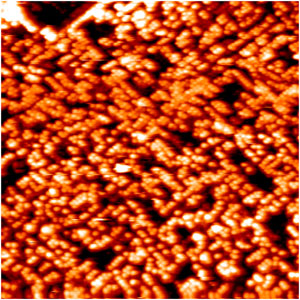
Thin layers of oxide materials and their interfaces have been observed in atomic resolution during growth for the first time by researchers at the Center for Nanophase Materials Sciences at the Department of Energy's Oak Ridge National Laboratory, providing new insight into the complicated link between their structure and properties.
August 4, 2010 Read more
 Subscribe to our Nanotechnology News feed