

Nanotechnology News – Latest Headlines
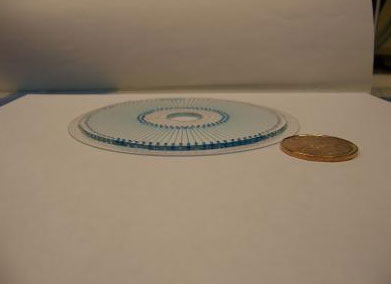
Faster DNA analysis at room temperature
Researchers have combined DNA microarrays with microfluidic devices, which are used for the precise control of liquids at the nanoscale.
August 3, 2010 Read more
New inexpensive solar cell design
Scientists at the University of Toronto in Canada have shown that inexpensive nickel can work just as well as gold for one of the critical electrical contacts that gather the electrical current produced by their colloidal quantum dot solar cells.
August 3, 2010 Read more
Molecules delivering drugs as they walk
An octopus-like polymer can 'walk' along the wall of a narrow channel as it is pushed through by a solvent.
August 3, 2010 Read more
Cells use water in nano-rotors to power energy conversion
Researchers from the Max Planck Institute of Biophysics in Frankfurt, and Mount Sinai School of Medicine in New York have provided the first atomic-level glimpse of the proton-driven motor from a major group of ATP synthases, enzymes that are central to cellular energy conversion.
August 3, 2010 Read more

Researchers to build foundation for quantum supercomputers with $7.5 million federal grant
Team led by Pitt physics and astronomy professor Jeremy Levy to resolve the major challenges to creating computers more powerful and efficient than all the world's existing computers with five-year US Department of Defense MURI award.
August 3, 2010 Read more
Physicists develop model that pushes limits of quantum theory
Physicists recently developed a new theoretical model to explain how the Pauli exclusion principle can be violated and how, under certain rare conditions, more than one electron can simultaneously occupy the same quantum state.
August 3, 2010 Read more
New tagging technique enhances view of living cells
Scientists hoping to understand how cells work may get a boost from a new technique to tag and image proteins within living mammalian cells.
August 3, 2010 Read more
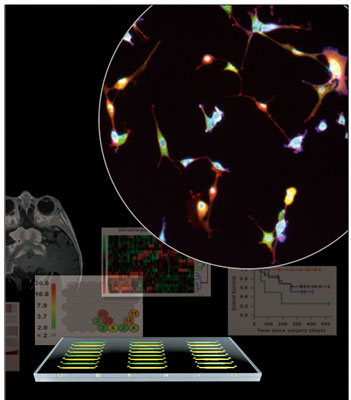
New diagnostic chip able to generate single-cell molecular 'fingerprints' for brain tumors
Technology marks advance toward predictive and personalized medicine.
August 3, 2010 Read more
Nanofibers help scientists study brain cancer
Cancer and engineering scientists at The Ohio State University are collaborating to create molecule-sized nanofibers to mimic the structure of white matter in the brain. By combining nanotechnology with a medically-approved polymer, researchers are able to study the invasive behavior of tumor cells.
August 3, 2010 Read more
Infectious disease, nanotechnology and urban ecology to be explored at Ecological Society of America's Annual Meeting
Ecological scientists will discuss findings on human-ecosystem interactions - from the effects of nanomaterials on plant growth to the diversity of insect species on green roofs, and even communities of airborne microbes in hospital buildings - at the Ecological Society of America's 95th Annual Meeting in Pittsburgh from August 1-6, 2010.
August 3, 2010 Read more
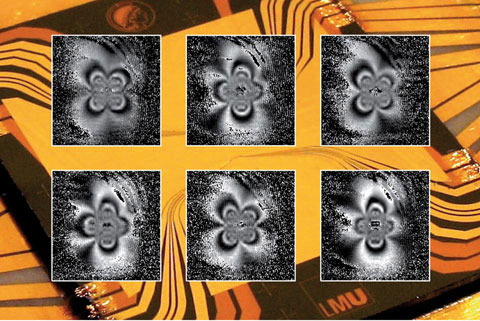
Cold atoms image microwave fields
Using clouds of ultracold atoms MPQ-LMU team of scientists makes microwave fields visible.
August 3, 2010 Read more
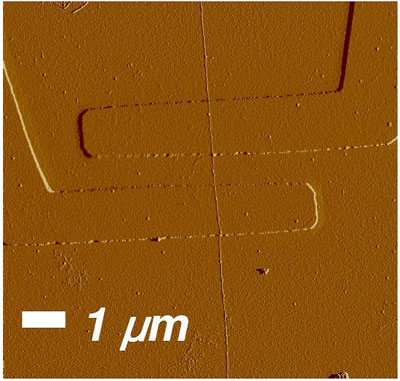
Carbon Nanotubes als Spinfilter
Alle Elektronen tragen ein magnetisches Moment, Spin genannt, das grundsaetzlich in zwei Richtungen zeigen kann. Setzt man geeignete Nano-Roehrchen aus Kohlenstoff einem hohen Magnetfeld aus, so lassen sie bei einem bestimmten Wert nur Elektronen mit einer Spinrichtung durchfliessen. Erhoeht man das Magnetfeld weiter, so werden nur Elektronen mit der anderen Spinrichtung durchgelassen.
August 3, 2010 Read more
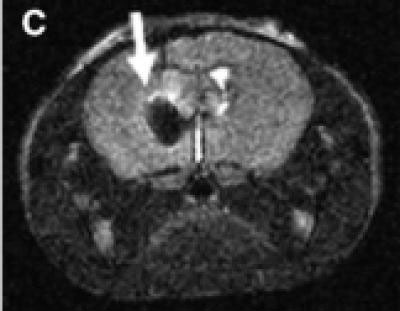
Iron oxide nanoparticles becoming tools for brain tumor imaging and treatment
Tiny particles of iron oxide could become tools for simultaneous tumor imaging and treatment, because of their magnetic properties and toxic effects against brain cancer cells. In mice, researchers have demonstrated how these particles can deliver antibodies to implanted brain tumors, while enhancing tumor visibility via magnetic resonance imaging (MRI).
August 3, 2010 Read more
Singapore's first nanotechnology consortium gives industry access to nanoimprinting technology
A group of organizations in Singapore have launched the Industrial Consortium On Nanoimprint (ICON).
August 3, 2010 Read more
Livermore's dynamic transmission electron microscope (DTEM) earns innovation award
An innovation that can help scientists observe a reaction moving at greater than 10 meters per second, with a few nanometers spatial resolution, is a feat some would say is nearly impossible. But not the Lawrence Livermore team of scientists who developed the dynamic transmission electron microscope (DTEM).
August 2, 2010 Read more
Researchers find universal law for material evolution
It's a problem that materials scientists have considered for years: how does a material composed of more than one phase evolve when heated to a temperature that will allow atoms to move?
August 2, 2010 Read more
 Subscribe to our Nanotechnology News feed