

Nanotechnology News – Latest Headlines
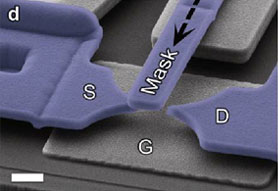
Carbon nanotubes as transistor material
ETH Zurich researchers have built a transistor whose crucial element is a carbon nano-tube, suspended between two contacts, with outstanding electronic properties. A novel fabrication approach allowed the scientists to construct a transistor with no gate hysteresis. This opens up new ways to manufacture nano-sensors and components that consume particularly little energy.
July 21, 2010 Read more
Nanoparticle-protein mix to greatly increase computer capacity
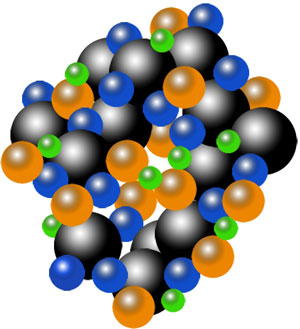
Scientists from the Hebrew University of Jerusalem have succeeded in showing how it is possible to greatly expand the memory capacity of future computers through the use of memory units based on silica nanoparticles combined with protein molecules obtained from the poplar tree.
July 21, 2010 Read more
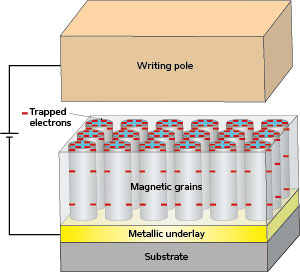
Electric-field-assisted magnetic data writing on a hard drive could improve storage densities
Electric fields can help magnetic hard drive heads write data, which may lead to higher storage densities.
July 21, 2010 Read more
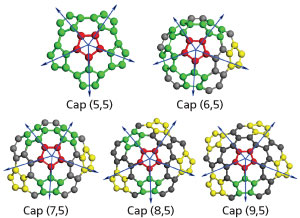
Nanomaterials: Twist-on caps
Reactions between carbon species and tube caps affect carbon nanotube growth and their ultimate electronic properties.
July 21, 2010 Read more
Research partnership to develop silicon nanoelectronic circuits inspired by the brain
The quest to come up with an artificial system organised like the biological nervous system promises to drive the future of humanoid robots and pave the way for a generation of supercomputers that can perform highly complex decision-making for gaming and defense technologies.
July 21, 2010 Read more
CNSE and CMOST to host Summer NanoCamp as part of 'Girls in Science and Technology' program
The effort to interest young women in the fields of science and technology received a boost on July 20 through a partnership between the College of Nanoscale Science and Engineering (CNSE) of the University at Albany and the Children's Museum of Science and Technology (CMOST) that showcased the exciting world of nanotechnology.
July 21, 2010 Read more
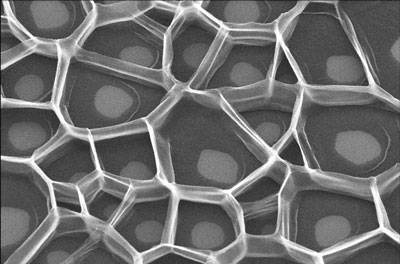
Carl Zeiss nano image contest off to a successful start
More than 70 users of ZEISS electron and ion microscopes from all over the world have already submitted their nano masterpieces to the first ever Carl Zeiss Nano Image Contest. The current voting record of the overall competition is held by Peter Nirmalraj from Trinity College Dublin.
July 21, 2010 Read more
Shaken and stirred: New partnership to create 'self-charging' batteries from ambient vibration
To serve a world bent on gaining autonomous power for wireless sensors, MicroGen Systems LLC, of Ithaca and Cornell University's Energy Materials Center (emc2) have signed a memorandum of understanding to develop 'self-charging' batteries - that use background shaking and stirring for their energy source.
July 20, 2010 Read more
Researchers develop unique method to improve testing for small delay defects in semiconductors
Semiconductor Research Corporation (SRC), the world's leading university-research consortium for semiconductors and related technologies, the National Science Foundation (NSF) and researchers from the University of Connecticut (UConn) and Duke University have found a new way to significantly improve the screening of small delay defects (SDDs) commonly found in semiconductors.
July 20, 2010 Read more
White paper: Development of highly reliable multilayer piezo actuators
Piezo technology specialist PI Ceramic has released a new white paper on the development and test of highly reliable multilayer piezo actuators.
July 20, 2010 Read more
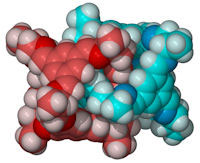
Scientists construct molecular knots with dimensions of 2 nanometers
Liverpool scientists have managed to create nanoscale knots in the laboratory by mixing together two simple starting materials - one a rigid aromatic compound and the other a more flexible amine linker.
July 20, 2010 Read more

Researchers seeking the fourth property of electrons
Electric dipole moment would explain the creation of the universe in the form that we know it.
July 20, 2010 Read more
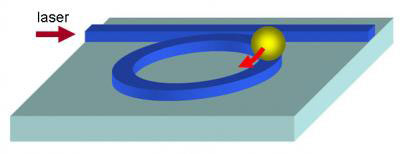
Silicon microring resonator could help advance nanomanipulation
To trap and hold tiny microparticles, engineers at Harvard have 'put a ring on it', using a silicon-based circular resonator to confine particles stably for up to several minutes.
July 20, 2010 Read more
NSF funds infection-resistant orthopedic nanocomposite research
Dr. Woo Young Lee of the Chemical Engineering and Materials Science department along with Dr. Hongjun Wang of Chemistry, Chemical Biology and Biomedical Engineering at Stevens Institute of Technology have recently received significant NSF funding for their research entitled 'Evaporative Assembly of Drug-Eluting Bioresorbable Nanocomposite Micropatterns'.
July 20, 2010 Read more
Institute of Food Technologists report reviews the role of food science and technology in meeting the needs of a growing world population
The first-of-its-kind scientific review takes a historical look at the food system, the many challenges ahead, and the crucial role of food science and technology in meeting the needs of the growing population.
July 20, 2010 Read more
 Subscribe to our Nanotechnology News feed