

Nanotechnology News – Latest Headlines
Irish high-tech companies get over 213m euros from European FP7 programs
Researchers from Irish companies and higher education institutions won funding totalling 213 million euros for collaborative research projects in areas like ICT, health, nano-technology and energy from the largest European R+D funding programme ever, announced Minister Conor Lenihan TD.
July 19, 2010 Read more

Nanophotonics proposal wins 1.5m euro European Research Council grant
Thomas Klar wins the forth ERC starting grant within CeNS.
July 19, 2010 Read more
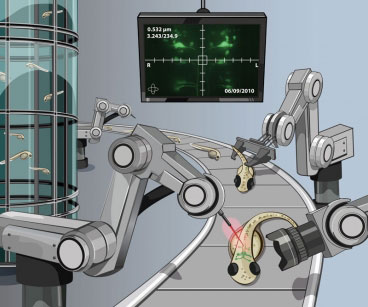
MIT creates technology for high-speed study of zebrafish larvae
With the aim of speeding up the process and enabling large-scale studies, engineers at MIT have developed a new technique that can analyze larvae in seconds.
July 19, 2010 Read more
Grant funds powerful microscope for nanoscience research
Materials science and nanotechnology researchers at the University of Nebraska-Lincoln are getting some much-needed equipment that will help enhance and expedite their studies.
July 19, 2010 Read more
Melting DNA into a barcode
A completely new method for producing an image of individual DNA molecules' genetic make-up has been developed by researchers in Sweden and Denmark.
July 19, 2010 Read more
Vaccine-delivery patch with dissolving microneedles boosts protection
A new vaccine-delivery patch based on hundreds of microscopic needles that dissolve into the skin could allow persons without medical training to painlessly administer vaccines - while providing improved immunization against diseases such as influenza.
July 19, 2010 Read more
International Conference on Science and Technology Education to focus on Islamic world
Among the events of the festival will be an educational workshop on nanotechnology.
July 19, 2010 Read more
Insights into the development of superior UVB blocking molecules
A research team in Thailand has investigated the absorption and emission spectra of ultraviolet (UV) B blocking methoxy substituted cinnamates using the symmetry-adapted cluster configuration interaction method.
July 19, 2010 Read more
Breakthrough in thin-film solar cells: New insights into the indium/gallium puzzle
Computer simulations designed to investigate the so-called indium/gallium puzzle have highlighted a new way of increasing the efficiency of CIGS thin-film solar cells.
July 19, 2010 Read more
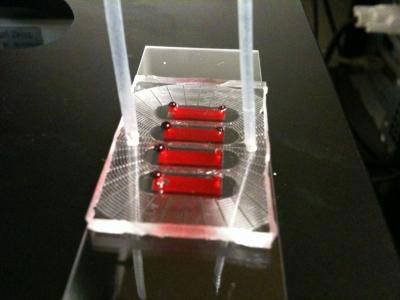
Novel microfluidic HIV test is quick and cheap
Microfluidic device uses antibodies to 'capture' white blood cells called T cells affected by HIV.
July 16, 2010 Read more
Sugar-coated nanotubes deliver high-dose radiotherapy
Starting with simple carbon nanotubes, a team of researchers from the United Kingdom and Spain has developed a sugar-coated nanocapsule that can deliver large doses of radioactivity to tumors.
July 16, 2010 Read more
Nanosponge drug delivery system more effective than direct injection
When loaded with an anticancer drug, a delivery system based on a novel material that its creators call a nanosponge is three to five times more effective at reducing tumor growth than direct injection of the same drug.
July 16, 2010 Read more
Nanoinformatics 2010: A collaborative roadmapping workshop
This workshop will bring together informatics experts, nanotechnology researchers and policy makers, and other stakeholders and potential contributors to jointly develop a comprehensive roadmap for the area of nanoinformatics.
July 16, 2010 Read more
Nanoparticles assembled inside tumors trap drugs and imaging agents
Researchers have shown that a system that assembles itself into a nanoparticle, complete with drug or imaging agent, once it gets inside a tumor can dramatically increase the rate at which clinically important molecules get into tumors and still trap those molecules inside the tumor.
July 16, 2010 Read more
Magnetic nanoparticles remove ovarian cancer cells from the abdominal cavity
Researchers at the Georgia Institute of Technology created magnetic nanoparticles that can selectively bind to and remove ovarian tumor cells from abdominal cavity fluid.
July 16, 2010 Read more
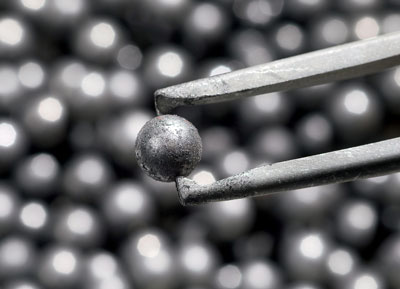
Nearly as hard as steel: Aluminum with fullerenes
Russian researchers are using special carbon nanoparticles to optimize materials. They are adding fullerenes to aluminum to obtain a new material that is roughly three times harder than conventional composites, yet weights much less.
July 16, 2010 Read more
 Subscribe to our Nanotechnology News feed