

Nanotechnology News – Latest Headlines
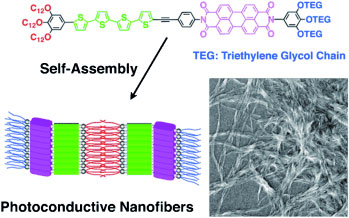
Design and synthesis of self-assembling organic devices
Researchers describe the rational design strategy using side-chain incompatibility of a covalently connected donor-acceptor (D-A) dyad to synthesize organic p/n heterojunctions with molecular-level precision.
June 14, 2010 Read more
German Federal Institute for Risk Assessment advises against using nanoscale silver ions in consumer products
BfR recommends refraining from using any nanoscale silver in consumer products until a definitive safety assessment becomes available.
June 14, 2010 Read more
Materials researchers micromanage atoms in hard metal
By combining theory and experiments, researchers at Chalmers University of Technology in Sweden have now taken a crucial step toward being able to micromanage the performance of the material, down to the level of the atom.
June 14, 2010 Read more
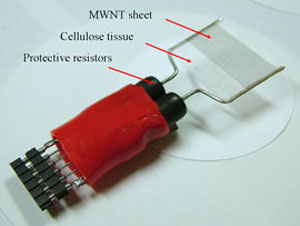
Nanotechnology speakers hold promise for sonar uses
University of Texas Dallas researchers have found that carbon nanotube sheets excel as underwater sound generators and noise-canceling speakers, two highly desirable traits for submarine sonar and stealth capabilities.
June 14, 2010 Read more
How bacteria make nano-syringes
For a successful infection, bacteria must outwit the immune system of the host. To this aim, they deliver so-called virulence factors through a transport channel located in the bacterial membrane. In some bacteria this transport channel is formed like a syringe, enabling them to inject virulence factors directly into the host cell. Scientists have now succeeded for the first time in elucidating basic principles of the assembly of this transport channel.
June 13, 2010 Read more
Watching plants grow, cell by cell
Automated imaging of cells in developing plants is described in a paper published this week in Nature Methods. These methods will permit a more detailed understanding of the cellular behaviors that underlie plant growth and development.
June 13, 2010 Read more

A look into the interior of molecules
For the first time ever, a European research team has managed to use attosecond laser pulses to observe the motion electrons in molecules.
June 13, 2010 Read more
UAlbany NanoCollege announces $2m in federal funding to support innovative nanotechnology education and research
Initiatives to enable critical advances for health care, military, IT and automotive applications.
June 12, 2010 Read more
Nanoparticle application prevents blindness in research model for retinitis pigmentosa
Researchers working toward cure for pigmentosa; other retinal diseases.
June 12, 2010 Read more
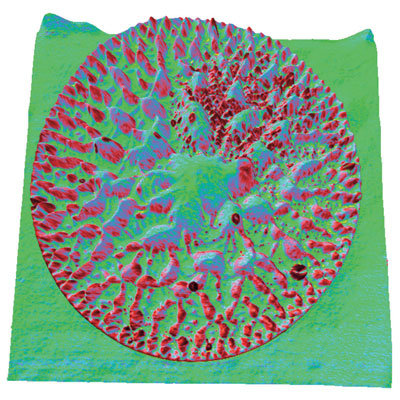
Free webinar on the use of atomic force microscopy to characterize biomaterials at the nanoscale
As part of its ongoing series of live webinars on AFM technology and advancements, Veeco Instruments Inc. will be hosting a free online seminar on 'Atomic Force Microscopy: Characterizing Biomaterials at the Nanoscale'.
June 11, 2010 Read more
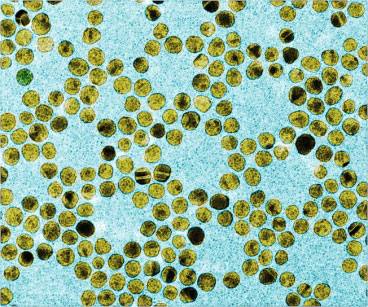
Engineers turn the stickiness of gold nanoparticles into an advantage
One property of gold nanoparticles stands in the way of many nanotechnological developments: They're sticky. Gold nanoparticles can be engineered to attract specific biomolecules, but they also stick to many other unintended particles - often making them inefficient at their designated task. MIT researchers have found a way to turn this drawback into an advantage.
June 11, 2010 Read more
Programmierbares DNA Nanopartikel-Ventil setzt gezielt Wirkstoffe frei
Damit die Dosis eines Medikaments kuenftig so niedrig wie therapeutisch moeglich gehalten werden kann, sollen die Wirkstoffe in Zukunft direkt zum Zielort im Organismus transportiert und dort erst freigesetzt werden. Dafuer sollen sie in Nanopartikel eingeschlossen werden, die ihre Fracht nur bei einem bestimmten pH-Wert, einer definierten Temperatur oder unter anderen spezifischen Bedingungen freigeben.
June 11, 2010 Read more
Observation of shell effects in superconducting nanoparticles of tin
The loss of electrical resistance of a metal particle is also a matter of its size. A group of researchers has now proven that the temperature below which a material becomes a superconductor can increase dramatically, when the material is present as spherical nanoparticles.
June 11, 2010 Read more
'Smart' underpants may save lives
Printed on the waistband and in constant contact with the skin is an electronic biosensor, designed to measure blood pressure, heart rate and other vital signs.
June 11, 2010 Read more
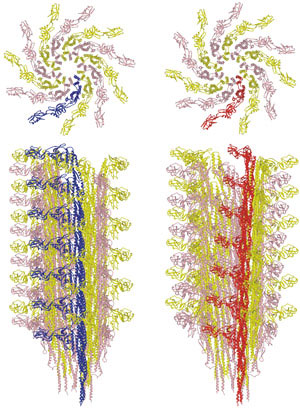
Unraveling how bacteria motor along
Motile bacteria switch between swimming patterns through conformational changes to a constituent protein of the propeller-like flagellum.
June 11, 2010 Read more
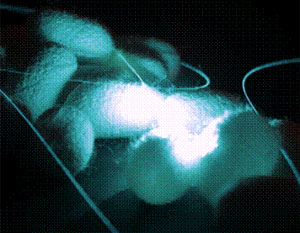
Silk could provide a sophisticated new way of monitoring health
Researchers in Australia have created microchips using silk fibres. In the lab they have demonstrated that these microchips can measure oxygen using haemoglobin embedded in the silk.
June 11, 2010 Read more
 Subscribe to our Nanotechnology News feed