

Nanotechnology News – Latest Headlines
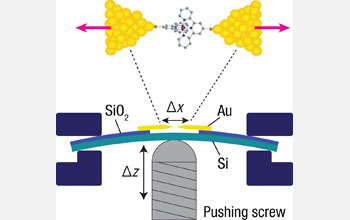
Stretching single molecules allows precision studies of interacting electrons
With controlled stretching of molecules, Cornell researchers have demonstrated that single-molecule devices can serve as powerful new tools for fundamental science experiments. Their work has resulted in detailed tests of long-existing theories on how electrons interact at the nanoscale.
June 10, 2010 Read more
Scientists glimpse the motion of electrons in molecules
Physicists in Europe have successfully glimpsed the motion of electrons in molecules. The results are a major boon for the research world. Knowing how electrons move within molecules will facilitate observations and fuel our understanding of chemical reactions.
June 10, 2010 Read more

A breakthrough toward creating nanocircuitry on graphene
Scientists have made a breakthrough toward creating nanocircuitry on graphene, widely regarded as the most promising candidate to replace silicon as the building block of transistors.
June 10, 2010 Read more
Tekes and the Science and Technology Commission of Shanghai renew nanotechnology cooperation
Tekes and the Science and Technology Commission of Shanghai renewed the cooperation agreement for an additional five years.
June 10, 2010 Read more
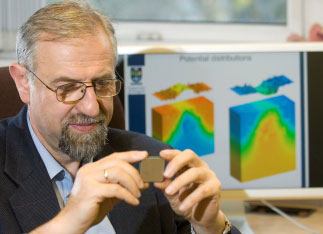
European 26m euros project to develop next generation nanotransistor chips
The University of Glasgow is playing a key role in a 26M Euro European project called MODERN looking at how to design the next generation computer chips - using variable and unreliable nanotransistors.
June 10, 2010 Read more
SEMATECH achieves submicron 3D IC bond alignment results
Researchers from SEMATECH's 3D Interconnect program based at the College of Nanoscale Science and Engineering's Albany NanoTech Complex have reported advances in wafer-to-wafer bonding alignment accuracies through a series of tool and process hardening improvements.
June 10, 2010 Read more

Quantum dot 'dark pulse laser' produces bursts of ... almost nothing
In an advance that sounds almost Zen, researchers at the National Institute of Standards and Technology (NIST) and JILA, a joint institute of NIST and the University of Colorado at Boulder, have demonstrated a new type of pulsed laser that excels at not producing light.
June 10, 2010 Read more
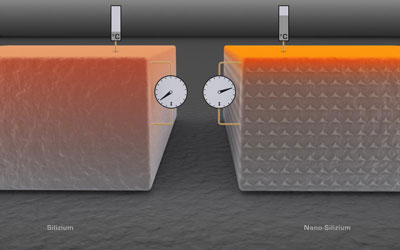
Silizium kann jetzt noch mehr
IFW-Forscher machen Silizium thermisch isolierend und erschliessen damit neue Anwendungsfelder fuer das Lieblingsmaterial der Halbleiterindustrie.
June 10, 2010 Read more
Keynote on transformational clean and nanotechnologies at TechConnect
Lockheed Martin, a global security company, will play a prominent role at the annual TechConnect World Conference and Expo, to be held in Anaheim, California from June 21-24.
June 10, 2010 Read more

Physical adsorption webinar - A materials characterization technique for determining the surface area, porosity, and total pore volume of solids
Physical adsorption is a technique used to characterize the surface and pore features of solids, that is, the materials texture. The adsorption isotherm generated by the Physical Adsorption technique enables one to characterize a solids' texture by determining its surface area, porosity, and total pore volume.
June 10, 2010 Read more
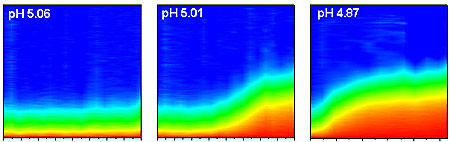
'Instant acid' method offers new insight into nanoparticle dispersal in the environment and the body
Using a chemical trick that allows them to change the acidity of a solution almost instantly, a team at the National Institute of Standards and Technology (NIST) has demonstrated a simple and effective technique for quantifying how the stability of nanoparticle solutions change when the acidity of their environment suddenly changes.
June 10, 2010 Read more
Free webinar on non-contact, 3D optical surface profilometry for ophthalmic manufacturing
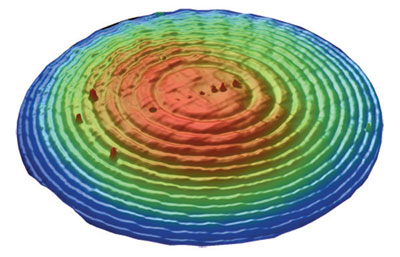
As part of its ongoing series of live webinars on 3D, non-contact surface profilometry, Veeco Instruments Inc. will be hosting a free online seminar on 'Non-Contact, 3D Optical Surface Profilometry for Ophthalmic Manufacturing'.
June 10, 2010 Read more
Liposome-hydrogel hybrids: No toil, no trouble for stronger bubbles
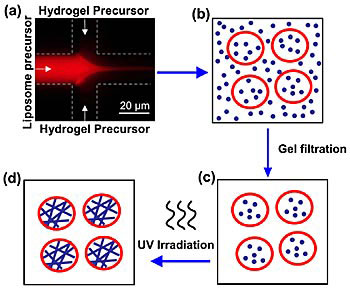
Researchers have developed a method to combine two substances that individually have generated interest for their potential biomedical applications: a phospholipid membrane 'bubble' called a liposome and particles of hydrogel, a water-filled network of polymer chains. The combination forms a hybrid nanoscale particle that may one day travel directly to specific cells such as tumors, pass easily though the target's cell membrane, and then slowly release a drug payload.
June 9, 2010 Read more
Walls falling faster for solid-state memory
After running a series of complex computer simulations, researchers have found that flaws in the structure of magnetic nanoscale wires play an important role in determining the operating speed of novel devices using such nanowires to store and process information.
June 9, 2010 Read more
Nanotechnology yields major advance in heat transfer, cooling technologies
Researchers at Oregon State University and the Pacific Northwest National Laboratory have discovered a new way to apply nanostructure coatings to make heat transfer far more efficient, with important potential applications to high tech devices as well as the conventional heating and cooling industry.
June 9, 2010 Read more
Johns Hopkins Institute for Nanobiotechnology welcomes 16 summer nanobio research interns
For 10 weeks this summer, 16 students from universities across the country will join the highly competitive Johns Hopkins Institute for Nanobiotechnology Research Experience for Undergraduates (REU).
June 9, 2010 Read more
 Subscribe to our Nanotechnology News feed