

Nanotechnology News – Latest Headlines
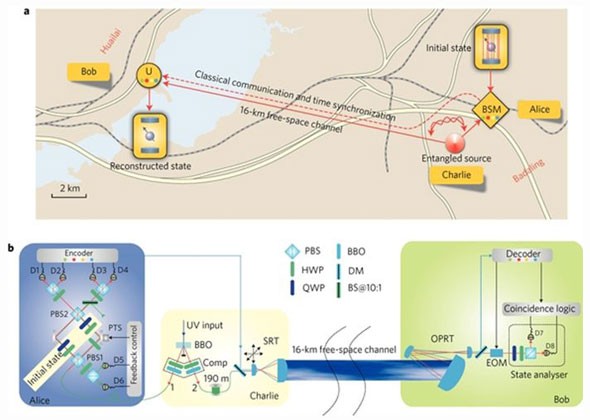
Quantum teleportation succeeded through a 16km long free space channel
In previous experiments the photons were confined to fiber channels a few hundred meters long to ensure their state remained unchanged, but in the new experiments pairs of photons were entangled and then the higher-energy photon of the pair was sent through a free space channel 16 km long.
June 7, 2010 Read more
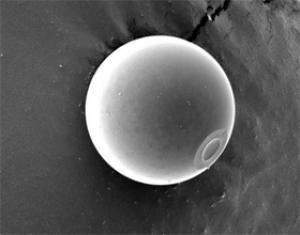
New technique turns proteins into glass: Could lead to new ways to deliver medication
Duke University researchers have devised a method to dry and preserve proteins in a glassified form that seems to retain the molecules' properties as workhorses of biology.
June 7, 2010 Read more

Study suggests that silver nanoparticles mitigate the cell damage caused by ethanol
The results of the study show that these clusters of small numbers of silver atoms catalyze ethanol oxidation at similar concentrations to those found in the blood of alcoholics and at values of membrane potential and pH that are compatible with those exhibited by mammalian cells.
June 7, 2010 Read more
Testing predictions in electrochemical nanosystems - from theoretical insights to the lab bench
Physicists at the Technische Universitaet Muenchen (TUM) are gearing up for experimental tests of findings they arrived at through theoretical considerations: that electrochemical reactions take place more rapidly on isolated, nanometer-scale electrodes than on their familiar macroscopic counterparts, and that this surprising behavior is caused by thermal noise.
June 7, 2010 Read more
Gas sensor chip paves the way to autonomous electronic nose
Imec and Holst Centre have developed very sensitive integrated sensing elements for gas detection. The polymer-coated microbridges in high-density arrays can detect ppm-level concentrations of vapors using on-chip integrated read-out techniques.
June 7, 2010 Read more
A new approach to finding and removing defects in graphene
Researchers pinpointed noncarbon atoms that create defects when graphene is produced through a technique called graphene-oxide reduction. The researchers also propose how to make that technique more efficient by precisely applying hydrogen - rather than heat - to remove the impurities.
June 6, 2010 Read more
Novel way of revealing 3-D internal cell structure
Three-dimensional imaging is dramatically expanding the ability of researchers to examine biological specimens, enabling a peek into their internal structures. And recent advances in X-ray diffraction methods have helped extend the limit of this approach.
June 5, 2010 Read more
Nanomedicine in The Netherlands - new report
Nanotechnology promises employment, sustainability and health. The Dutch government invests heavily in it. But how do we achieve these promises? In preparation for a parliamentary debate about nanotechnology on 21 April 2010, the Rathenau Institute initiated a working visit of MPs to one of the most promising areas of its application: healthcare.
June 4, 2010 Read more
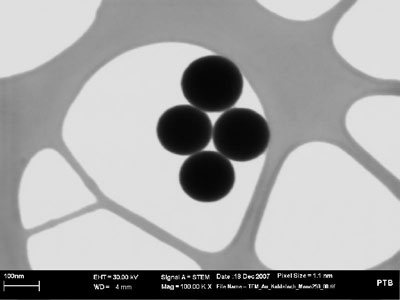
Wie gross ist klein - neues Nanopartikel Messverfahren
PTB-Wissenschaftler entwickeln genaues und rueckfuehrbares Messverfahren fuer Nanopartikel.
June 4, 2010 Read more
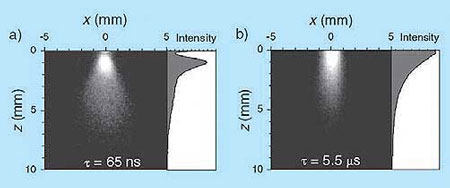
Generation and evolution of metal nanoparticles during utrashort LASER ablation and plasmon excitation of gold nanoparticles
The ultrashort laser ablation of solid materials is basis of different modern and advanced scientific and technological areas as fabrication of metal and semiconductor nanoparticles, deposition of nanostructures and their embedding in optical films, or deposition on their surfaces in order to alter exciting properties or development of new.
June 4, 2010 Read more
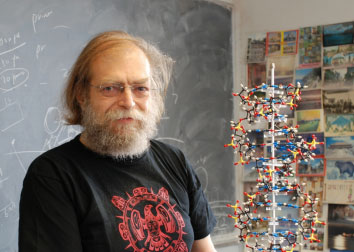
Nadrian Seeman wins 2010 Kavli Prize in Nanoscience for nanorobotic devices
New York University Chemist Nadrian Seeman has been awarded the 2010 Kavli Prize in Nanoscience for his creation of robotic devices that have the potential to create new materials a billionth of a meter in size.
June 4, 2010 Read more
Scientists create artificial mini 'black hole'
Chinese researchers have successfully built an electromagnetic absorbing device for microwave frequencies. The device, made of a thin cylinder comprising 60 concentric rings of metamaterials, is capable of absorbing microwave radiation, and has been compared to an astrophysical black hole.
June 4, 2010 Read more
The 2010 Kavli Prize winners announced
Eight scientists whose discoveries have dramatically expanded human understanding in the fields of astrophysics, nanoscience and neuroscience has been recognised with the award of the million-dollar Kavli Prizes.
June 3, 2010 Read more
Research team creates a quantum simulation that can be scaled to large systems
For most people, frustration is a condition to be avoided. But for scientists studying certain 'frustrated' ensembles of interacting components - that is, those which cannot settle into a state that minimizes each interaction - it may be the key to understanding a host of puzzling phenomena that affect systems from neural networks and social structures to protein folding and magnetism.
June 3, 2010 Read more
Neue Nano-Ideen auf der Nanofair
Die fuehrende Konferenz zum Thema Nanotechnologie in Europa findet bereits seit 2002 in Dresden statt und wird in ihrer achten Auflage am 6. und 7. Juli 2010 zur Nanotechnologie-Leitveranstaltung des DRESDEN-concept ausgebaut.
June 3, 2010 Read more
Researchers pursue plasmonics and photonics technology for optical improvements
Researchers are investigating new applications for terahertz sensors. Based on their findings, these sensors could be used for improving optical sources, detectors and modulators for optical interconnections and for creating biomolecules, such as plastic explosives.
June 2, 2010 Read more
 Subscribe to our Nanotechnology News feed