

Nanotechnology News – Latest Headlines
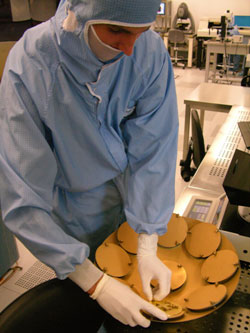
Clean room at Fondazione Bruno Kessler expands by 40%
The so-called Clean Room of Fondazione Bruno Kessler in Povo (Trento), part of the Micro-Technologies Laboratory with a staff of 18 researchers and technicians, is expanding: on Tuesday, 4 May at 2.30 p.m. in the headquarters in via Sommarive, there will be the inauguration of a new area, a 200 quare meter sector in addition to the already operational 500.
May 3, 2010 Read more
Joint transnational call for proposals on nanomedicine by EuroNanoMed
Following the success of the 1st Joint Transnational Call in 2009, EuroNanoMed is launching its 2nd Joint Call for funding of transnational innovative research projects in Nanomedicine. This call will enable scientists from European and associated countries to establish collaborative research consortia spanning multiple disciplines.
May 3, 2010 Read more
A teaching moment for nanotechnology
Rice University's Nobel Prize-winning researchers dreamed of solving the world's problems, but that can only happen if new generations learn to carry on their work. That's a prime reason the tier-one university is celebrating the Year of Nano in 2010, the 25th anniversary of the discovery of the carbon 60 molecule - aka the buckminsterfullerene, or buckyball.
May 3, 2010 Read more
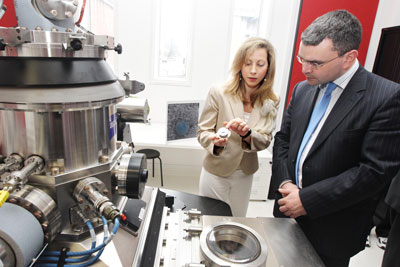
CRANN opens 12m euro Advanced Microscopy Laboratory
The Advanced Microscopy Laboratory (AML) is a world class nanoscience research, which features some of the world's most advanced microscopes allowing material to be viewed at the atomic scale.
May 2, 2010 Read more
CRANN nanotechnology labs win 3.2m euros funding
Three of Trinity College Dublin's CRANN PIs were last week announced as award winners under Science Foundation Ireland's Principal Investigator Programme.
May 2, 2010 Read more
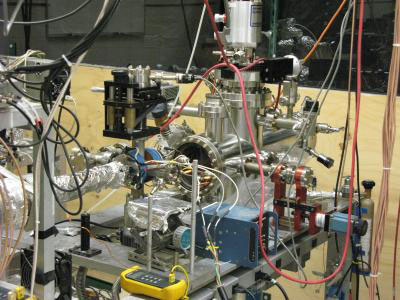
Researchers isolate collection of 'pure' or spin polarized positronium atoms for the first time
Positronium is a short-lived system in which an electron and its anti-particle are bound together. In 2007, physicists at the University of California, Riverside created molecular positronium, a brand-new substance, in the laboratory. Now they have succeeded in isolating for the first time a sample of spin polarized positronium atoms.
May 2, 2010 Read more
Registration opens for Bristol Nanoscience Symposium 2010
Registration opens today (May 1) for the Bristol Nanoscience Symposium 2010, a two-day event that will bring together leading figures from the international scientific community at one of the finest nanoscience facilities in the world.
May 1, 2010 Read more
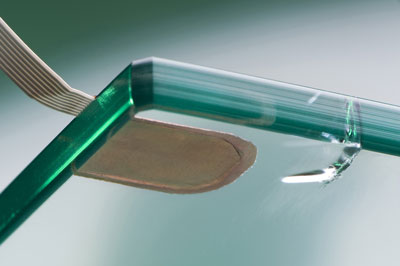
Sensor predicts glass breakage
Modern glass facades inform the architecture of major cities throughout the world. In recent years, however, there have been cases of broken glass, with collapsing facades endangering passers-by. Now, a special sensor can detect micro-fissures and warn of impending breakage beforehand.
May 1, 2010 Read more
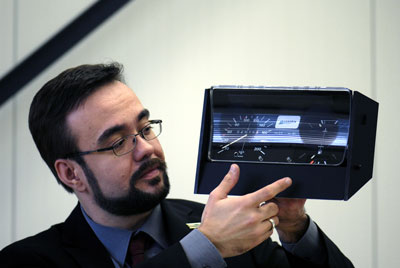
New nanocoating ensures a perfectly non-reflecting view on displays
A new nanocoating ensures a perfectly non-reflecting view on displays and through eyeglasses. The necessary surface structure is applied to the polymeric parts during manufacture, obviating the need for a separate process step. The hybrid coating has further advantages: the components are scratch-proof and easy to clean.
May 1, 2010 Read more
Artificial nose gives as good as it gets
Is smell a personal sense, one that is specific to culture? No, says an Israeli team of scientists who have successfully 'trained' an electronic system capable of predicting the pleasantness of new odours.
April 30, 2010 Read more
Looking beyond diamond for quantum computing
A team of scientists at UC Santa Barbara that helped pioneer research into the quantum properties of a small defect found in diamonds has now used cutting-edge computational techniques to produce a road map for studying defects in alternative materials.
April 30, 2010 Read more
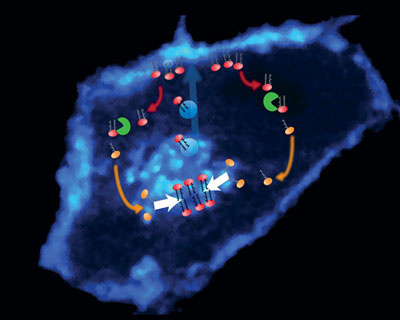
Unlocking the secret of how cells maintain the spatial distribution of proteins
Scientists have discovered how cells ensure the correct distribution of proteins throughout their interior. What they have found is that many of the proteins which need to be transported to the cell membrane are furnished with a kind of anchor consisting of a fatty acid, which serves to embed the proteins in the cell membrane.
April 30, 2010 Read more
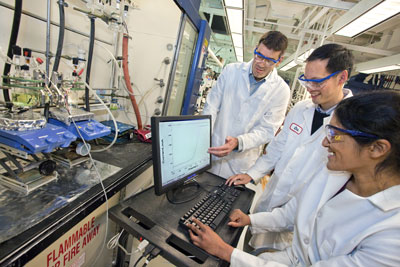
Scientists discover inexpensive metal catalyst for generating hydrogen from water
Hydrogen would command a key role in future renewable energy technologies, experts agree, if a relatively cheap, efficient and carbon-neutral means of producing it can be developed. An important step towards this elusive goal has been taken by a team of researchers with Lawrence Berkeley National Laboratory (Berkeley Lab) and the University of California, Berkeley.
April 30, 2010 Read more
Nanopediatric research focuses on nanomedicine for children
'Children are not small adults' - pediatricians say that's what makes their specialty different from the practice of medicine in adults. For similar reasons, researchers exploring the medical uses of nanotechnology believe that the use of molecular-level nanomedicine techniques in children will also require its own specialty.
April 30, 2010 Read more
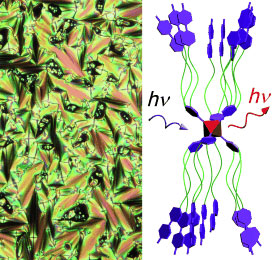
An odd couple - photoluminescent liquid crystals based on metal clusters
Combine liquid crystals (mesogens) and metal clusters and you get clustomesogens - a new class of compounds, the first examples of which have now been produced.
April 30, 2010 Read more
DNA construction kit for nanoengines
Scientists have succeeded for the first time in making, out of DNA double stands, an interlocked molecule (rotaxane) with freely moveable components. This opens up exciting possibilities for nanorobotics and synthetic biology.
April 30, 2010 Read more
 Subscribe to our Nanotechnology News feed