

Nanotechnology News – Latest Headlines
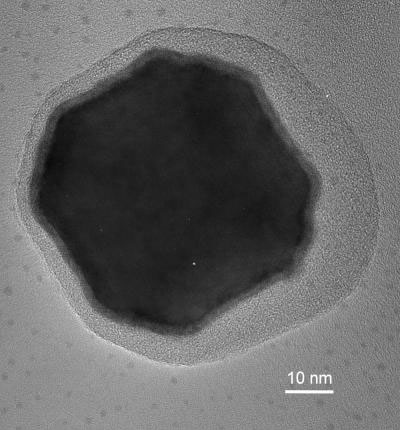
Magnetic nanoparticles offer new cancer breakthrough hope
A multi-disciplinary team of scientists from the University of Leicester could be potentially paving the way for the development of a powerful new strategy for both the early diagnosis and treatment of prostate cancer.
April 16, 2009 Read more
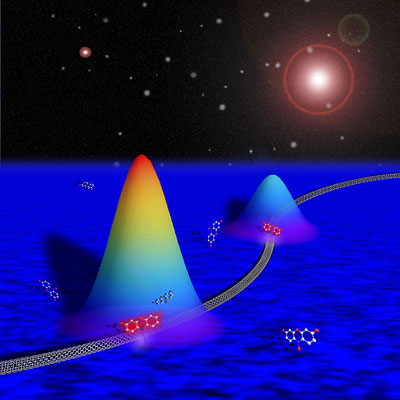
Carbon nanotubes catalyst research could lead to cleaner fuels
Among their many other interesting properties, carbon nanotubes have been found to act as catalysts for some important chemical reactions, including some that could be used to make cleaner fuels. Researchers have now pinpointed unique sites where the reactions take place on single-walled nanotubes.
April 16, 2009 Read more
'Ballistic spin resonance' offers innovative approach to flipping spin
Researchers in Germany and Canada have developed a new technique called ballistic spin resonance that 'flips the spin' of unpaired electrons without using oscillating fields, which are cumbersome to generate on microchips.
April 16, 2009 Read more
Scientists get a grip on colliding fermions to enhance atomic clock accuracy
Physicists have measured and controlled seemingly forbidden collisions between neutral strontium atoms - a class of antisocial atoms known as fermions, which are not supposed to collide when in identical energy states.
April 16, 2009 Read more
Putting the squeeze on an old material could lead to 'instant on' electronic memory
New research involves taking a well-known oxide, strontium titanate, and depositing it on silicon in such a way that the silicon squeezes it into a special state called ferroelectric - a result that could prove key to next-generation memory devices.
April 16, 2009 Read more
Using separate colors of light can shrink nanoelectronics circuitry
A University of Colorado at Boulder team has developed a new method of shrinking the size of circuitry used in nanotechnology devices like computer chips and solar cells by using two separate colors of light.
April 16, 2009 Read more
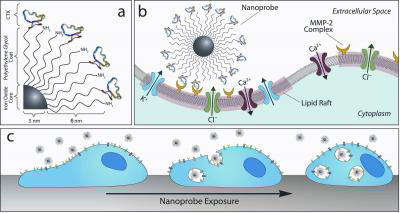
Combining nanoparticles with a scorpion venom slows brain cancer
By combining nanoparticles with a scorpion venom compound already being investigated for treating brain cancer, University of Washington researchers found they could cut the spread of cancerous cells by 98 percent, compared to 45 percent for the scorpion venom alone.
April 16, 2009 Read more
Phantoms Foundation coordinates the first Spain Pavilion at NSTI Nanotech 2009
The Phantoms Foundation in collaboration with The Spanish Institute for Foreign Trade (ICEX) will bring together for the first time a nanoscience and nanotechnology Spanish Pavilion at NSTI.
April 16, 2009 Read more
University College London receives GBP 5m for nanotechnology healthcare research
University College London (UCL) has won four grants worth a total of just over GBP5million from the Engineering and Physical Sciences Research Council (EPSRC) to support research into large-scale integrated projects that exploit nanotechnology for healthcare purposes.
April 16, 2009 Read more
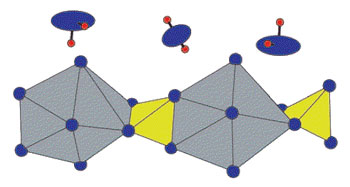
Singapore researchers first to transform carbon dioxide into methanol
Scientists at the Institute of Bioengineering and Nanotechnology have succeeded in unlocking the potential of carbon dioxide by converting it into a more useful product.
April 15, 2009 Read more
New highly fluorescent gold nanoclusters have broad implications for biolabeling
Researchers from Singapore's Institute of Bioengineering and Nanotechnology have achieved another biomedical breakthrough with highly fluorescent gold nanoclusters for sub-cellular imaging.
April 15, 2009 Read more
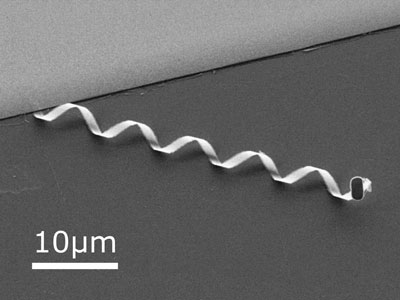
Swiss researchers build microrobots by copying bacteria
For the first time, ETH Zurich researchers have built micro-robots as small as bacteria. Their purpose is to help cure human beings.
April 15, 2009 Read more
Slicing open nanotubes offers fast route to graphene nanoribbons
A team at Stanford University under Hongjie Dai has developed a new method that will allow relatively precise production of mass quantities of the graphene nanoribbons by slicing open carbon nanotubes.
April 15, 2009 Read more
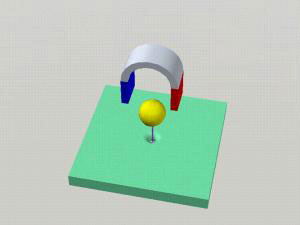
Novel nanopore technique to sequence human genome
Physicists have developed a novel procedure to map a person's genome. They report the first experiment to move a DNA chain through a nanopore using magnets. The approach is promising because it allows multiple segments of a DNA strand to be read simultaneously and accurately.
April 15, 2009 Read more
$6.1 million grant for diamond-based quantum information processing and communication
In the quest for quantum information processing, diamonds may be a physicist's best friend. According to scientists at University of California, Santa Barbara, diamonds could revolutionize the field of quantum mechanics in computing by leading to ultra-secure communication, lightning-fast database searches, and code-cracking ability.
April 15, 2009 Read more
 Subscribe to our Nanotechnology News feed