

Nanotechnology Spotlight – Latest Articles
 Subscribe to our Nanotechnology Spotlight feed
Showing Spotlights 9 - 16 of 42 in category E-Textiles, Wearable Electronics (newest first):

Smart fabrics detect and repel pathogens to prevent hospital infections
New smart fabric technology repels, kills, and detects disease-causing microbes on hospital textiles, potentially reducing infections and improving patient safety.
August 20, 2024

Ultra-flexible electronic slime takes cues from shape-shifting amoeba
Scientists have developed a highly deformable, adhesive electronic hydrogel inspired by amoebas that could enable customizable epidermal electronics.
May 22, 2024

Nanoprinting turns textiles into multipurpose health monitoring devices
Researchers have developed a method for integrating functional nanopatterns with comfortable textiles, enabling applications like non-invasive glucose sensing and light-activated antimicrobial masks.
April 30, 2024

Unlocking the full potential of MXenes for next-generation e-textiles
Scientists devise a novel strategy to completely maximize inexpensive MXene materials for scalable and reliable electronic fabrics with integrated capabilities.
September 5, 2023

Cooling and drying on the go: The latest in nanoengineered textiles
Functional, nanoengineered textiles are designed to enhance human comfort in outdoor activities that require cooling, warming, or drying, resulting in improved comfort levels and increased productivity in outdoor work. Furthermore, there is the potential for functional textiles to be integrated with IoT devices for a range of applications, including healthcare, sports, and fashion, demonstrating how nanotechnology can be used to create smart textiles that can provide real-time data on various metrics.
March 6, 2023

Self-powered bioelectronic face mask measures glucose levels
New research describes the first example of self-powered bioelectronics on a mask that can measure the biological glucose signal with continuous energy. In their work, the researchers demonstrate a 3-in-1 mask device that can 1) harvest energy (a biofuel cell); 2) store energy (a supercapacitor); and 3) indicate glucose concentration (a biosensor). The small biofuel cells can harvest energy from the sweat on a person's face and indicate the level of the analyte that tracks health and nutrition.
September 19, 2022
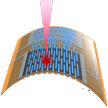
Toward perdurable flexible electronics
In order to realize practical device applications of stretchable strain sensors, stability without sacrificing sensitivity, stretchability, and scalability is crucial. To that end, researchers report a kirigami-structured graphene-polymer hybrid nanocomposite for strain sensors by a laser direct writing technique on a polyimide sheet. The approach of laser direct writing not only contributes to the conversion of polyimide material into conductively porous carbonized film, but also gives rise to the formation of kirigami-shaped structures with highly stretchable capability in a fast and efficient manner.
March 23, 2021
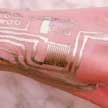
Direct printing of wearable health sensors onto skin
Skin-interfaced, wearable electronics have attracted significant attention due to their unique roles in preventative monitoring, diagnostic confirmation, and convenient therapeutic options. The ultimate application of these bio-integrated devices for practical and convenient applications hinges on the seamless integration of on-body sensors with wireless transmission modules. As a promising direction toward this class of integrated systems, soft body area sensor networks include on-body sensors for physiological signal monitoring and flexible printed circuit boards for signal conditioning/readout and wireless transmission.
September 15, 2020