

Nanotechnology Spotlight – Latest Articles
 Subscribe to our Nanotechnology Spotlight feed
Showing Spotlights 2057 - 2064 of 3577 in category All (newest first):
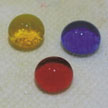
Nanocoated fabric is super-repellent and self-healing
Any coating, no matter how durable, is susceptible to physical and chemical damages. Self-healing, which has become a popular theme in the field of material science, can endow coatings with ability to recover their surface properties after being damaged. New work demonstrates that a superamphiphobic fabric with remarkable multi self-healing ability against both physical and chemical damages and exceptional liquid-repellency to low surface-tension liquids including ethanol can be achieved through a two-step wet-chemistry coating technique.
October 18, 2013

Artificial intelligence (AI) in nanotechnology research
While nanotechnology combines the knowledge of physics, chemistry and engineering, AI has heavily relied on biological inspiration to develop some of its most effective paradigms such as neural networks or evolutionary algorithms. Bridging the link between current nanosciences and AI can boost research in these disciplines and provide a new generation of information and communication technologies that will have a large impact in our society, probably providing the means so that technology and biology merge
October 15, 2013
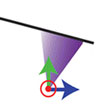
Robust 3D atomic force microscopy without the need for lateral scanning
The realization of a three-dimensional atomic force microscopy portends exciting research directions across nanoscience and nanotechnology. Demonstrations to date have been limited by the indirect means that are required to extract a three-dimensional force vector from the traditional 1D observable in AFM (i.e., cantilever deflection). Existing 3D AFM techniques require recording thousands of frequency shift curves at different lateral locations followed by off-line integration (to yield energy) and lateral differentiation (to yield lateral force). This procedure is inherently slow. In new work, researchers now report 3D force measurements based on a 3D local observable, rather than on cantilever deflection alone.
October 14, 2013

Nanotechnology for solar cell applications - graphene-based materials
Graphene-based nanomaterials have many promising applications in energy-related areas. In particular, there are four major energy-related areas where graphene will have an impact: solar cells, supercapacitors, lithium-ion batteries, and catalysis for fuel cells. Graphene could be a promising replacement material for indium tin oxide. A recent review provides an overview of research on graphene and its derivatives, with a particular focus on synthesis, properties, and applications in solar cells.
October 10, 2013
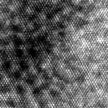
Covetics - Rare new hybrid fuses nanocarbons and metal in bond stronger than sp2
Covetics - this new class of materials marks a game-changer for engineers and designers that have long sought to combine high-strength carbon with metal in their pursuit to improve metal's performance. For the first time the hybrid fuses nanocarbons and metal in a bond that is stronger than graphene-like sp2 carbon bonds. To create covetics, its inventors developed a new method of carbon catalyzation which uses molten metal and metal alloys as an ionizing medium. Nanocarbon structures form in situ while bonding to the metal ionizing medium.
October 9, 2013

Fuel cells from gelatin
Researchers are working hard to find inexpensive alternatives to platinum catalysts for use in hydrogen fuel cells. Doped carbons were discovered to be a possible alternative to platinum-based materials about five years ago. Researchers have now developed a really simple route to carbon materials that perform almost as well as a commercial platinum/carbon in a key fuel cell reaction. To make these materials, they use gelatin - the same gelatin you'd use to make jelly/jello.
October 7, 2013

A smart nanothermometer
It is a challenge to measure the temperature variation at the surface of nanoparticles under optical illumination since nano-localized temperature variation is the most important parameter for applications ranging from nanomedicine to photonics. In particular, the conversion of light to heat trough the exploitation of the Localized Plasmonic Resonance (LPR) has enabled a remarkable breakthrough in fighting cancer. Now, researchers have advanced the monitoring of nanoscale temperature variations under optical illumination by combining the properties of gold nanorods and the capabilities of thermotropic cholesteric liquid crystals.
October 4, 2013
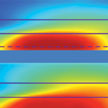
On demand nanofin heat sinks for computer chips (w/video)
Heat has become one of the most critical issues in computer and semiconductor design: The ever increasing number of transistors in computer chips requires more efficient cooling approaches for the hot spots which are generated as a result of the operation of the transistors. Researchers have now demonstrated a microfluidic technique of using thermally conductive and magnetic nanoparticles that can form low-dimensional fins in the vicinity of hot spots. This work is the first ever report on using nanoparticles for making nanofins on demand in microfluidics.
October 3, 2013