

Nanotechnology Spotlight – Latest Articles
 Subscribe to our Nanotechnology Spotlight feed
Showing Spotlights 2889 - 2896 of 3574 in category All (newest first):
Nanotechnology gets a grip
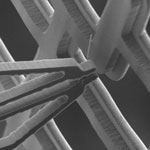
Nanotechnology researchers are actively working on the beginnings of various nanorobotic systems that one day could lead to automated, assembly-line type nanofabrication processes. Last year we reported on a nanogripper, a kind of a robotic 'hand' some ten thousand times smaller than a human hand. This 'pick-and-place' device used a silicon gripper which was controlled by a nanorobotic arm and was capable of picking up a carbon nanofiber and fix it onto the tip of an atomic force microscope cantilever. One of the problems that is vexing researchers is that the nanoscale miniaturization of these grippers comes at the cost of reduced strength - the smaller the gripper, the weaker it becomes. Therefore what is needed is a gripper design that is strong enough yet sufficient flexible and small to handle tough materials like carbon nanotubes.
November 26, 2008
Next generation nanotechnology computer memory made of graphene
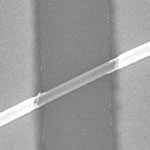
Experiments with graphene have revealed some fascinating phenomena that excite researchers who are working towards molecular electronics. It was found that graphene remains capable of conducting electricity even at the limit of nominally zero carrier concentration because the electrons don't seem to slow down or localize. This means that graphene never stops conducting. Taking advantage of the conducting properties of graphene, researchers now have described how graphene memory could potentially be used as a new type of memory that could significantly exceed the performance of current state-of-the-art flash memory technology. Their results show the possibility to build next-generation memory devices with vast amounts of memory using nanocables with a silicon dioxide core and a shell of stacked sheets of graphene.
November 25, 2008

A British take on nanotechnology risks
The UK's Royal Commission on Environmental Pollution in a new report clearly states that it found no evidence of harm to health or the environment from nanomaterials but it believes that the pace at which such new nanomaterials are being developed and marketed is beyond the capacity of existing testing and regulatory arrangements to control the potential environmental impacts adequately. A major conclusion of the report is that nanomaterials are hugely variable in their nature. They are not a uniform class of materials, and attempts to regulate or legislate solely on the basis of their size or how they are made are misguided. It is the functionality of nanomaterials, i.e. what they do and how they behave, that matters and this should form the basis of governance and regulation. The report makes a number of recommendations on how to deal with ignorance and uncertainty in the area of nanomaterials, which could also be applied to other areas of fast-paced technological development.
November 24, 2008

Shields up! How nanotechnology can protect satellites from energy weapons
When the U.S. military talks about space superiority it defines this as the degree of control necessary to employ, maneuver, and engage space forces while denying the same capability to an adversary. Although 'space forces' has a Star Wars ring to it, the term basically refers to satellites and these satellites - at least as far as unclassified information goes - do not carry weapons (yet); although the public website of the U.S. Air Force Space Command in listing its capabilities mentions the ability to conduct defensive and offensive counterspace operations, and space environment assessments. The main functions of the military's space capabilities today are information related - weather, communications, surveillance, reconnaissance, navigation and missile warning capabilities - and has become critical to many military operations. As other military powers build up their space programs, defensive and offensive space capabilities become more of an issue for war planers - something they call counterspace activities.
November 21, 2008
Phase maps of nanotechnology materials aid in assessing their environmental impact
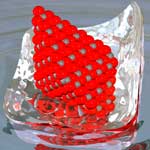
Titanium dioxide nanoparticles have become a commercially significant nanomaterial and are being used in products around the world - in cosmetics and sunscreen lotions, paint formulations, coatings, self-cleaning additives, even in antibacterial applications. The increased use of nanomaterials such as titania goes hand in hand with a growing number of reports on the risks associated with these materials, which have arisen because insufficient information has been gathered about their reactivity and stability once they leave the laboratory. Unfortunately, pinpointing every conceivable situation that nanoparticles could interact in is an enormous multi-parameter problem and solving this by experimental testing alone is not feasible due to the huge numbers of combinatorial variations. This is where theoretical predictions can help, by rapidly and systematically sampling possibilities, and highlighting where experimentalists should focus their attention.
November 19, 2008

Nanotechnology scales weigh atoms with carbon nanotubes
Shrinking device size to nanometer dimensions presents many fascinating opportunities such as manipulating nano objects with nanotools, measuring mass in attogram ranges, sensing forces at femtonewton scales, and inducing gigahertz motion, among other new possibilities waiting to be discovered. The two principal components common to most electromechanical systems irrespective of scale are a mechanical element and transducers. The mechanical element either deflects or vibrates in response to an applied force. Depending on their type, the mechanical elements can be used to sense static or time-varying forces. The transducers in microelectromechanical systems (MEMS) and nanoelectromechanical systems (NEMS) convert mechanical energy into electrical or optical signals and vice versa. A Spanish team has now demonstrated an ultrasensitive carbon nanotube based mass sensor in which they measured chromium atoms with a mass resolution of only 1.4 zeptograms.
November 18, 2008

Nanotechnology's complicated risk-benefit dichotomy
Adding yet another twist to the emerging debate about the potential risks of nanomaterials, researchers have demonstrated how difficult it is to map out the health effects of nanoparticles. They have shown that, even if a certain nanoparticle does not appear toxic by itself, the interaction between this nanoparticle and other common compounds in the human body may cause serious problems to cell functions. On one hand, this effect could be used to great advantage in nanomedicine for killing cancer cells. On the other hand, unfortunately, it is unknown at present whether the same effect could be observed with healthy cells as well. Since the number of possible combinations of nanoparticles and various biomolecules is immense, it is practically impossible to research them systematically. This latest example of the risk-benefit dichotomy of nanotechnology just shows how thin the line is between promising applications such as effective cancer killers and the unknown risks posed by unintentional effects of exactly the same applications.
November 17, 2008

Nanotechnology e-textiles for biomonitoring and wearable electronics
If current research is an indicator, wearable electronics will go far beyond just very small electronic devices or wearable, flexible computers. Not only will these devices be embedded in textile substrates but an electronics device or system could ultimately become the fabric itself. Electronic textiles (e-textiles) will allow the design and production of a new generation of garments with distributed sensors and electronic functions. Such e-textiles will have the revolutionary ability to sense, act, store, emit, and move - think biomedical monitoring functions or new man-machine interfaces - while ideally leveraging an existing low-cost textile manufacturing infrastructure. A recent research report proposes to make conductive, carbon nanotube-modified cotton yarn. This would offer a uniquely simple yet remarkably functional solution for smart textiles - close in feel and handling to normal fabric - yet with many parameters exceeding existing solutions.
November 14, 2008