

Nanographene: Structure, Synthesis, and How It Differs from Graphene
What is Nanographene?
A nanographene is a finite, nanometer-scale fragment of graphene's hexagonal carbon lattice in which edges, shape, and size dominate its electronic, optical, and chemical properties.
Simple definition: Nanographene is a molecule-sized or nanoscale piece of graphene. Unlike large graphene sheets, its edges and limited size strongly change its electronic, optical, and chemical behavior.
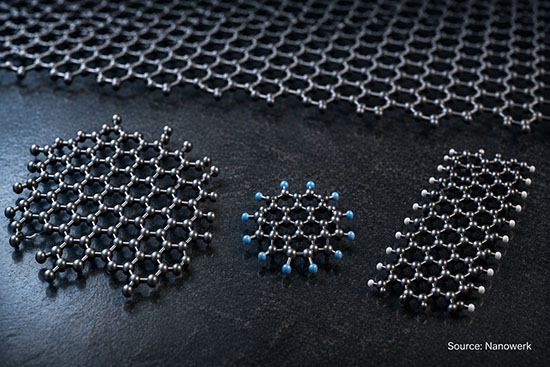
Nanographenes share graphene's local structure of sp2-bonded carbon atoms arranged in a honeycomb network, but they stop short of the macroscopic dimensions that define extended graphene. Typical sizes range from molecular fragments only a few nanometers across to flakes tens of nanometers wide. The family includes graphene quantum dots, whose reported size cutoffs vary by field, and graphene nanoribbons a few nanometers wide. The smallest molecular nanographenes, such as hexa-peri-hexabenzocoronene with 42 sp2 carbon atoms and a diameter of about 1.4 nm, sit at the boundary with classical polycyclic aromatic hydrocarbons.
At this scale the carbon framework that makes extended graphene a gapless semimetal becomes a discrete molecular system. Quantum confinement usually produces a finite HOMO–LUMO gap or effective electronic bandgap, edge atoms make up a substantial fraction of all atoms in the structure, and properties depend sensitively on whether those edges are armchair, zigzag, or a mixture. The growing chemistry community around nanographenes, anchored by sustained work from groups including Klaus Müllen's at the Max Planck Institute for Polymer Research, has built a library of atomically precise structures whose nanotechnology applications span optoelectronics, sensing, and quantum information.
Key takeaways:
- A nanographene has the same hexagonal sp2 carbon framework as graphene, but at nanoscale lateral dimensions.
- Edges, finite size, and quantum confinement can give nanographenes tunable gaps and discrete molecular character that extended graphene lacks.
- Graphene quantum dots and graphene nanoribbons are specific subclasses of nanographenes.
- Atomically precise nanographenes are produced by bottom-up organic synthesis and on-surface chemistry.
Nanographene vs. Graphene: Why the Distinction Matters
In the strict sense, graphene is an extended, ideally infinite or macroscopic single-atom-thick carbon layer in which a small piece behaves much like a much larger piece. Its electronic structure, with conduction and valence bands meeting at the K-points of the Brillouin zone to form Dirac cones, gives it semimetallic conduction, ultra-high carrier mobility, and zero bandgap. The 2010 Nobel Prize in Physics recognized the isolation and characterization of single graphene sheets.
A nanographene, by contrast, is a finite graphene fragment at the nanometer scale. Locally the carbon framework is identical, but the lattice is no longer translationally infinite, a substantial fraction of carbon atoms now sits at an edge, and quantum confinement of the π-electron system becomes important. The same honeycomb sheet that conducts like a metal at micrometer dimensions becomes a discrete molecule with a measurable HOMO–LUMO gap, defined absorption and emission spectra, and chemistry dictated by edge atoms.
In chemistry, the term nanographene most often refers to atomically precise molecular graphene fragments synthesized with controlled shapes and edges. In materials science, it can also be applied more broadly to small graphene flakes obtained by cutting or exfoliating graphite or extended graphene. The simple distinction is that graphene is the extended two-dimensional material, while nanographene is a nanoscale, finite piece of graphene-like carbon in which edges and molecular size matter.
| Term | Usual meaning | Typical size | Key feature |
|---|---|---|---|
| Graphene | Extended 2D carbon sheet | Micrometers to wafer scale | Extended 2D semimetal with no bandgap |
| Nanographene | Nanoscale graphene fragment | ~ 1 to 100 nm | Edge effects, quantum confinement, tunable gap |
| Graphene quantum dot | Very small nanographene with size-tunable optical properties | Often a few nm; reported cutoffs vary up to ~100 nm | Strong photoluminescence, size-dependent emission |
| Polycyclic aromatic hydrocarbon (PAH) | Molecular aromatic carbon framework | < 2 nm | Discrete molecule, overlaps with smallest nanographenes |
| Graphene nanoribbon | Quasi-one-dimensional graphene strip | Width typically a few to tens of nm; length tens of nm to much longer | Width- and edge-tunable bandgap |
The boundaries in this table are deliberately fuzzy. The smallest nanographenes overlap with the largest PAHs, and large nanographenes shade into graphene flakes. What unites all of the nanographene categories is that, unlike extended graphene, they cannot be understood without explicitly accounting for finite size and edges.
Why Edges and Size Determine Nanographene Properties
Two physical features drive the divergence between nanographene and extended graphene: quantum confinement of the π-electron system, and the chemistry and electronics of edge atoms. Both grow more important as the fragment shrinks.
Quantum confinement can open tunable gaps
Restricting the carbon framework to nanometer dimensions quantizes the π-electron states and lifts the band crossing that makes extended graphene a semimetal. The resulting gap often scales inversely with size, so a graphene quantum dot a few nanometers across can have absorption in the visible or near-ultraviolet, while a 50 nm flake behaves much closer to extended graphene. In graphene nanoribbons, the gap depends jointly on the ribbon width and on edge orientation, and atomically precise ribbons fewer than ten carbon atoms wide can have gaps above 1 eV. This bandgap engineering through size and shape is one of the central reasons nanographenes attract optoelectronics interest that extended graphene cannot satisfy.
Armchair and zigzag edges produce different physics
Two ideal edge geometries dominate the discussion. Armchair edges have a boundary profile resembling the armrests and seat of an armchair and generally yield semiconducting nanographenes with a robust bandgap that depends on width. Zigzag edges follow a sawtooth-like row of carbon atoms and support localized states near the Fermi level. Theory predicts that these zigzag edge states can carry spin polarization, opening routes to one-dimensional magnetism in a carbon-only material. Real edges are usually a mixture of armchair and zigzag segments, with reactivity that depends on the local geometry, and any defect at the edge propagates strongly into the electronic structure of the whole fragment.
Edge atoms drive chemistry
Because edge atoms have unsatisfied bonds in the bare lattice, they are the natural sites for chemical termination. Hydrogen-passivated edges are the simplest case; functional groups such as carboxyls, hydroxyls, halogens, amines, and long alkyl chains can be installed by design. These groups change solubility, set the photoluminescence quantum yield, alter the redox levels, and tune interactions with biological systems. The same edge sensitivity that makes nanographenes so tunable also makes them difficult to characterize precisely, since real samples often display a distribution of edge structures unless atomically precise synthesis is used.
Synthesis: Top-Down Cutting and Bottom-Up Assembly
Nanographenes are produced along two complementary paths. Top-down methods start from bulk graphite or graphene and cut it down; bottom-up methods start from small molecules and build up. The trade-off between the two routes is the central practical question in the field, recently reviewed under the heading of precision synthesis versus bulk-scale fabrication of graphenes.
Top-down routes to nanographenes
Top-down approaches include hydrothermal or acid cutting of graphite and graphene oxide, electrochemical exfoliation followed by size selection, ultrasonic liquid-phase exfoliation, and unzipping of carbon nanotubes by oxidative or plasma treatments to produce nanoribbons. These routes are scalable to gram or kilogram quantities and are the source of many graphene quantum dot materials explored for sensing, imaging, and related applications. They typically produce broad distributions of size and edge structure, and the edges are usually decorated with oxygen-containing groups inherited from oxidative chemistry.
Bottom-up molecular and on-surface synthesis
Bottom-up synthesis assembles a nanographene from precursor molecules through controlled coupling and ring-fusion reactions. In solution, a polyphenylene scaffold is first built by Suzuki, Yamamoto, or Diels–Alder couplings, then planarized by oxidative cyclodehydrogenation, often called the Scholl reaction. The 2010 Nature paper by Cai and coworkers introduced the on-surface variant: precursor monomers are deposited onto a clean Au(111) surface in ultra-high vacuum, where thermal activation drives Ullmann-type coupling into a polyphenylene chain, followed by cyclodehydrogenation to yield atomically precise armchair graphene nanoribbons. Both approaches can produce nanographenes whose every carbon atom is in a chemist-designed position, at the cost of small absolute yields and limited transferability off the growth substrate.
Chemical vapor deposition
Chemical vapor deposition (CVD) bridges the two approaches. Tailored aromatic precursors decomposed on a catalytic substrate can grow graphene nanoribbons and small nanographenes with reasonable size control, and CVD can also produce graphene flakes that are subsequently cut down. CVD-grown nanoribbons typically lack the atomic precision of on-surface synthesis but are easier to scale.
Properties That Make Nanographenes Distinctive
Beyond tunable electronic gaps, nanographenes show several properties that are absent or muted in extended graphene. Extended pristine graphene does not normally show useful photoluminescence, but graphene quantum dots and many molecular nanographenes can emit across the visible spectrum, with photoluminescence quantum yields ranging from modest values in many top-down graphene quantum dots to very high values in carefully designed or passivated structures. Extended graphene is the more mobile material on a free-standing sheet, but in narrow ribbons the open bandgap allows nanographenes to function as channel materials in field-effect transistors with on/off ratios that extended graphene cannot reach. Spin-related effects are also unique to nanographenes: zigzag edges and odd-membered carbon rings can host unpaired electrons, providing a route to molecular magnetism in a metal-free system, and scanning tunneling microscopy has imaged these edge states directly on individual ribbons.
Applications of Nanographenes
Three application areas account for most of the interest in nanographenes. The first is optoelectronics, where graphene quantum dots and emissive molecular nanographenes are used as light absorbers in solar cells, fluorophores in light-emitting diodes, and active layers in photodetectors. The second is sensing, where nanographenes serve as fluorescent or electrochemical reporters for metal ions, biomolecules, and reactive species, often integrated into nanosensor platforms. The third is biomedical imaging and delivery, where graphene quantum dots are explored as water-soluble, potentially lower-toxicity alternatives to traditional cadmium-based quantum dots for cellular fluorescence imaging and as carriers in targeted drug delivery, although biocompatibility depends strongly on surface chemistry, dose, and purification.
More recently, atomically precise graphene nanoribbons have moved from the surface chemistry laboratory toward nanoelectronic devices, with semiconducting ribbons being incorporated into transistors and quantum-transport experiments. Nanographenes also overlap structurally with carbon dots, with the broader family of carbon nanomaterials, and with related carbon allotropes such as fullerenes and carbon nanobelts, providing a unified molecular vocabulary for low-dimensional carbon. Spin-polarized zigzag edge states in particular are now being studied as potential building blocks for carbon-based nanoelectronics and quantum technologies.
Limitations and Outlook
Several practical challenges still limit the field. Top-down nanographenes are easy to make in bulk but hard to define structurally; samples typically contain a distribution of sizes and edge types, and reproducibility between laboratories remains uneven. Bottom-up molecular synthesis delivers atomic precision but milligram-scale quantities, and the largest atomically precise nanographenes pose serious solubility and aggregation problems unless decorated with bulky alkyl side chains. On-surface synthesis is restricted to specific noble-metal substrates, and transferring the resulting ribbons onto an insulator without breaking them is itself a research problem.
The most active fronts include heteroatom doping with nitrogen, boron, sulfur, or phosphorus to introduce designed electronic or magnetic states; structurally non-planar nanographenes with helicene or saddle-shaped geometries that bring chirality and circularly polarized luminescence into the picture; self-assembly of nanographenes into hierarchical superstructures; and integration of atomically precise ribbons into devices through cleaner transfer and contact strategies. As these fronts mature, the chemistry of nanographenes is increasingly bridging the long-standing gap between synthetic organic chemistry and condensed-matter physics, with the same hexagonal carbon framework appearing in molecules, ribbons, and bulk sheets.
FAQ: Nanographene
Is nanographene the same as graphene?
No. Graphene refers to an extended, ideally infinite two-dimensional sheet of sp2-bonded carbon atoms in a hexagonal lattice and behaves as a zero-bandgap semimetal. A nanographene is a finite fragment of that same lattice at the nanometer scale, in which edges, shape, and size become central to its properties. Locally the bonding is identical, but electronic confinement and edge effects give nanographenes a finite bandgap, discrete molecular energy levels, and tunable optical behavior that extended graphene lacks.
How small does a graphene fragment have to be to count as a nanographene?
There is no sharp cutoff. Typical nanographenes range from molecular fragments only a few nanometers across to flakes tens of nanometers wide, and the smallest examples overlap with large polycyclic aromatic hydrocarbons such as hexa-peri-hexabenzocoronene, which contains 42 sp2 carbon atoms and is about 1.4 nm across. In many contexts, graphene quantum dots are treated as the smaller, optically active end of this family, although reported size cutoffs vary from below about 10 nm to below 100 nm depending on the field.
Why do many nanographenes have a finite bandgap when graphene does not?
Extended graphene is a semimetal because its conduction and valence bands touch at the K-points of the Brillouin zone. When the sheet is reduced to a nanometer-scale fragment, translational symmetry is lost and the π-electron states become quantized. This confinement usually produces a finite HOMO-LUMO gap or effective bandgap whose size scales roughly inversely with fragment dimensions. The magnitude and character of the gap depend strongly on edge topology, symmetry, defects, chemical termination, and whether the sample is molecularly precise. In graphene nanoribbons, the gap also depends sensitively on width and on whether the edges are armchair or zigzag.
What is the difference between a nanographene and a graphene quantum dot?
A graphene quantum dot is a small, optically active nanographene that exhibits clear quantum-confinement-driven electronic and optical behavior such as size-dependent fluorescence. The term “nanographene” covers a broader family and is often used in chemistry for atomically precise molecular fragments of graphene with well-defined shapes and edges. Size cutoffs for graphene quantum dots vary by field, so the distinction is best understood as functional as well as dimensional.
Why do edges matter so much in nanographenes?
In a nanometer-scale fragment, a large fraction of carbon atoms sits at an edge, where bonding is incomplete and the local electronic environment differs from the interior. Two ideal edge geometries, armchair and zigzag, lead to very different behavior: armchair edges typically give a robust semiconducting gap, while zigzag edges support localized edge states near the Fermi level that can carry spin polarization. Edge atoms are also the most reactive, so chemical functionalization at the edges strongly modifies solubility, photoluminescence, and catalytic activity.
How are atomically precise nanographenes synthesized?
Atomic precision is achieved by bottom-up organic synthesis. Small aromatic precursor molecules are coupled into a polyphenylene scaffold and then planarized by oxidative cyclodehydrogenation, often called the Scholl reaction in solution chemistry. Alternatively, on-surface synthesis on a noble-metal substrate, such as Au(111), allows precursor monomers to polymerize and cyclodehydrogenate under ultra-high vacuum, yielding graphene nanoribbons and nanographene molecules whose edge structure and width are defined by the precursor design.
Further Reading
Foundational on-surface synthesis: Nature, Atomically precise bottom-up fabrication of graphene nanoribbons
Nanographene chemistry review: Chemical Society Reviews, New advances in nanographene chemistry
Precision versus scale: Nature Reviews Chemistry, Precision synthesis versus bulk-scale fabrication of graphenes
Graphene nanoribbon structure-property review: Chemical Society Reviews, Atomically precise graphene nanoribbons: interplay of structural and electronic properties
Optoelectronic and energy applications: Advanced Science, Small size, big impact: recent progress in bottom-up synthesized nanographenes for optoelectronic and energy applications
Nanoelectronics review: Nature Reviews Materials, Bottom-up synthesized graphene nanoribbons for nanoelectronics
