| Mar 27, 2025 |
Advances in smart gel technology transform controlled drug releaseResearchers have developed a nanocomposie hydrogel that responds to multiple stimuli for precise drug release.(Nanowerk News) Gels that respond to second near-infrared (NIR-II) light have shown promise in medical uses because they can be activated from a distance and NIR-II light can penetrate deeply into tissues, making the NIR-II-responsive gel a valuable platform for non-invasive and targeted drug delivery. However, traditional reliance on a single NIR-II response mechanism often falls short of meeting the diverse requirements of clinical settings as different physiological conditions require more adaptable release pathways. |
| Recognizing this, researchers have innovatively combined multiple materials to create a new generation of versatile hydrogel in the study published in Small ("Engineering Multiresponsive Alginate/PNIPAM/Carbon Nanotube Nanocomposite Hydrogels as On-Demand Drug Delivery Platforms"). |
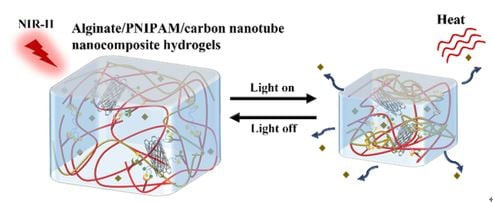 |
| NIR-II light is used to trigger the drug release from the gel network. (Image: National Taiwan University) |
| This cutting-edge nanocomposite hydrogel combines alginate, temperature-sensitive polymer poly(N-isopropylacrylamide) (PNIPAM), and NIR-II-responsive carbon nanotubes (CNTs), where alginate and CNTs are connected by dynamic interfacial crosslinks formed by imine and boronate ester bonds. |
| The integration of these components and interactions results in a highly responsive gel capable of adapting to various environmental stimuli such as pH, hydrogen peroxide, temperature, and NIR-II light. The dynamic connections between alginate and CNTs contribute to the stability of the gel while offering valuable features like self-healing and injectability, ideal for minimally invasive medical interventions. |
| Researchers demonstrate exceptional performance of the alginate/PNIPAM/CNT hydrogel in both in vitro and in vivo drug release studies, showing the hydrogel undergoes structural transformations when exposed to environmental changes. Notably, NIR-II light induces a temperature-sensitive reaction within the hydrogel, enhancing the targeted release with minimal invasiveness. These characteristics position the alginate/PNIPAM/CNT hydrogel as a promising candidate for next-generation drug delivery systems. |
| “Multi-responsive hydrogels can be used to pave the way for more personalized healthcare solutions by offering improved adaptability and effectiveness in treating complex clinical conditions," says Prof. Yi-Cheun Yeh. |
| Source: National Taiwan University (Note: Content may be edited for style and length) |