| Sep 19, 2025 |
Scientists unlock new way to control light waves in two-dimensional materialsResearchers found a method to tune Dirac plasmon polaritons, paving the way for efficient terahertz devices that could revolutionize sensing, imaging, and computing.(Nanowerk News) Scientists have found a new way to steer light waves so small they could transform communications, imaging, and sensing technologies. These waves, known as Dirac plasmon polaritons (DPPs), combine light with the motion of electrons in ultra-thin materials like graphene and topological insulators. |
| Ordinary light is limited by the speed of light in open space, but DPPs can compress it into areas a hundred times smaller than its natural wavelength. This makes them powerful tools for manipulating light on the tiniest scales, where conventional optics cannot reach. |
| What sets DPPs apart is their behavior in special materials where electrons act as if they have no mass. This quirk allows the waves to be tuned with remarkable precision, a feature that could reshape the future of nano-optoelectronic devices. |
| Their importance is especially striking in the terahertz (THz) range—a little-used part of the spectrum between microwaves and infrared. This “THz gap” holds promise for security scanning, ultra-fast wireless networks, and medical diagnostics, but scientists have struggled to control light at these frequencies. |
| In a study published inLight: Science & Applications ("Tracing terahertz plasmon polaritons with a tunable-by-design dispersion in topological insulator metaelements"), a team led by Prof. Miriam Serena Vitiello has unveiled a breakthrough. Using a topological insulator called Bi₂Se₃, they built nanostructures with carefully arranged elements that let them tune the behavior of DPPs. |
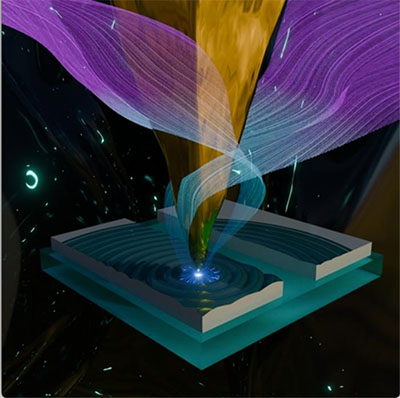 |
| Illustrative scenario of propagation of DPP, at Terahertz frequencies, induced by the tip of a s-SNOM microscope in topological insulators coupled nano-antennas. (Image: Leonardo Viti et al.) |
| With phase-sensitive near-field microscopy, the researchers launched and imaged these waves as they traveled through the structures. They discovered that by adjusting the spacing between the elements, they could increase the polariton wavevector by 20 percent and extend the signal’s reach by more than half. |
| This fine control could pave the way for compact terahertz devices such as detectors, modulators, and waveguides. More broadly, it points to reconfigurable photonic circuits that could power advances in quantum technology, faster computing, and energy-efficient solar systems. |
| “This is a significant step toward tunable terahertz optical devices with lower energy loss and higher performance,” the researchers noted, highlighting the potential for new directions in nanophotonics and nonlinear optics. |
| Source: Changchun Institute of Optics, Fine Mechanics And Physics (Note: Content may be edited for style and length) |