| Jun 15, 2026 |
How water becomes the heart of a supercapacitor
Tiny clay channels let water move charge efficiently, enabling an early-stage supercapacitor made from water, clay and graphene for greener storage.
(Nanowerk News) Water can transport electrical charge surprisingly efficiently when confined to extremely narrow channels. A research team from Hamburg University of Technology, working within the Cluster of Excellence “BlueMat: Water-Driven Materials”, has now harnessed this behaviour in a novel supercapacitor.
|
|
Measurements at DESY’s PETRA III X-ray light source showed that water forms films only a few molecular layers thick inside the tiny channels. This observation helped explain how the energy storage device works. The findings could open up new pathways towards sustainable energy-storage technologies in the future.
|
|
Water is one of the most thoroughly studied substances on Earth. Yet when confined to channels only about one nanometre wide, it behaves in unexpected ways. Researchers at Hamburg University of Technology (TUHH) have now exploited these unusual properties to develop a novel supercapacitor. Measurements at the PETRA III X-ray light source at DESY, a research centre of the Helmholtz Association, provided crucial insights into the behaviour of ultra-thin water layers within the material.
|
|
The device, known as the “Blue Capacitor”, uses water as its electrolyte – the medium that transports electrical charge. Unlike conventional batteries and supercapacitors, it requires no added salts, acids or other chemical electrolytes. Instead, it relies entirely on water, clay minerals and graphene, a highly conductive form of carbon.
|
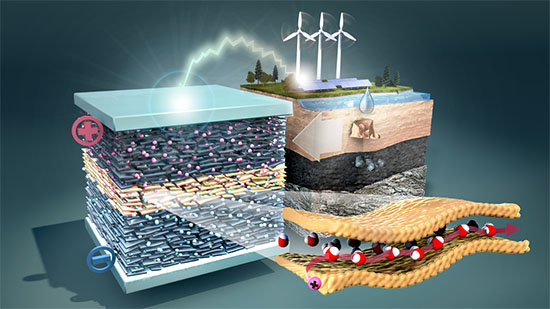 |
| The new energy storage system is based on the naturally abundant elements water, clay, and graphene and enables effective and sustainable energy storage. (Image: Martin Künsting)
|
|
The key to the technology lies in channels within the clay minerals that are only about one nanometre wide – roughly 100,000 times thinner than a human hair. Within these tiny cavities, water develops properties that are not observed in bulk water. Together with graphene, the clay minerals form a network of millions of such channels, allowing electrical charge to move with remarkable efficiency.
|
|
To investigate water in these extremely confined spaces, the researchers used the brilliant X-ray beam of PETRA III. The measurements showed that water forms films only a few molecular layers thick inside the clay structures and allowed the team to study these films in detail.
|
|
“Water is one of the most thoroughly studied substances in science – and yet it continues to surprise us. Using the brilliant X-rays provided by PETRA III, we were able to observe directly how water arranges itself inside channels only one nanometre wide. These insights were essential for understanding why the material transports electrical charge so efficiently,” says Patrick Huber, Professor at Hamburg University of Technology and head of a research group at DESY.
|
|
The study (Nature Communications, "All-water supercapacitor enabled by 1-nm clay channels") also highlights the opportunities that will be offered by the future PETRA IV 4D X-ray microscope. With its significantly increased brilliance, the facility is expected to reveal processes in materials with even greater spatial and temporal resolution. This could provide deeper insights into the behaviour of water in confined spaces and improve our understanding of next-generation energy-storage materials.
|
|
In laboratory tests, the supercapacitor maintained stable performance over more than 60,000 charge-discharge cycles. It also operated at voltages of up to 1.6 volts, a comparatively high value for a water-based energy-storage device. The researchers see this as further evidence that the unique properties of confined water can be harnessed for practical applications.
|
|
The technology is still at an early stage of development. In the long term, however, the concept could offer new approaches to sustainable energy storage, for example for balancing electricity generated by solar and wind power. Beyond energy storage, the findings may also prove relevant for other fields, including advanced sensors, bio-inspired systems and neuromorphic computing.
|